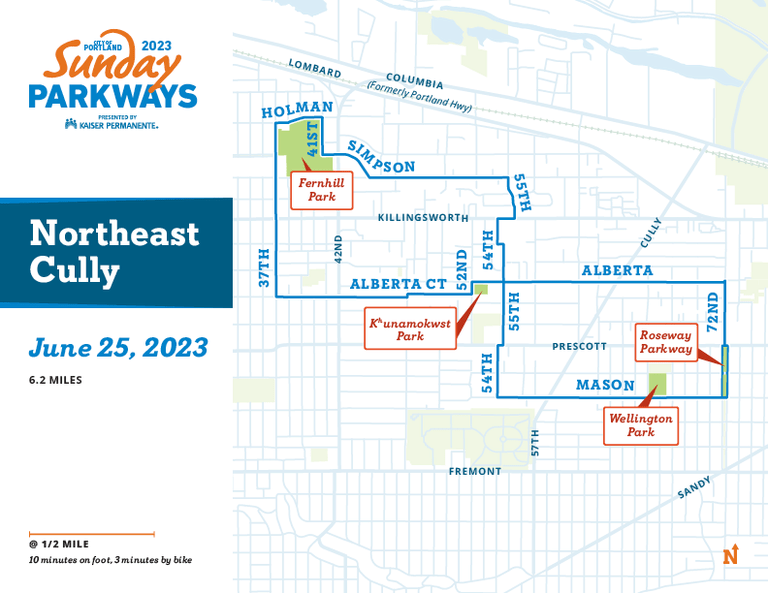
A bit of background for the unaware – Portland Sunday Parkways is a program run by the Portland Bureau of Transportation modeled after Bogotá’s ciclovía program where they close a few routes through the city every Sunday to all automotive traffic. I’d say “modeled after” is a bit of an embellishment though, considering the Bogotá ciclovía happens every Sunday (plus holidays!), and Portland will only manage three in 2023.
Additionally, it’s important to note that the Bogotá ciclovía closes 75+ miles of street every single week. Portland will manage to close a total of 11.5 miles over three events. So in a year, Bogotá closes a total of 3,900+ miles of street for their ciclovía program while Portland manages just 11.5. I’m no math expert, but 11.5 is less than 0.3% of 3,900 – which makes the comparison between the two programs feel pretty weak.
But Sunday Parkways are still the marquee “car free” event in the city of Portland, or at least the only one that has any sort of official city government recognition. Because of that, I think they are worth a closer look.

Can a ciclovía be transformative? In Bogotá, there is plenty of evidence that the ciclovía program has transformed the city – over 1 million people participate in it weekly! Portland Sunday Parkways on the other hand has had a fairly minimal impact on the fabric of the city. Bike Portland does have glowing reviews of the pre-pandemic rides (including a bit about Ted Wheeler attending his first ride in 2015), but it certainly hasn’t done much to transform the fabric of the city. I’d say that the event has been barely noticeable.
In Bogotá, major streets get closed and people flock to them. It’s impossible not to notice! In Portland, I wouldn’t even know they existed if I weren’t a transportation dork – and while perhaps the longer-tenured Portlanders feel otherwise, it feels like Sunday Parkways hasn’t really gotten the love it needs to thrive as an event (A very unscientific Twitter poll tells me that 61% of my followers have never heard of it). And considering that last year featured an angry man brandishing a gun, it’s safe to say there has not been a transformative effect for the culture of roadway space in Portland.
This matters a lot – the goal of a ciclovía style event is to give street space back to the public. If hardly any streets (none of them major) are shut to motor vehicles, is it even worth calling Sunday Parkways a “ciclovía style event”? I suppose you probably can guess that I’ll say “no” (you’re correct in that).
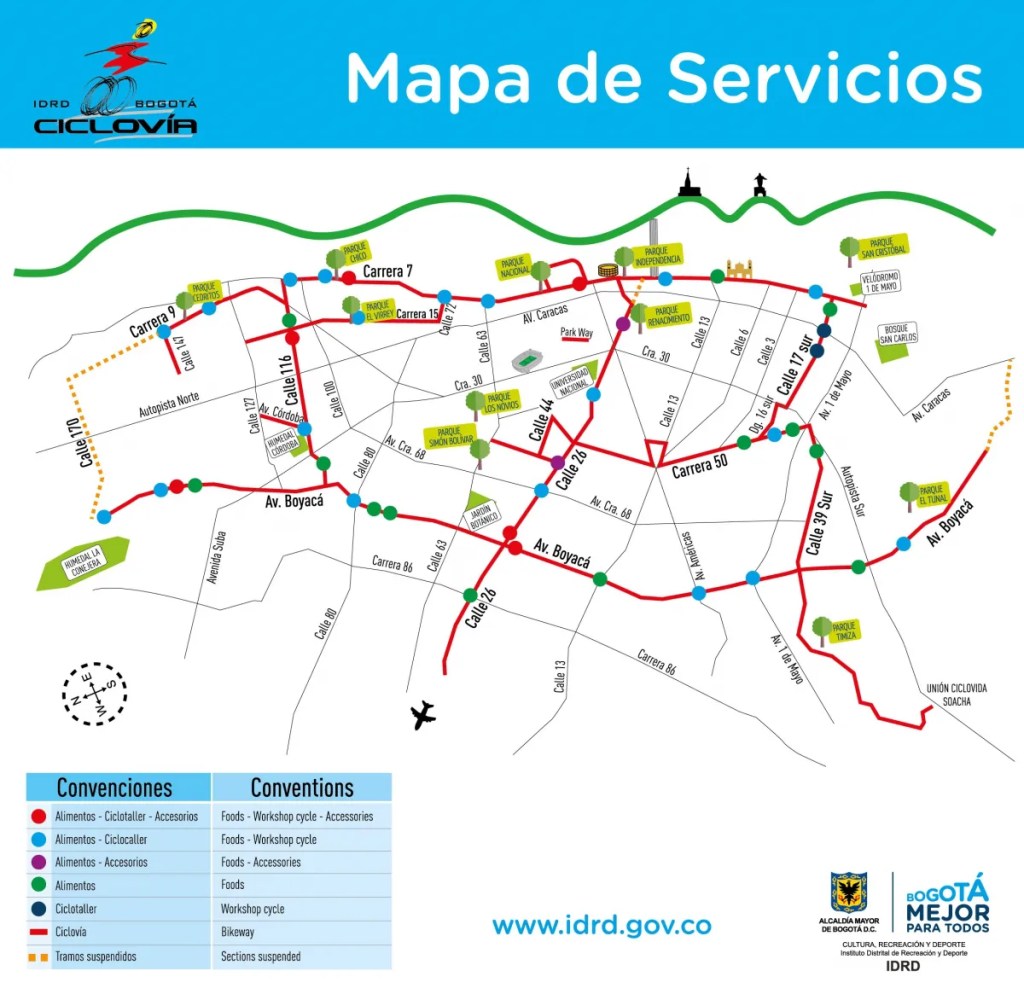
The roads highlighted here aren’t minor. Calle 26 is partially grade separated, and connects the central city to the airport. A Portland equivalent would be something like 82nd Ave! And that is exactly why it’s a great program. It gives the most important streets back to the people, once a week. In typical USA fashion, we have appropriated something really cool from Latin America and made it kind of not so good. Portland Sunday Parkways is the Taco Bell of ciclovía programs.
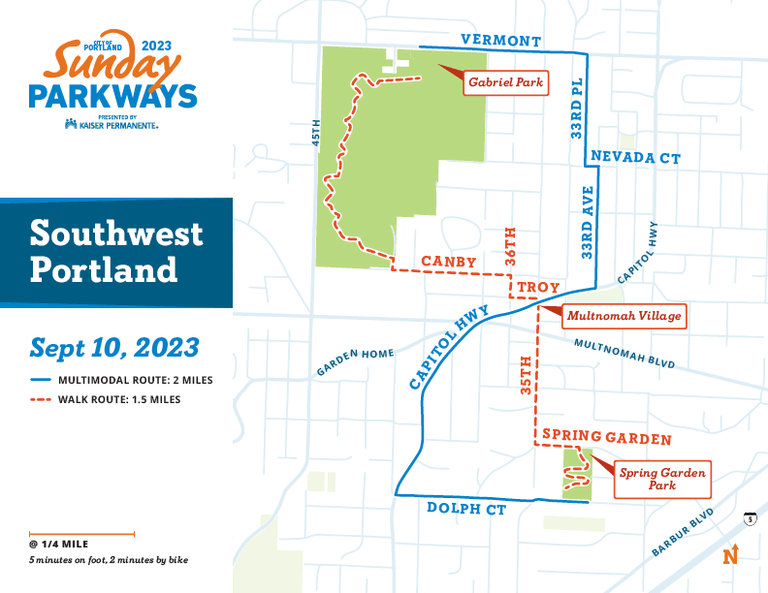

Okay, well Portland Sunday Parkways isn’t nearly as good as Bogotá’s ciclovía, so what? What’s the big deal? Are you just a hater?
Yes, I am a hater thanks for asking. But the big deal is that Sunday Parkways has weird goals and subtly reinforces car culture by being a rare event. When PBOT is unwilling (or unable) to run the event more than three times a year, and only on neighborhood streets it sends the message that cyclists (and pedestrians) don’t belong on major roads. Remember, major roads are for adults and adults drive cars after all.
And the goals of Portland Sunday Parkways are pretty strange in the context of Bogotá’s ciclovía as well.
- Prioritize three neighborhoods that have been underserved by Sunday Parkways in the past
- Create equitable, accessible, and inclusive events that reflect the communities they take place in
- Improve traffic management and volunteer training to ensure participant safety during the event
Two of these goals are incredibly counterproductive to what a good ciclovía event should be, but each for different reasons. For starters, good ciclovía events are large enough to encompass the entire city – so anything involving neighborhoods that have previously been underserved by the program should have been solved by making an actual ciclovía event. Also, the best ciclovía in the world has a very static “route” – it’s been roughly the same since the 70s. Changing what streets are closed is a source of confusion for motorists, and for participants. And two out of three routes on Sunday Parkways this year are repeats from last year, so not really sure they are doing a good job of completing the goal here. It’s difficult to find the history of the event (and I have no doubts that prior iterations have focused on downtown/inner east Portland), but again the best way to solve this is to make the event encompass the city.
The second goal is good, and I’m glad PBOT is making a stated effort to make events they host equitable, accessible, and inclusive. Biking related events can be subject to a fair amount of elitism, so this is a goal worth having and talking about.
And the final goal, why is that a public facing goal? Could they really not think of a better goal for the entire Portland Sunday Parkways program than “improving traffic management”? Safety is a good goal – especially when drivers brandish guns! But that is not something that needs to be stated in the limited space you have to tell the public about the goals of the program. What about “creating a space for active modes of transportation”? What about “giving people space in the streets back”? What about “curating a safe way for pedestrians and cyclists to use our city streets”?
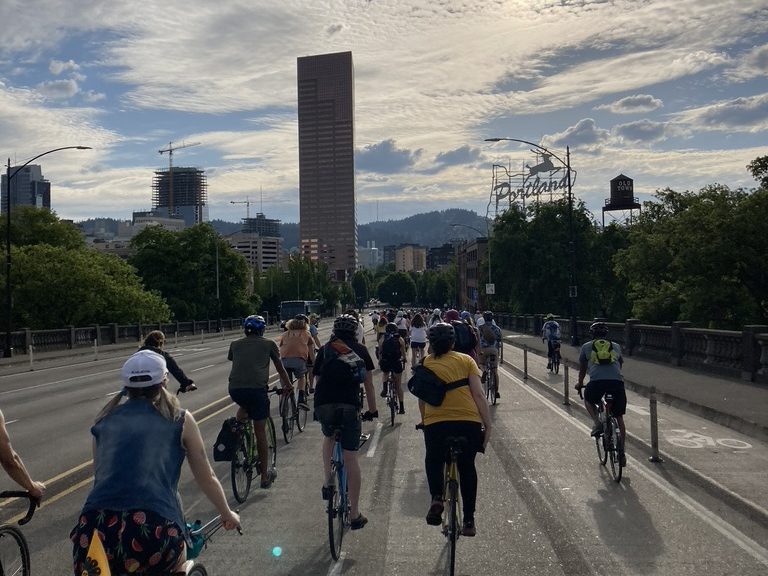
PBOT is unwilling to even consider a primary benefit of a ciclovía as a goal for the Sunday Parkway program. When cyclists, pedestrians, and non-automobile users are given space on the roads, it normalizes the idea that streets are for everyone and that they are a public space. We have the excellent Pedalpalooza rides to look forward to, but if PBOT got their act together we could have a truly transformative official event. Rather than something that pays lip service like our present program does.
What I Would Do
I’d like to propose a Bogotá style plan, with static closures every Sunday during a specific time, on major/semi-major thoroughfares that are typically functionally closed to cyclists. Here’s a map I threw together recently.
It’s not a perfect map, and in a lot of ways it’s not as “radical” as Bogotá. But it would be a good place to start. SE Stark in particular is a street I would really love to see closed for a cycling event. It’s got it all – a mostly flat alignment (outside Mount Tabor), a good amount of smaller commercial areas (around 14th, 28th, and east of Tabor), and it’s also the most dangerous street in the city for pedestrians and cyclists (east of 205). And not that I care about car traffic, but there are ample parallel options for drivers to boot.
The specific streets that close are less important to me than consistency, and frequency. It needs to happen weekly, year-round, rain or shine.
A Note On Weather
Year-round, rain or shine?? But we can’t close streets in the winter, no one bikes in the rain! It’s cold, wet, and scary! Why bother with making this a year-round event?
Well, I like biking in the Portland rain, actually. Being outside in inclement weather is an enjoyable experience – if you have the prospect of a hot shower at the end of the day. Do I dream of a perfect summer day when I’m on a cold, dark, and wet ride in the middle of January? Of course. But dreaming of sunny days is pretty much the only thing that gets me through the Oregon winter.
And for what it’s worth those European cities that are held up as models for cycling utopias – be it Amsterdam or Copenhagen have “worse weather” for cycling than we do in Portland. In terms of both sunshine hours and Köppen Climate classification, Portland is closer to Rome than it is to Amsterdam.
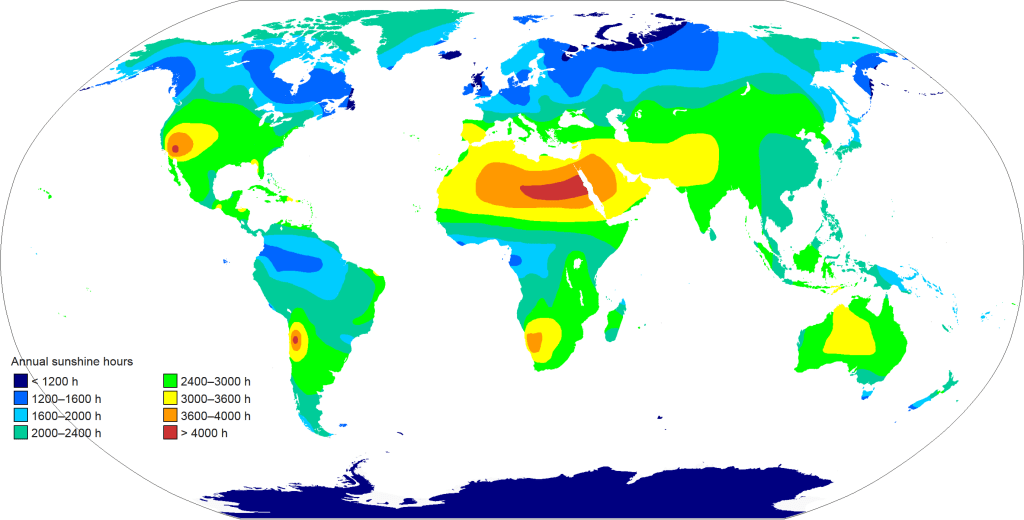

This is all to say that weather is a poor excuse for not going outside. A little rain won’t hurt – as the Dutch say “you aren’t made of sugar, you won’t melt”. Every self respecting Portlander already has a decent rain coat, and the outdoor-industrial complex is basically head quartered on the West Coast of the US. People spend thousands every winter to go ski down a mountain – why can’t we develop a culture of being outside in every day life too?
Frankly, when we plan cycling events only in the summer, it reinforces the need for a car. If you feel like you can only bike when it’s nice out, then you need your car for all the times when it’s not so nice out. I’m sure more people bike on nice days in Copenhagen than crappy ones, but you’d be hard pressed to find a Danish governmental agency acting like cycling in the rain in impossible. Rain is a fact of life in Portland from October to May – if cycling is to be a fact of life as well, then cycling in the rain needs to be part of that.
We Can Have Nice Things Too
But it takes a lot of work to get things done. Realistically, all we have to do in Portland to get a real ciclovía event is have visionary leadership and ample public pressure. Maybe don’t hold your breath on this, but you can start by attending the Sunday Parkway events that we do have and demanding more from your public officials. Ride your bike, take the bus, go on walks. If you want your city to be a better place, I think the first place to start is to engage with the city as a human being. Which is something PBOT could make a lot easier, if only they knew about how they do things in Bogotá…
 City Hikes
Leave a comment