
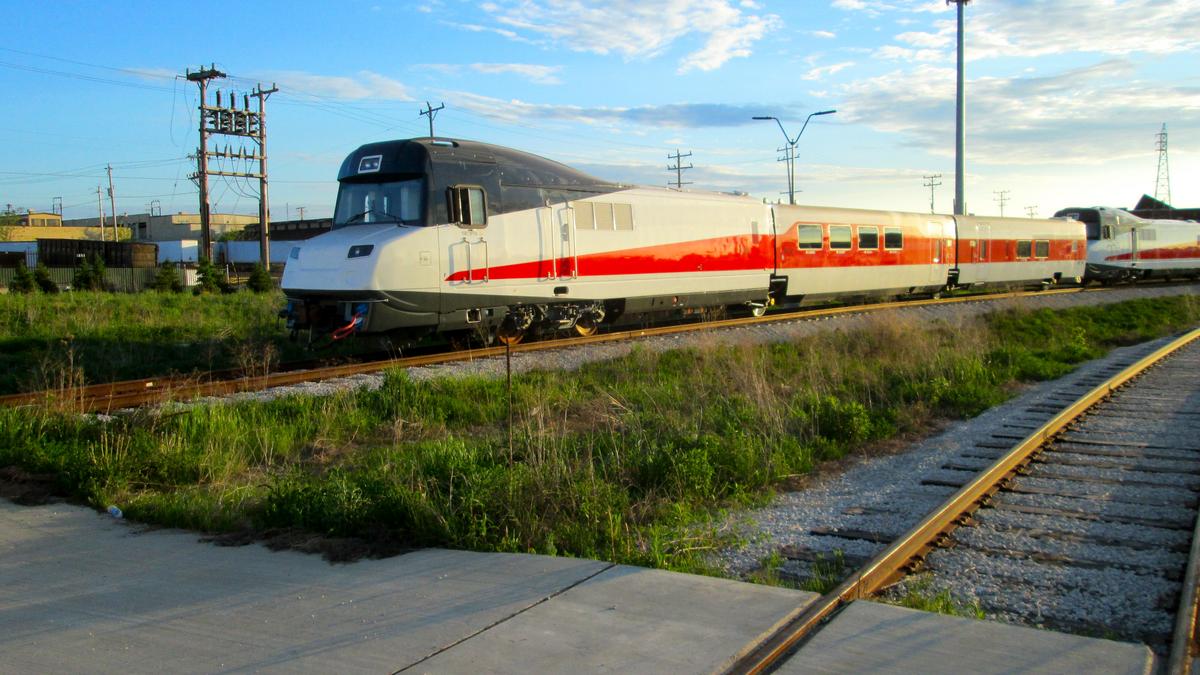
While a high speed line from Chicago to Milwaukee is a fairly straightforward endeavor, featuring a lightly used freight line that could potentially be purchased by the state of Wisconsin, things get pretty murky once we get to the German Athens of America (I’m bringing that nickname back). The general consensus among just about everyone who has an opinion about this sort of thing is that Madison ought to be the next major stop on the line. A plan even progressed all the way to the state purchasing rolling stock from Spanish manufacturer Talgo before being cancelled by Scott Walker to score cheap political points. Unfortunately, this plan is where we ought to start (even if it’s painful for me).

The train would have followed the historical main line of our old friend, the Milwaukee Road, to Watertown before heading down their branch to Madison via Sun Prairie. Plans included top speeds of 110 mph between Madison and Milwaukee with stops in Oconomowoc, Brookfield, and Watertown. The service would have been operational in 2012, back when I was in tenth grade or so. But instead, Scott Walker wanted made cancelling the train a key portion of his gubernatorial campaign and rode the Tea Party wave and capitalized on manufactured urban-rural resentment to scuttle even this fairly modest plan.

Ultimately, Wisconsin was on the hook for like $100 million mostly from Talgo – who kept the trains – and Scott Walker truly made an ass out of himself in the 2016 Republican Presidential primary. In a truly ridiculous turn of events, the city of Lagos (yes, that one) bought the two trains for use on their new metro. As far as I can tell, it’s not operational yet but if it ever gets up and running using these trains I will have to visit just to ride them.
Well that was depressing, what’s next for the Milwaukee to Madison section of our high speed rail journey?
What Route Should We Take?
As in our last discussion of high speed rail, there are a few options to choose from. They boil down to the same former Milwaukee Road line identified way back in the 1990s for the cancelled 2010 plan, an abandoned Chicago & Northwestern main line now the (quite lovely) Glacier Drumlin State Trail, and I-94. Additionally, we have a series of options to consider leaving Milwaukee, which are mostly related to a very curvy (and therefore slow for high speed trains) routing just west of the station. They each have drawbacks, but I think there is a clear choice to make.
Option 1: The Milwaukee Road

The winner for the previous era, this has the benefit of being the most straightforward choice. However, it is also a very busy freight line from Milwaukee to Watertown and is projected to get busier in the Canadian Pacific Kansas City era. It also has the benefit of serving some of the larger cities between Milwaukee and Madison, owing to the historic circumstances of the Milawukee Road. While it would be foolish to plan a high speed service with stops in Wauwatosa, Brookfield, Pewaukee, Oconomowoc, Watertown, and Sun Prairie between Madison and Milwaukee, we would be wise to revisit a key idea from our previous post.
Since the technical requirements of high speed rail preclude freight operations, or at least require either physical or temporal segregation there would be quite a lot of capacity after even the most ambitious service pattern was realized. Because of this, standing up local regional services from both Madison and Milwaukee would be possible – and these local services could more intensely serve local stops. For this alignment, a high speed service with limited stops in Watertown and Brookfield, with regional trains filling service in to the rest of the cities and towns is what likely makes most sense. Keep this in mind for the other options as well, since standing up a high speed and regional/commuter service simultaneously would be killing two birds with one stone.
Option 2: Chicago & Northwestern
The former C&NW main line between Madison and Milwaukee really puts the “former” in “former main line”. Abandoned sometime in the after 1965, but likely before the slew of branch abandonments in southern Wisconsin by the Milwaukee Road led the state to create a commission to buy those lines to retain rail service in 1980. It has been Glacial Drumlin State Trail since 1986, and while at least one public comment on the 2050 Rail Plan recommends this option, I have my doubts.
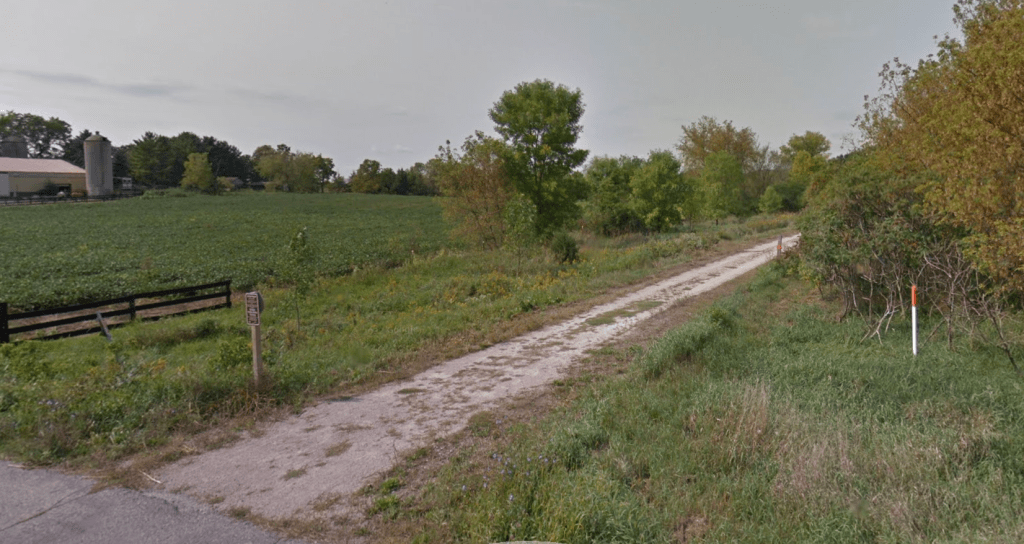
For starters, while it might be fairly direct it also has many more curves than the Milwaukee Road line. And because of other abandonments, it lacks a logical connection to Milwaukee’s station which would require some fairly extensive work to reconnect. Plus, the entire line would need to be reconstructed with a lot of curves to be straightened and subsequent land to be acquired. And to make matters worse, the only real benefit in terms of regional connectivity would be in the Milwaukee area itself.
To be clear, a high speed passenger line connecting Waukesha and West Allis to Milwaukee is a great idea – but I’m skeptical that the route west of Waukesha here makes a whole lot of sense. The next largest place on the alignment is the Madison suburb of Cottage Grove, followed by Lake Mills. Not exactly a routing that connects important rural centers.
Option 3: I-94
Since option 2 is rebuilding a rail line that would require a lot of property acquisition, we should consider an option that would not require any* property acquisition by the state – in the right of way of I-94. Highway alignments have drawbacks for rail service, particularly as it pertains to pleasant stations, but I think this is a case where the benefits may outweigh the drawbacks.

The benefit of this option over the Milwaukee Road option is ownership – something that is extremely important for quality passenger service. Even if a deal could be struck with CPKC for a good initial service pattern, the lack of future scalability and the fragility that comes with relying on a huge private company for a key public service is too much to bear for me. And there should be huge cost savings and far fewer complications as compared to the C&NW option.
And while this option has the worst potential for good suburban/regional/commuter rail service, it does have the upside of directly serving Miller Park and the state fairgrounds. It also has the benefit of an annoyingly straightforward connection to the station, as I-94 mostly parallels the existing rail corridor between the Lake Interchange and Miller Park. But given the most significant other places served are Lake Mills, Johnson Creek, and Delafield using this alignment for anything other Madison to Milwaukee travel is unlikely.
Well, What Will It Be?
Realistically, the state is pursuing the old Milwaukee Road option for the Hiawatha extension to Madison. I get it, but I also think the drawback of relying on CPKC for such a vital public service is too much to bear. It would make sense to recommend a high speed alignment following I-94, as there is ample room for a train, and the right of way is already grade separated in its entirety.
Considering that it’s only about 80 miles between the two cities, a high speed service should only really be stopping once or twice – ideally in the Milwaukee suburbs and at a rural location (probably near Lake Mills). This means the station locations are less of a concern than they would be for a metro style service, and given the complications likely to arise from any further expansion towards the Twin Cities the money saved by the state here will be very much needed on future projects.

However, there are reasons to be wary of this choice politically. As you may recall, an urban-rural divide was created and exploited around a Madison-Milwaukee train back in 2010 and removing even nominal connections to rural places like Watertown would make this a tougher sell. Based only on my rudimentary understanding of Wisconsin politics, it may actually make sense to focus on a different service (say, Milwaukee to Green Bay via the Fox Valley) before fleshing out the service to Madison. Or to at least do multiple projects in tandem, to avoid the perception of favoring Madison and Milwaukee over other parts of the state.
But still, that will come in a later post. I still am not entirely sure it makes sense to bypass Watertown and other potential rural nodes on a new rail alignment in Wisconsin.
Who Is High Speed Rail For?
But ultimately, this is why it’s necessary to have a wider vision of high speed rail in Wisconsin. It’s not just about running a gravity model and determining which cities are largest and closest to each other to determine where high speed rail should go. Such an economically deterministic approach will necessarily leave huge swaths of Wisconsinites out. But we can still make smart decisions to connect almost the entire state, in just a few rail lines.
To do this, we only really need to look as far as the current Amtrak plans for Wisconsin. Connecting Milwaukee with Green Bay, and running a line to the Twin Cities via La Crosse, Eau Claire, and Madison encompasses all but two major population centers in the state – Wasau/Stevens Point and Janesville/Beloit. But they also manage to pass through tons of small towns. A return for high speed rail to Adams or Beaver Dam – which at one point saw the fastest scheduled train in the world (the Chicago & Northwestern 400) call at their stations – would bring huge benefits.

In fact, if we consider the relative benefits for transportation investment, rail service of any kind to small towns not served by commercial airports, intercity buses, or even interstate highways ought to rank extremely high. In the Whitefish Station in Montana, I saw a stat from Amtrak that 25% of passengers boarding the Empire Builder in Montana would not have traveled at all without the service being available to them. The Empire Builder being retained over the North Coast Limited in Montana has been a point of contention, since the North Coast Limited serves all the major cities in Montana, while the Empire Builder serves none of them.
To be clear, both services should have been retained – but the value of serving rural communities is clearly invaluable for residents, even if it may not be the “obvious” economic choice in a vacuum. Frankly, the destruction of intercity rail service (and now intercity bus service) has done more than just about anything else to contribute to the death of the American small town. Any intercity rail policy that fails to address this is missing a huge opportunity to build political consensus.
Reconsidering What Is Feasible
So in this vein, my choice to build a Shinkansen style service between Milwaukee and Madison seems somewhat short sighted. While a coordinated plan could be drawn up to consolidate freight service to open up lines for exclusive and intensive passenger service, there are drawbacks to this approach as well. For one, freight service remains important in many Wisconsin cities and consolidation means that some cities will end up with either just freight service or just passenger service.

However, if we consider the both consolidation and building a few key lines (or rebuilding) in some cases, then we may just be on to something. And if we take this to be a real possibility, then we need to revisit our choice between Madison and Milwaukee. Because the primary reason to choose an I-94 routing is really a lack of ownership and control on the old Milwaukee Road. If we can develop a plan to take over this line, while maintaining equal or better freight operations (from the perspective of the freight customers) then we have a winning strategy.
This all sounds great, but I am getting slightly off-topic – and will save the details of a more detailed aspirational rail plan for Wisconsin for a later date. Put simply, our choice of alignment depends on what is feasible, and if it is not feasible to own the former Milwaukee Road alignment to Watertown then an I-94 alignment is a good option – albeit one that has fewer benefits and likely higher costs.
Should We Still Extend the Hiawatha? And What About Milwaukee Commuter Rail?
Yes, of course we should. And yes, of course we should. But what we really need is a coordinate vision for making both happen at once. And if you haven’t noticed yet, this lack of clear tangible steps to take in the 2050 plan is one of its major drawbacks. Establishing coherent rail policy means articulating particular goals, and it’s clear that the state does not really have these – or at least not enough of them.
Wanting 10 round trips on Hiawatha, or the poorly named “TCMC Second Round Trip” (that’s Twin Cities, Milwaukee, Chicago), or service to Madison, Green Bay, and Eau Claire is great. Using the existing framework of Amtrak establishing new routes is risky – and far riskier than basically anyone at the state seems to realize. There are almost no instances of Amtrak re-establishing passenger service in conjunction with a Class I railroad in a reasonable amount of time. If you hadn’t noticed, Gulf Coast service is still not up and running, despite Hurricane Katrina being almost twenty years ago. To be clear, this is not Amtrak’s fault in the slightest, but it still is important to consider.
Almost all of Amtrak’s success stories rely on public ownership of the rails. Yet there are basically no words in Wisconsin’s 2050 rail plan about this – despite Wisconsin being a state that actually owns a significant amount of right of way. When it is mentioned, it’s only in the context of preserving rights of way. This is obviously important, but the relationship between public ownership and quality passenger service is so vital to the success of passenger rail in the US it’s shocking to see any agency exclude it.
Anyways, thanks for reading. More on how we ought to connect Madison to Minneapolis/St. Paul, Milwaukee to Green Bay, and a whole host of other juicy details about an aspirational rail plan to follow. Stay tuned!
 City Hikes
Leave a comment