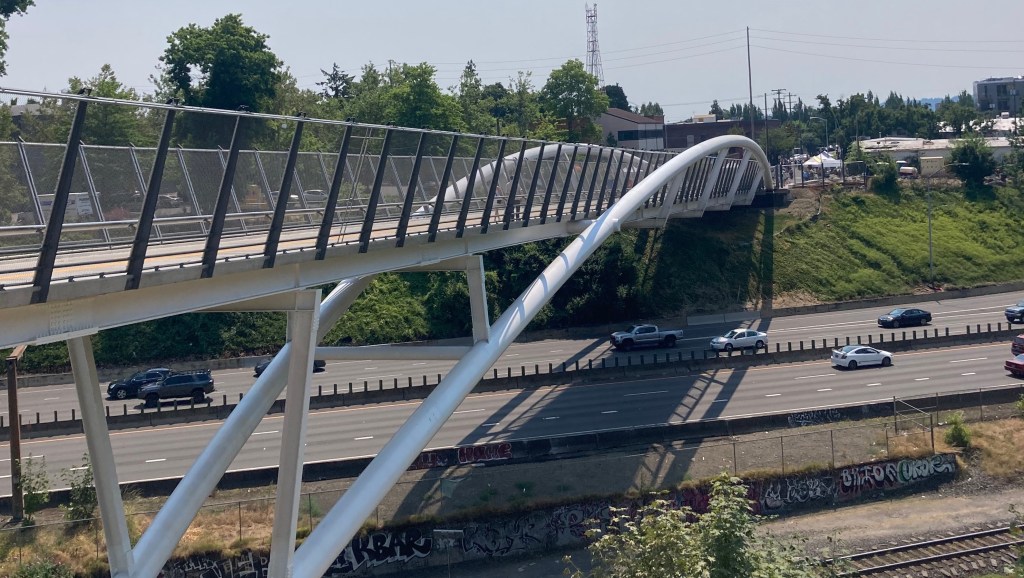
Tomorrow, Olivia and I fly off to Europe until the end of the month (expect lots of updates!! I’m very excited!!). Coincidentally, tomorrow is also the day that TriMet, ODOT, and the governor’s office are collaborating for a big one-day project that requires the closure of the I-84 (Banfield Freeway) section of the MAX system. Now, I’m no curmudgeon (citation needed), but it’s not the end of the world to close rail lines for needed maintenance, and a Sunday would be the day to do it.
But this project is to clean up graffiti (press release here)!
I’d like to thank Governor Kotek and the Oregon Department of Transportation for their vision to rejuvenate this and other transportation arterials through Portland
Sorry – what are we doing here? This whole thing is part of $20 million given by the legislature to “remove graffiti, clean up trash, restore campsites and protect critical infrastructure”. Great, there are places where graffiti clean up is needed – but I’d argue the focus should really be only on things like signs that provide navigation. It seems unlikely that a full closure of the busiest roadway, transit, and freight rail corridor in the state of Oregon – even for a day – makes sense to paint some walls. Especially since there is an approximately 100% chance that this graffiti will immediately re-appear!
If this is the “vision to rejuvenate … transportation arterials” in Portland, our city is – pardon my French – fucked. And $20 million??? I know this isn’t all going towards this project, but still. I’d agree with the TriMet press release that “This section of I-84 is both a highly visible and heavily trafficked part of the Portland metro region” But come on! It’s heavily trafficked by cars going 55 mph+. Do they really mind a bit of graffiti on the walls as they pass by? Maybe I just don’t understand this line of reasoning – but I do not associate graffiti with “decline” or “rot”. Graffiti is part of human nature, and people have been scribbling stuff on walls for as long as there have been people and walls. Just feels like a broken windows policing mentality to me.
Also: people are dying at record rates on major ODOT controlled roads like TV Highway, Powell, and 82nd (formerly controlled anyways). These three roads combined for 101 fatalities from 2015 to 2022 (latest year that data is available from ODOT). For comparison, there were 20 on the Banfield section of I-84.
These orphan urban highways (of which Lombard, Barbur, and Beaverton-Hillsdale also qualify) are where investment is most needed for safety. I’d argue that they are also more important for “aesthetic” investment – since people actually linger around them (despite the hostile pedestrian environment). Every dollar spent on graffiti clean-up on the Banfield is a dollar spent prioritizing how drivers feel when they go by some graffiti, rather than being spent on literally saving lives on the Powell Boulevards of the world.
It’s true that more than just cars traverse the Banfield – but as a transit rider who uses the corridor on occasion, it’s hard to feel excited about this project when the real issue (to me) is incessant noise from the freeway while waiting for a train. More than 2,000 people/weekday wait on just the Hollywood MAX Stop. Trains come frequently (~every 5 minutes), but that’s still like 30,000 person-hours of waiting with truly unhealthy noise levels per year. Why not install platform screen doors? Or at least enclose the freeway platforms to protect from the noise? Incidentally, that’s not a question I feel comfortable answering to be honest – since passive noise is a tactic used by transit agencies to drive homeless people away.
We just got out of a long period of construction, closures, and shuttles for the MAX lines running on I-84 (as a part of the Better Red project, and to perform some needed maintenance of way). Those projects, while potentially not planned to minimize ridership disruptions, were forgivable. Spending a few million to give graffiti artists a clean slate? Doesn’t really feel like a good thing to be doing.
Wait, Is This Shuttle Bus Piece Even in the Trip Planner?
And it gets worse. I just went to plan our trip to the airport tomorrow using TriMet’s (usually pretty good) trip planner. They do not mention that the trip from Lloyd to Gateway will be on a shuttle bus that takes an extra 20 to 30 minutes.

This is pretty sickening – though luckily we’ll have other options. I imagine we will end up on the 9 or 17 out to the Green Line, and then will transfer to the Red Line at Gateway. It’s probably ~15 minutes slower than the usual 70 -> Red Line trip, but whatever. Beats taking a miserably slow shuttle bus. It’s also worth saying that this trip will also be delayed on the 70, as “One bus line, Line 70-12th/NE 33rd Ave, will be detoured off of the NE 12th Avenue bridge until 12 p.m. when I-84 reopens to autos”. That detour is probably to Grand/MLK, but it would sure be nice to know that for certain!
Surely the shuttle buses should be in the GTFS right? No, they are not. After a quick inspection, the calendar.txt file has no special calendar defined for tomorrow – even though there obviously should be since the typical Sunday schedule does not involve a complex shuttle operation. If we look a specific trip in stop_times.txt (say #13800298 – a Red Line Trip towards Beaverton at 7am tomorrow), we see no indication of a shuttle bus.
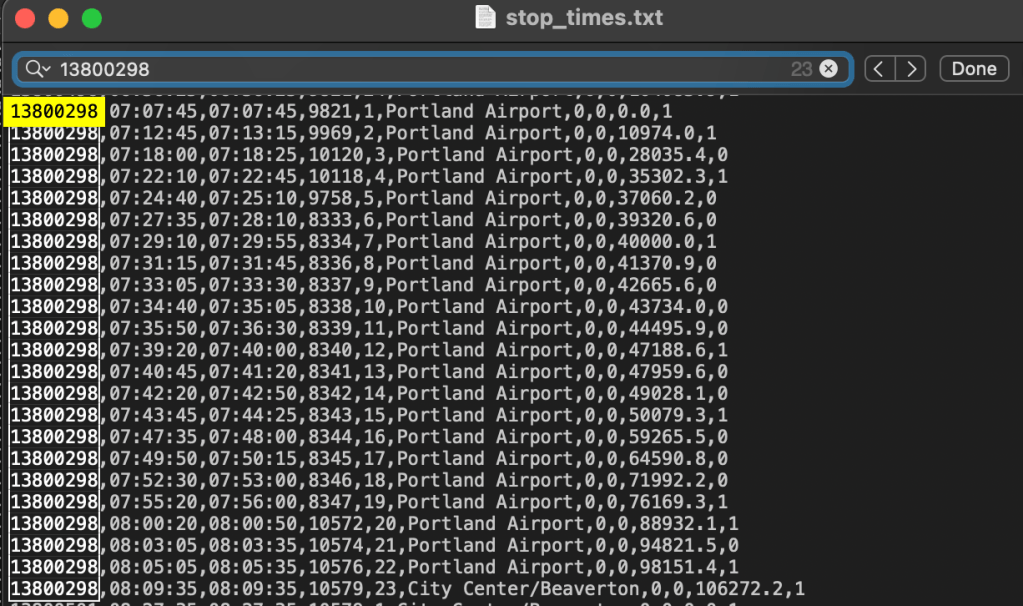
This is very bad, and very frustrating. Even if I were to think that this graffiti project were to be worth it, riders planning trips need to know how long it will on the shuttle buses. I am flying internationally! I can’t just have a 30 minute delay out of the blue! Do you understand how stressed I get when flying?
Strong rules and customs are needed to ensure that public transit is usable for all, there’s no debating that. Even if I think it’s distasteful for TriMet to specifically ban “large bags of recycled cans and bottles” from buses and trains, I can understand the logic. And as someone whose day to day life does not involve driving a bus, I’m willing to show deference to those who do. But I do not think the salient issue facing the Portland region is that people redeem bottles and cans via the bus, and I don’t think the issue is graffiti in a highway right of way.
Portland brands itself as forward thinking on transportation issues, but I can’t think of a less bold or visionary plan than this. Catering to how drivers feel and neglecting to even update transit schedules (meanwhile – the Banfield re-opens to drivers at 12 pm!) is not the way forward. Spending scarce dollars on band-aid “fixes” that do nothing is not the way forward. We need to fully re-imagine roadway corridors and run way more transit – and anything that falls short of that needs to be called out as what it is: a half measure designed to ameliorate the concerns of the loudest pundits, while leaving the most vulnerable behind.
 City Hikes
Leave a comment