Despite my reputation as a train guy, I’ve got a big appreciation for buses as well. Of course, this is usually in the context of regular city buses, but on occasion I’ve been known to take an intercity bus. Most recently, this summer Olivia and I took a FlixBus from Eugene to Portland since it lined up better with the end of Olympic Trials (as an FYI, FlixBus bought the much maligned Greyhound in 2021. This post will cover both carriers). It was a busy, but uneventful bus ride. My recollection is that Olivia slept while I pondered my life decisions (something all Greyhound passengers can relate to).
Given that it was a busy bus (even before we got on it), I was surprised to learn that this bus no longer exists. While Greyhound does still serve the Portland – Eugene route, the bus we took came from Medford and Grants Pass.

Sort of unbelievably, this means that there are zero direct trips per day between the Willamette Valley and Southern Oregon. Despite the I5 corridor the busiest intercity travel route in the state of Oregon, and Southern Oregon being the second most populated region of the state, apparently it’s just sort of fine that there is no good way to get there on a bus or train.

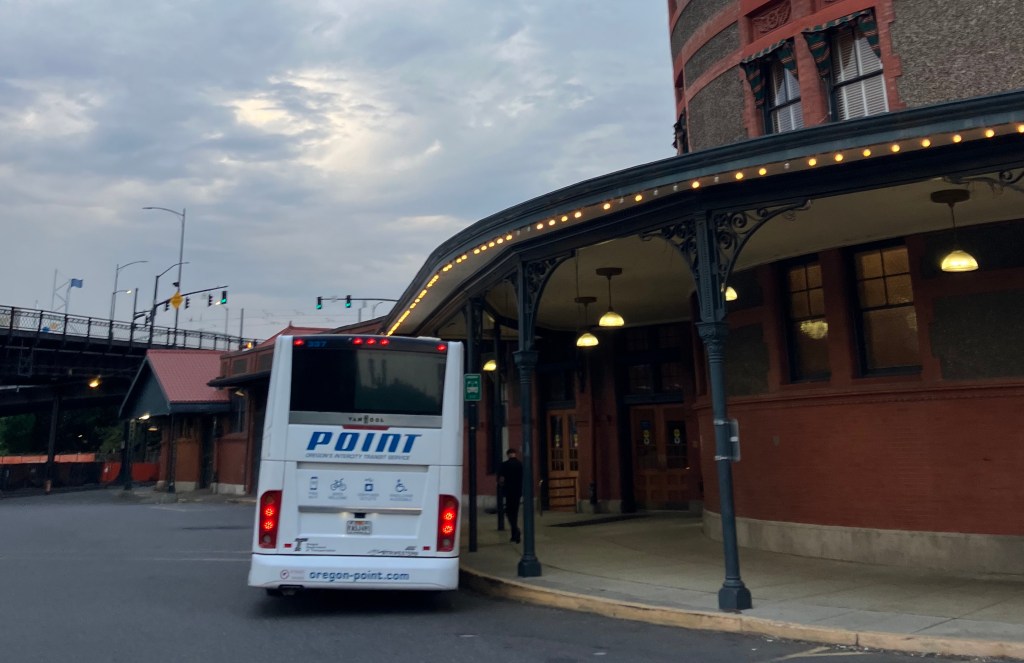
And this includes Amtrak – this 20 hour trip involves going to Klamath Falls on the Coast Starlight and waiting overnight for the state-run POINT bus. Not exactly a reasonable trip. Which is part of what makes this whole situation so frustrating – we already have a very good state-run intercity bus operator. POINT has historically set up routes where private operators have been unwilling to provide enough service (Eugene – Portland), where they have abandoned former service (Astoria – Portland), or where service never readily available (Brookings – Klamath Falls via Medford, Bend – Ontario).
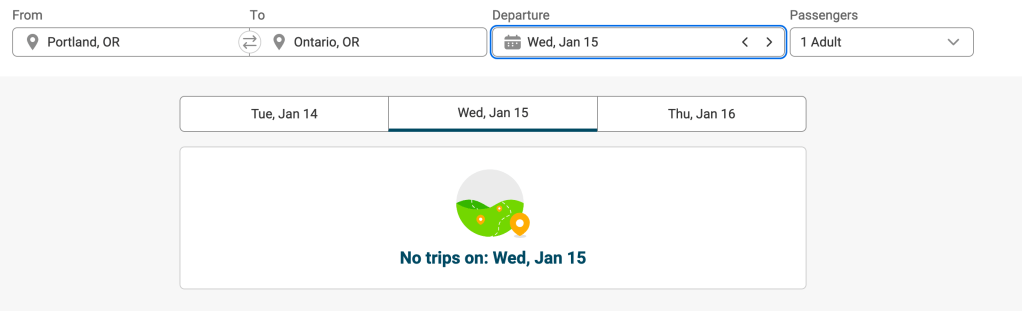
And to make matters worse, on the other major intercity travel corridor in the state (I-84), bus service is due to be cut this month. And it’s not like no one rides this route. The bus today (Jan 4) was sold out, and the bus tomorrow seems to be packed. But evidently, that’s not enough to justify service.

I’m not privy to Greyhound’s financials, but it’s long been clear that they’ve been struggling. If you are a regular Greyhound rider, you are all too aware of this. The customer service is legendarily bad. The buses are a mixed bag. They’ve been selling off basically all of their bus stations to generate revenue for investors, leaving riders out on the curb.
In short, it’s a bare-bones operation with no thought given to rider comfort. The fact that they can’t make a route like Portland – Boise pencil out when they have a monopoly is not a good sign for future bus riders. Even if we already functionally exist in a society where intercity travel is gated behind car ownership, even a bare bones service like a once daily trip between Portland/Salem/Eugene and Grants Pass/Medford or Pendleton/La Grande/Ontario meant that people could make things work without a car.
I’d like to live in a society where I don’t always have to drive or fly if I want to visit a new place. It’s frustrating to watch things get worse instead of better.
There Used To Be So Many Intercity Buses
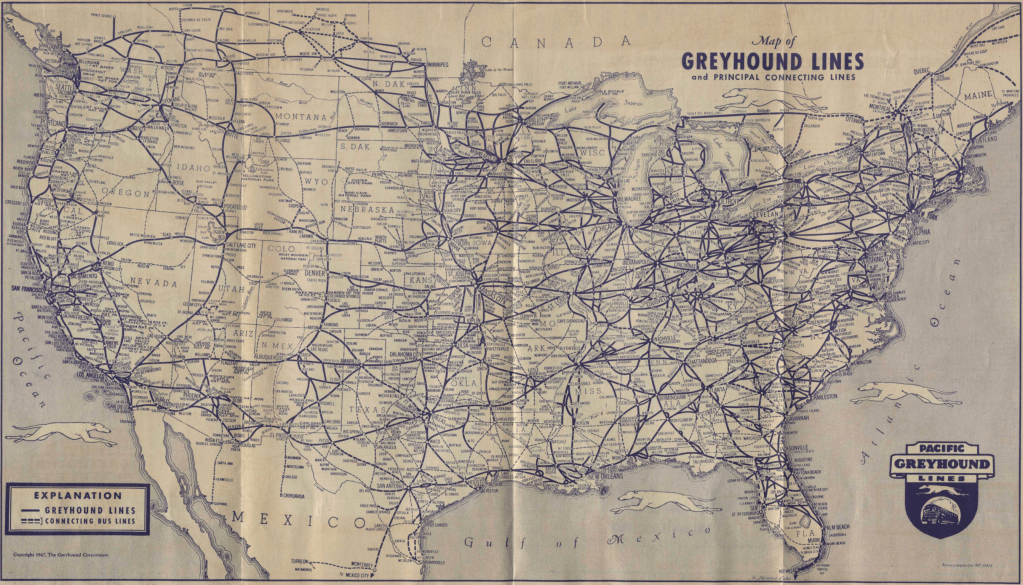
In the 1940s, the map routes served by Greyhound basically looked like the map of federal highways. Anywhere that the roads went, you could count on finding a Greyhound. And not just once a day.
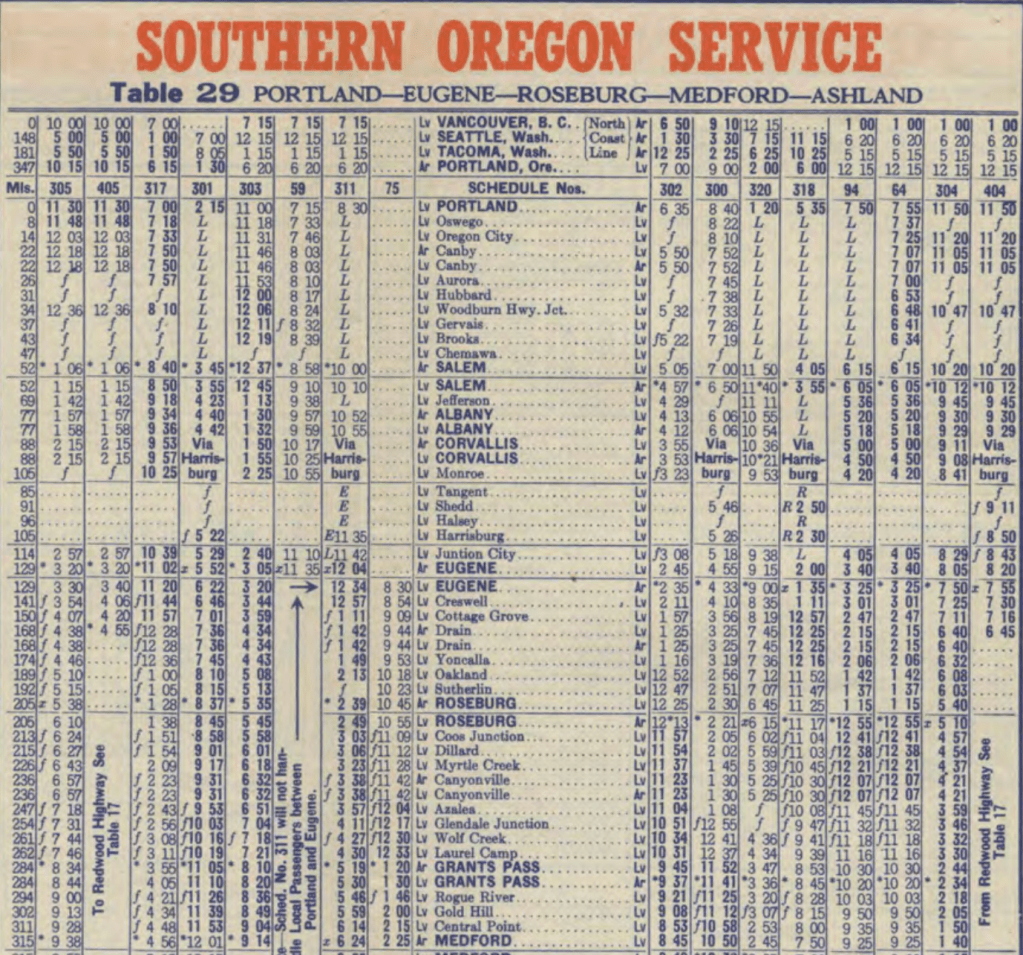
In 1937, the route that would become I5 in 20 years hosted eight round trips between Medford and Portland. And they managed this at a time when Southern Pacific still ran passenger trains on the Siskiyou line (though just two round trips per day – page 830), while also not being the sole intercity bus carrier on the route. So travelers had their pick of when to leave, and missing a bus or train was only a problem in that you probably had to buy another ticket.
While the proliferation of Greyhound and other competing intercity bus lines played a large role in the death of intercity rail travel in the US, at least that death came with an alternative option. The current death of intercity bus travel at the hands of public disinterest and budget airlines will leave a hole in the market, especially for rural Americans.
Maybe this is why I’ve become disillusioned with normative ideas of progress. It seems like every time I do some amount of historical research, I find evidence that things used to be better. Intercity bus riders used to have stations, and more than one bus a day. What a concept! Now, we beg for service our grandparents would have considered to be bad. Sure, we can drive, but I’d really rather not have to. Is that so much to ask for?
Who Gets Left Behind

A lot has been written about the acceleration of urbanization around the world and in the US. As cities grow, rural towns shrink. Is Greyhound dying a slow and painful death a symptom or cause? That’s a matter of opinion, but I lean symptom. Part of the story for urbanization is cultural, and our culture generally does not value small towns except as vignettes of a backwards past to be become tourism hotspots or doomed to fade into dust.
But even the towns that manage to become tourist hotspots – places like Bend, Aspen, Truckee, or Flagstaff – the chances of having quality intercity bus service aren’t great. Since tourism like this caters to the sort of person who can afford to not ride Greyhound, and most of the modern tourist activities in these towns require a car anyways (hiking, mountain biking, etc.), why bother running a coach bus that only the working class really uses?
I’ve written at length before about how the death of passenger rail is ultimately part of the reason why small town America, but surely the death of intercity bus service will be just as bad. And to make matters worse, there is no Amtrak coming around the bend to at least provide a skeleton of support. Our lack of federal leadership on intercity bus service (when was the last time you saw a federal official mention Greyhound?) means that states are left to pick up the pieces.
And of course, this means that the bus rider’s experience will vary across state lines. It means that schedules may not be coordinated, and it means that multi-state through routes are unlikely to be prioritized. It’s entirely possible that come January 15th, you will never again be able to ride a bus from Portland, Oregon to Boise, Idaho. Of course, this is bad for Porlanders and Boiseans but it’s far worse for those in between.
Are We Going to do Anything About It?
At least in Oregon, the lost routes stand a chance of being reinstated. I’m optimistic that ODOT will prioritize resuming intercity service between the Willamette Valley and Southern Oregon at the very least. Since the Medford-Ashland-Grants Pass combined statistical area is the largest in the state outside of the Willamette Valley, it makes sense to have a bus. Things feel more difficult for northeastern Oregon, where surely the connection to Boise is part of the draw of the route. Still, if POINT can provide service along Highway 20 from Bend to Ontario, surely service along I-84 should be trivial.

But it seems exceedingly unlikely that the federal government will come to save the day. There is just as little of a chance of something wacky like a National Parks based intercity bus carrier as there was when I wrote about that two years ago, and I’m not exactly confident that the next four years will bring an administration focused on meaningfully addressing the pressing issues of every day Americans.
So what can be done? Well, I started the morning with an email to my state reps asking them to sponsor legislation supporting intercity bus service along the two former Greyhound routes. I’d encourage you all to do the same – even if you aren’t in Oregon, Greyhound is dying everywhere so I’m sure there’s a local intercity bus problem. Send me a message if you want me to help with research!
But maybe this is the sort of problem that can only really be solved by a bigger dream. For me, that’s obviously high speed rail, but I can’t get into the details on that now since this is supposed to be just a quick hitting post on a Saturday morning. In any case, thanks for reading and I’ll see you next time.


 City Hikes
Leave a comment