

Before the end of the WWII, most US cities had begun the transition from a streetcar dominated mode of public transit to a bus dominated one. This topic has been written about ad nauseam, with conclusions ranging everywhere from “General Motors conspiracy” to “buses are simply better”. Personally, I fall somewhere closer to the later, and feel that the overt conspiratorial aspects of mid-twentieth century transit politics are better explained by a combination of racism and genuine pro-automotive sentiment in all sectors of (White) American society1. There are simply actual advantages buses have, especially in the context of a busy American city that has created the political infrastructure to publicly subsidize street paving.
See, while there are many reasons why streetcars had speed advantages over buses and carriages, a primary one was the fact that streets were not paved with speed of carriage travel in mind. It wasn’t until the bike-induced good roads campaigns of the turn of the twentieth century, and the subsequent automotive explosion that public financing for road infrastructure was the norm. In the days before this, streetcars operating on lower maintenance rail systems made fiscal sense, since they couldn’t well afford to pave an entire road network. If you’re a transit operating company, and there is an existing public system to pave streets, it makes relatively little sense to maintain your own network of streetcar tracks.
And of course, buses have operational benefits as well. A bus can easily maneuver around a double-parked car, and is just generally easier to plan service for. This flexibility is not always a positive, as the fixed constraints of a streetcar network which make service pattern changes more difficult also give routes more permanence, which is generally good for riders, but it does mean that new service can be spun up without much issue. In addition to the Faustian bargain of operational flexibility, diesel buses are much less energy efficient, generally lower capacity, and pollute a great deal more than an electric streetcar2.
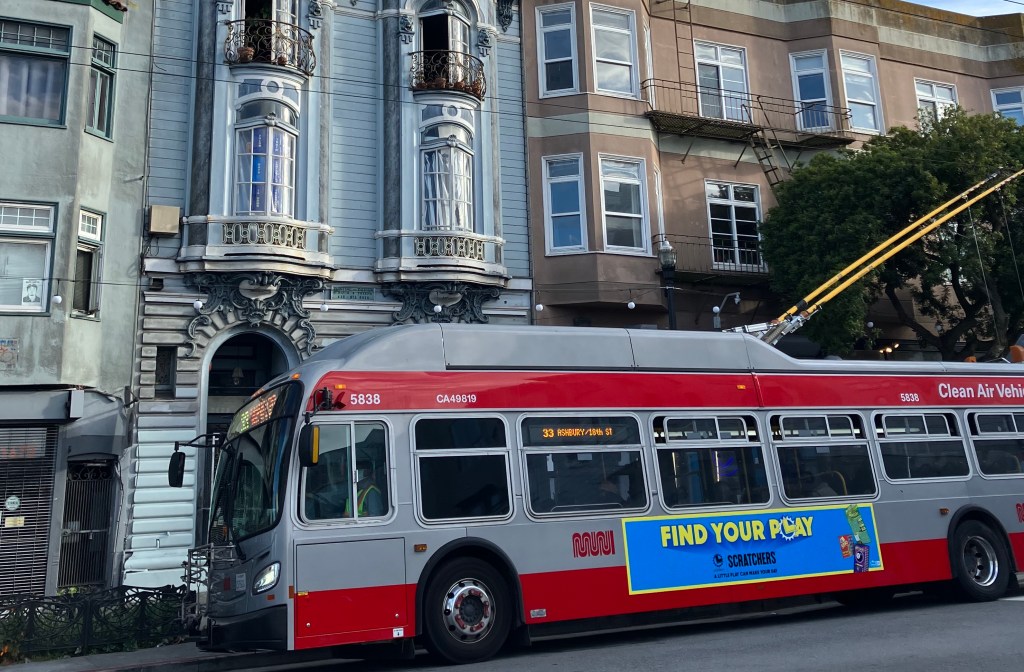
As cities transitioned from streetcars to buses, the first order of business was usually the introduction of the “trackless trolley” – or the trolleybus. Since the overhead catenary wires were already hung3, and the electric power distribution systems already in place, a trolleybus conversion was a relatively easy affair. And trolleybuses do offer benefits that streetcars do not – namely, trolleybuses can climb far steeper slopes, while providing a middle ground of operational flexibility between streetcars and diesel buses (the lack of tailpipe pollution present for diesel is also a strong plus).
But in the years since the great introduction of trolleybuses, all but four US cities have phased them out. Incidentally, this is approximately the same number of extant first-generation streetcars still operating in the US4. It’s common for streetcars to be covered in a veneer of nostalgia, but this is rarely extended to the humble trolleybus. Cities have cited, recited, and wax poetic about Portland’s super-duper successful modern streetcar as a catalytic engine of urban redevelopment the world over, and rail transit in general is assumed to be needed to decouple the American dream from the debt trap of modern car ownership, but very few of us are talking about the revolutionary climate-friendly opportunities for the trolleybus.
It’s not so hard to understand why this is. We’ve all seen Who Framed Roger Rabbit after all. The conspiracy of sabotage at the hands of corporate stooges looms large over the death of urban rail systems in the US, and that gives it a certain cultural cachet. The 11th hour dismantling of Portland’s system by soon-to-be defunct private operator, Rose City Transit, barely registers in the annals of “the Portland story”5 – and we’re a city that markets itself as wonky about transportation!
And I know what you’re thinking: “I’ve all read the 2018 TriMet Non Diesel Bus Plan, they didn’t think trolleybuses were even worth a study – do you really know more than Oregon’s largest transit agency?”6. On that point, it’s worth acknowledging that since the trolleybus lacks the cultural cachet of the streetcar, and since there are few domestic examples of growing networks, most people assume that the trolleybus died a death of natural causes and warrants no further discussion. Evidently, this is the case at TriMet7. But I don’t think that’s a very rigorous way of going about this, and given that bus electrification policy is very much something we need to be considering. Let’s talk about the battery electric elephant in the room: battery electric buses.
Difficulties With Battery Powered Electric Buses

There is extensive literature detailing the operational constraints and difficulties with battery electric buses (BEBs), with most of the conclusions being that some care needs to be taken in both route design and en-route fast charging8. What this will mean in practice is that agencies which adapt a “plug and play” strategy for BEBs may struggle to provide the same level of service with the same number of vehicles, as routes have not generally been designed with battery operation in mind. Even a state of the art 500 kW charging unit9 may require layovers which induce additional bus needs.
Let’s consider one of TriMet’s longer, but not exceptionally long routes, the 15-Belmont/NW 23rd. It’s a 20 km, fairly hilly route with high ridership. With a 1.5 to 2.5 kWh/km range for normal BEB operations10, a round-trip on the BEB #15 would consume about 80 kWh. With a fast charger installed at one end of the route11, this requires 10 minutes of fast charging to recoup. This may not sound like much time, but best I can tell from the #15 schedule, the typical layover time on either end is about 7 minutes12. Even in a delay-free operating environment, and even with the highest power charger on the market, adding 10 minutes of charging time will impede normal operations13, as buses are not currently scheduled to need this.
Higher battery capacities can be utilized, and the highest capacity buses have battery packs in the 600 kWh range. That’s not enough range to stay in service for a full working day on this route, though with that large of a battery the 10 minute charging per round trip is something that a typical bus in service would utilize just once or twice in a day, marginally reducing the need for additional buses to maintain service. But the need still remains, and given the longer charging times required for full replenishment (> 1 hour, as opposed to a few minutes for a diesel bus), in real-world operating conditions it’s reasonable to assume that more buses will be needed to maintain the same levels of service14.
Most literature and study from agencies leans heavily on the fact that maintenance costs (and by extension full lifecycle costs) for battery buses is lower than diesel ones. Preliminary research suggested 20% less in 2018 for TriMet, but we should be wary of this number. In King County Metro’s 2011 of study of their trolleybus network15, the difference in maintenance outlay for diesel and electric (trolley) buses themselves was essentially zero, and there is little reason to think a battery drive train is easier to maintain than a trolley wire driven one16. Looking at the total vehicle operation and maintenance related expenditures for trolleybuses versus diesel buses in San Francisco reveals similar total expense levels per vehicles in peak service as well17, indicating that the maintenance benefits of electric drive trains may be somewhat overstated.
Absent any specific, real-world data, and given that the primary cost benefit to transit agencies is the assumed lower maintenance costs, it would be nice to see something more nuanced than a 20% across the board assumption that seems to be based in large part on slightly scaling back manufacturer promises. And at least in the case of TriMet, the larger fleet size requirements required in their base assumption case (of a primarily depot-based charging system) is entirely ignored, despite imposing the need for at least 10% more buses to maintain current service levels18, while rosy assumptions about lower maintenance cost are given little scrutiny. This is extremely frustrating, and is something which boggles the mind. Despite mentioning “significant” operational impacts, there is no attempt to cost this out.

Of course, the environmental benefits of electric buses over diesel buses are self-evident19. But this doesn’t excuse shoddy assumptions, even if the desire to frame the preferred alternative as both cost-effective and environmentally friendly is understandable. The only problem is that an entire mode of non-diesel bus is excluded, and it’s one that has all of the upsides of battery powered buses, far fewer operational constraints, and just one downside.
The Overhead Catenary Thing

In that 2011 King County study20, the conclusion is essentially that absent FTA fixed-route funding (which trolleybuses technically qualify for), the total cost of trolleybus service is about 10% higher than equivalent diesel service2122. Most of this difference is related to the cost of maintaining the overhead catenary system, which was about $2M over the lifecycle of a given bus on Seattle’s 70-something mile system. This is a significant cost, and often one that is pointed to by detractors as to why a newly built trolleybus system is impractical.
However, when we consider that our equivalent BEB services require 10% to 15% more buses to maintain service, things start to turn towards trolleybuses, as the overhead catenary system needs to be judged against the cost of expanding facilities and adding BEB related infrastructure. In a piece from the Urban Transport Magazine23, with a more pessimistic 20% extra bus penalty, this worked out to be $405M to $450M in favor of the trolleybus. Using our numbers, I came to an essentially equal cost basis for battery buses versus trolleybuses24.
The major reason for this is that modern trolleybuses have significant off-wire operation capability, and the wires can be used to recharge that battery. Sometimes referred to as “in-motion charging”, this allows us to have our cake and eat it too. By reducing the need for charging outside of service hours, agencies can maintain similar sized fleets as they do now for diesel service. And this capability lessens the fragility of the trolleybus system writ large, as dewirements and other nuisances that trolleybus riders of old endured simply do not matter as much25.
The only downside is that we have to hang those “unsightly” trolley wires. The downsides of this are a matter of taste, but King Country Metro considered trolleybuses to positively contribute to neighborhood character while creating visual clutter. They also list specific benefits to riders – including the sense of permanence that a fixed guideway system (like a trolleybus) induces. This is a well-studied phenomena with regards to rail transit, but it’s intuitive to me that it would matter for trolleybuses too. The greatest upside of a regular bus is its flexibility, but that flexibility is a Faustian bargain for riders. Do you trust your transit agency to keep up service levels when they implement battery electrification? I’m not sure I do.
Why This Matters
Even though buses are undoubtedly pollution machines, the strong push for bus electrification feels quixotic to me. A busy TriMet route like the 9 carries some 6,000 riders a day on 18,000 passenger miles26, and with 9.4 riders per revenue mile, even the paltry 4.5-ish27 mpg a diesel bus gets works out to 42 mpg. This may not sound like much, but recall that the average passenger vehicle gets 26 mpg28. Bus electrification policy plainly matters for climate reasons, but getting people out of cars into buses also matters. If our bus electrification schema makes bus service more expensive to operate, as it seems likely to do, it will make it more difficult for transit agencies to run enough service to get people out of cars.
Given that trolleybuses are at least situationally more cost effective to operate than standard diesel buses, which are in turn typically more cost effective to operate than battery electric ones, it’s vitally important that local transit agencies seriously consider the trolleybus as a vehicle for transit electrification. It seems that a large part of the appeal of battery electric buses is their perceived “plug and play” ability – that you can just sort of buy some battery buses and call it good – but the reality is that they introduce serious operational constraints that simply cannot be worked around. It’s ironic that the electrification option that is more flexible in just about every way – a trolleybus with a small onboard battery allowing for ~25 miles of travel – has been routinely ignored.
Embedded in the TriMet bus electrification plans is a deeply rooted technological optimism. There are continual phrases like “more expensive now, less expensive in the long run” when talking about battery electric buses, assuming that our technological systems and industrial capacity will reach a point where the break even point is in favor of battery electric. We’re just hoping that all of our bus transit needs can be met by a technology, which as of the time that TriMet wrote that report, had ranges well under 100 miles. Things are a bit better now, but typical ranges are still basically in the 150 mile range for normal operations29. This may be suitable for some routes, but longer routes or routes far away from depots without costly en-route chargers will be unlikely to survive. The 9-Powell that feeds directly into the Powell depot is one thing, but will TriMet be able to economically run a battery electric bus to Estacada some 25 miles from the nearest depot?
It should be obvious that I have my doubts. In the case they can’t, is the 2040 promise to electrify the fleet also a promise to cut service which could be sort of economically served by a diesel bus30, but really can’t be by a battery electric one? Evidently, you may think that a trolleybus service to Estacada would be even less economical than a battery electric bus, and you’d be correct31: the broader point is that in our zeal to pivot towards a greener future, we’ve lost the memory of a greener past. Experience in Seattle, San Francisco, and many other parts of the world where trolleybuses are still being built with gusto32 would suggest that there are sound reasons to continue investment in this allegedly obsolete technology.
I can admit to a certain amount of bias on the topic. Whenever I take the train up to Seattle, I walk over to the stop for routes 3 and 4, and hop on an honest to God trolleybus to make the journey to Mark & Shelby’s place. It’s a quiet, smooth, and lovely ride every time, and it’s this kind of experience I miss every time I leave. I’ll admit that it’s possible for a battery bus to achieve some semblance of this experience, but I find the trolley wires charming and it should be clear that there’s at least plausible evidence for trolleybuses being cost-competitive.
And we need our public transit agencies to engage with the facts of life as they are, not as they might be. Too much of electrification policy is centered around the assumption that battery power is just going to work out in the end. It very well may, but just as was the case with the rise of the automobile in the first place, the very idea that something will take over is a strong determining factor in making the take over happen. When we allow this kind of unthinking progression to occur, we loose out on opportunities to build different worlds – often to our detriment. So next time you see the chance to comment on bus electrification policy in your city or town, consider what you stand to gain with a trolleybus system, and be thoughtful and earnest with detractors.
Thanks for reading, ’til next time
Footnotes
- There are certain cases where it’s undoubtable that auto industry intervention played an important, specific role in speeding up the abandonment of trolley lines – LA is particularly notable on this front. But the National City Lines cartel’s role in the dismantling of good transit networks writ large is still overstated. ↩︎
- New diesel buses are generally much cleaner than their older counterparts, but the inherent inefficiency of an internal combustion engine makes an rider-for-rider energy use consideration tilt heavily in favor of electric power vehicles. ↩︎
- A second wire is needed for a trolleybus for return power (a function accomplished in the streetcar via the steel rails), but this is a trivial installation. ↩︎
- “approximately” may seem like a strange word choice, but there is a bit of a blurry line at play here. Some systems – New Orleans in particular – are unambiguously still streetcars. But most are more like the Muni Light Rail lines, probably more aptly categorized as “modernized light rail”. There’s also this funicular in Dubuque, which made it onto the Wiki page of US streetcar systems. I’d say that it’s really just four and a half (New Orleans, Boston, San Francisco, and Philly for sure, with half a point for Cleveland because of the Shaker Rapid Lines – but those were always more like modern light rail than streetcars) which still operate historic streetcar lines, since all those cities run streetcars (or streetcar-like electric rail vehicles) on corridors which have had streetcars since the electric streetcar was introduced. Sorry Dubuque, I love you but your funky little funicular isn’t a streetcar. ↩︎
- Though if you want to read more about it, this 2006 blog post about it is excellent! ↩︎
- Study here, for the curious ↩︎
- I’ve been told on occasion that there are people at TriMet who are quite passionate about trolleybuses. If you’re reading this for any reason, just know that I strongly support you in your endeavors, and would cook you all a dinner if it meant we got trolleybuses in Portland. ↩︎
- This study highlights how the use of 400 kW+ fast charging reduces the need for “proactive charging events” to essentially zero. However, a 10 to 15 minute layover is still assumed for this fast charging, and depending on the specifics of the route this may more time than the schedule can bear. ↩︎
- GILLIG’s pantograph charger is rated for 540 kW, but there’s some inefficiencies associated with battery charging. 500 seems fair. ↩︎
- Taken from this study ↩︎
- It would be possible to split this on both ends, but in my experience with TriMet routes, one end of the route is usually a continuous pick up sort of situation, while the other end has a longer layover. ↩︎
- This is inferred from arrivals in one direction of the route to departures in the other, and assuming that there isn’t often an extra bus waiting. For rush hour trips and more complex schedule times, this may not be entirely accurate but I think it’s a good enough first pass. ↩︎
- Despite this study finding that 300 kW charging facilities would be sufficient for “normal operations”, their normal was Knoxville Area Transit, a pulse-based system with most buses operating on 30 minute to 1 hour frequencies. ↩︎
- TriMet generally did not consider super fast charging as a preferred alternative in their BEB study, which further constrains BEB operation patterns and necessitates an even larger fleet to maintain current service levels. The power output of the charger is the limiting factor in any case. Consider the fleet needs for the #15 if 150 kW depot charging is used. Once a bus makes it’s 4 or so runs it can on a charge (~8 hours), it’s then confined to the depot for the next 2 hours. A diesel bus could go right back into service, and given that TriMet has a 16 to 18 hour service day, this constraint alone would imply a 10% to 12.5% larger fleet. At 500 kW, this is reduced in-kind to 3.5% to 4% – which is still significant, though obviously less so. ↩︎
- This is one of my favorite studies to reference, so it’s worth a read! ↩︎
- If anything, we should expect higher maintenance costs for a battery bus given the battery packs require maintenance too. ↩︎
- Per the NTD. It’s not entirely clear to me if these figures include catenary maintenance or not. If it does, I think the conclusion is that 20% savings is fair, but given the information from the King County study (which is more direct and relevant than the NTD data), I’m inclined to think this isn’t fully inclusive of overhead catenary maintenance. ↩︎
- See footnote 14. ↩︎
- Much ado is made about the environmental costs of EV production, but the relevant metric is really the difference between EV production and conventional vehicle production. While it’s true that EV production requires more rare earth metals, the impact of mining for iron and other raw materials for production, and the fossil fuel industry in general, are not insignificant. ↩︎
- See footnote 15. ↩︎
- These are on routes that already have trolleybus service, which are occasionally super-hilly routes (the 3 and 4 go straight up James which is seriously insanely steep), but are mostly not particularly suited for the trolleybus (the 8 down Rainier is pretty flat the whole way). ↩︎
- Inclusive of FTA fixed route funding, the trolleybuses are about 30% less costly to run ↩︎
- Available here ↩︎
- This was done by adjusting each assumption for BEB related costs down by 50% in the article linked in footnote 23 ↩︎
- There may still be a need for short stops to put the trolley poles back up on occasion, but this could be accomplished at layover times as well ↩︎
- Ridership numbers here ↩︎
- Sourced from the NTD ↩︎
- Sourced from here ↩︎
- Sourced from here ↩︎
- It’s fairly debatable as to if our current service patterns on routes like the 30-Estacada are economical, but they would probably be the first buses to see serious fleet size related cuts in an all battery future. ↩︎
- I was going to go on a long rant about how “Italian cities often have weird old interurban trolleybus lines that are still operational”, but that’s not a very convincing argument. And yes, we could try to utilize existing electric power infrastructure (initially built by a precursor to PRL&P to serve the hydroelectric plant nearby and the former interurban railway), but that wouldn’t exactly be cheaper than trolley wire installation anywhere else. ↩︎
- Italy, Mexico, and China are the largest contributors here but Morocco, Turkey, Sweden, and Czechia have built systems in recent years. Also, have to give a shout out to this mid-century freight trolleybus in rural Belarus. ↩︎
 City Hikes
Leave a comment