I recently spent a few days locked in the bureaucracy of the DMV. I had to register my car in Oregon and get a Real ID, and I figured I had put this all off for long enough. So I got my two forms of address verification, my passport, my birth certificate, my car title, and my results from an emissions test and headed in to the belly of the beast. As per usual, I missed out on one key detail on my first try – you can’t use a third party emissions test when registering a car out of state – so I had to return the following day after my four hour wait. This whole situation hinged on the absurdity that an Oregon plate is required for the e-form verification, so despite the fact that the person who would give me an Oregon plate was behind the counter, they couldn’t do so because I didn’t have the e-form requiring said plate. So I had to drive an extra 40 miles in total. It was all very silly.
On the second day, I headed to the Gresham DEQ station and stopped by the Gresham DMV to get my ticket to wait in line. Quoted a four hour wait again, I headed to the co-op to work a volunteer shift and complain. As I did this, the wait ballooned to eight hours, so I elected to go downtown instead. It took me less than an hour at the downtown DMV, but I was short on reading materials. The provided reading at the DMV isn’t exactly fun and exciting, but the “Retiring from Driving” pamphlet caught my eye.
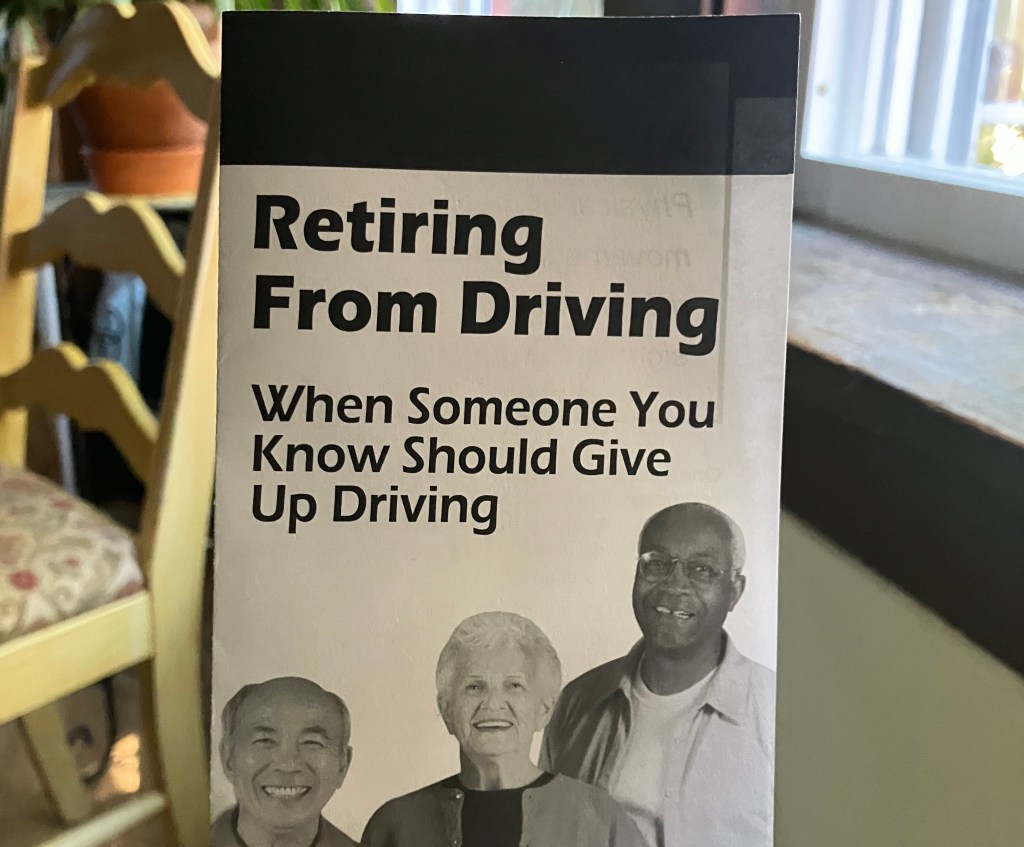
The contents were altogether extremely mundane, but also sort of terrifying. Let’s take a gander to see what we find.
The Emotional Foundation of Self: An Automobile
In this pamphlet, two sentences stand out to me:
“One’s sense of freedom, control, and competence is strongly tied to the ability to drive”
… and …
“The transition from driving can be emotionally difficult for the driver and for family members”
I find both of these to be in the “I guess this is probably true, but oh my god this is depressing” category of sentences. On the first point, it speaks to the fact that driving is not seen as a privilege, or as a serious undertaking, but is rather a cornerstone of identity. This makes some sense, since getting around freely is a core tenant of a free society, but it also implies that not being able (or willing) to drive somehow lessens your ability to be in control of your own life.
In my own life, I’ve found this to be not exactly accurate. The freedom to do whatever you want in theory is very different from the things you do in practice. While my car ownership means that I could theoretically live in a transit-desert, single family home neighborhood like Arnold Creek in SW Portland1, I know that making this choice would severely limit my ability to live the sort of life I do now – even if I still technically could. In general, I’m less concerned with if I have the freedom to do something than if my life is set up in a way to make it easy.
So while for many people, a car is tied to these basic fundamental aspects of being a person, this is ultimately downstream of them choosing to set their life up in that way. The fact that this choice goes essentially unchallenged is characteristic of a society where transportation by car is the de facto standard. This leads us to considering the second quote: the real emotional difficulties this introduces into people’s lives.
While aging does put serious constraints on people’s non-automotive mobility, making walking and riding transit more difficult, the impacts to drivers are acute and sudden. Once you lose your license due to age, you’re not likely to ever get it back. This sudden shock is an obvious social problem, and it’s no wonder that the Oregon DMV feels the need to produce a pamphlet and a series of webpages going over the topic. But it doesn’t have to be like this, and perhaps waiting until it’s just about too late to socialize people on using public transportation is a bad thing on all levels.
Regular, Frequent, Public Transit

The main reason why I felt compelled to write a bit about this is that the pamphlet from the DMV doesn’t even mention regular public transit service, instead opting to focus on arranging for frequent visits, delivery services, and senior center shuttles. Heading to the ODOT web page for driver fitness2 is more promising, with at least a list of transit providers, but there is hardly any information about functionally using public transportation. While most people are presumably familiar with the basics, there is a real learning curve. If you aren’t familiar with fare payment or with bus schedules, it’s challenging to start.
Of course, lacking a unified state-wide system of fare payment and scheduling makes a state agencies ability to comment on how to ride the bus limited, but the variation isn’t that big between regions, and the information provided by ODOT on their website is not generally reliable. As an example: the “plan a car-free trip”3 page’s description of “How to use the trip planner” has not been updated since the system was overhauled to use the “Get There” trip planning option over Google Maps.

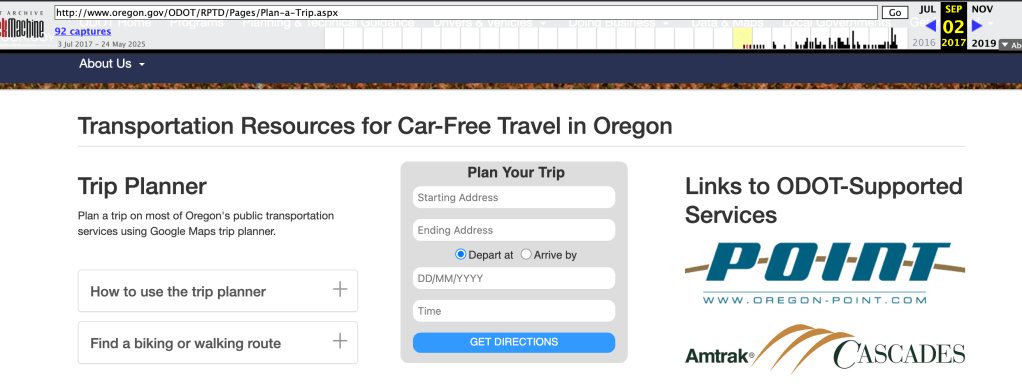
Perhaps the conclusion that “ODOT doesn’t really care about transit” isn’t a groundbreaking one, but the total afterthought on how someone transitioning to life without a car may actually interact with this service is unacceptable. ODOT maintains a library of all of the GTFS4 files in the state, yet can’t be bothered to distill that information into a trip-planning tool specific for Oregon. They could hire one person to do the lion’s share of that work5 – but of course, the priority is always cars, cars, and more cars. If we want folks to be able to age with dignity, then having genuine transportation options once they can no longer drive is critical6, and it’s clear that ODOT’s approach of “obvious afterthought” won’t do.
Are State DOTs Even Capable of this Work?
Just about every state department of transportation in the country has its roots in highway building. In Oregon, ODOT began its life as the State Highway Department, and only became the Department of Transportation in the late 1960s. For the most part, little changed between the late days of the Highway Department and the early days of the Transportation Department, with essentially all of the work done by the department being highway related. This continues to the modern day, where some 90% of funds are spent on highway related expenditures7.
Even if ODOT documents are filled with references to a “balanced transportation system” and pictures of trains and boats, the fact remains that 90%+ of all agency spending is dedicated to highways. If assume that our public investment in transportation projects has skewed very heavily towards highways8, we would expect that creating an actually balanced system would involve spending more money on things that aren’t highways. At a minimum, a 51/49 split would slowly start shifting the balance away from highways in the long term.
But this is obviously not what has happened. We simply say “balanced transportation system” as a shibboleth to indicate that we considered the impact to public transportation in the least genuine way possible. I’ve written about this in other posts9, but this leads to situations where ODOT boldly claims things like Yamhill Country Transit being a primary benefactor for the Newberg-Dundee bypass project, despite the fact that they run ~0 buses that will use it, and that more car capacity will weaken the economic reasoning for supporting public transportation10.
Outside of New York, where historical circumstances lead to the MTA in the City being controlled at the state level11, state-level transit support is universally lower than state-level highway support. In both the historical political context and the current funding context, we should not expect state transportation departments to engage with public transportation as a real thing that people might use for reasons other than “traffic relief”. For people “retiring from driving”, traffic relief is obviously not a substantial motivation for why they may want to ride the bus. Living without a car entails far more than just reducing peak hour auto congestion, and quality transit service needs to be around at all hours of the day if anyone is expected to ditch their car and still feel like they can have the freedom to navigate the place they live.
If we want to build a future where you can grow old without the fear of losing yourself once you can no longer drive, it will take far more than whatever ODOT has currently cooked up. Are things likely to change? I’ll let you be the judge of that, but I am not optimistic at the state level. ODOT is in a perennial funding crisis, and even with a D supermajority, the best funding package (which failed miserably) I saw seemingly kept the 90/10 driving/transit split intact. Lacking the political will to move the needle at the state level means that auto culture will remain ingrained to the point that family relationships are permanently damaged by older folks refusing to give up their sense of freedom and self in favor of staying on the road and endangering themselves and everyone else.
As demographic shifts move us into a future with a higher proportion of older folks, this crisis will deepen. Will we pivot to a future where we can all ride public transit with dignity, or will we further our class divides – leaving transit to rot for the poor while the rich take Ubers piloted by a permanent underclass? This may seem hyperbolic, but by refusing to invest in public transportation for everyone, our public agencies create a future where anemic public transportation is only used by the desperate, and those who have the means to avoid it will. We all get old at some point, and we owe it to our future selves to make decisions now that benefit us all down the line. I can’t think of a better investment for the financial and social health of older folks than good public transportation, and it’s a shame that the best ODOT can do is a half-baked web page with out of date and generally difficult to use information.
Thanks for reading, ’til next time!
- It’s not like I could afford a place here anyways, but you get the idea ↩︎
- Which you can find here ↩︎
- Available here ↩︎
- General Transit Specification Feed: the data standard for transit service providers to communicate their schedules in a uniform way to mapping services (and nerds) ↩︎
- I recently accepted a job elsewhere, so won’t be available but I know many talented and passionate people who could do this! ↩︎
- There’s a good reason why the AARP is a consistent voice for more walkable communities! ↩︎
- See the 2023-25 budget, page 4. Note that “just” 65% of the budget is in the “Delivery and Operations” category (formerly the “Highway Division” category), but just 8% goes into public transportation (inclusive of rail). Most of the administration related tasks and debt service can and should be allocated to highway spending. ↩︎
- Given that the inflation adjusted cost of the entire MAX system is lower than the estimated cost of just the IBR project, and is about the likely cost of the I5 Rose Quarter + 205 widening project, this is absolutely fair. ↩︎
- Like this one here! ↩︎
- This “transit as congestion relief” strategy is quixotic, and not very good, but it’s quite common in Oregon. Even if you think it’s accurate or good, it’s hard to see how a highway expansion project would benefit a transit agency – since it would give people fewer reasons to ride the bus by having more car capacity. Of course, if there is congestion relief in practice from the expansion, a bus may experience fewer delays, but I’ve seen the way ODOT designs bus cut-outs on state highways and am not very convinced. ↩︎
- With the circumstances being “Nelson Rockafeller boxing Robert Moses out of control of his little empire” ↩︎
 City Hikes
Leave a comment