
One of my pet theories is that driving everywhere and using a GPS to navigate prevents you from properly conceptualizing space. I’m not entirely sure if this is backed up by any kind of peer reviewed study, but it’s been on my mind since moving to Seattle. Part of the reason why is that I spent a long weekend here in 2022 with my friends, and we went to an assortment of places (below).
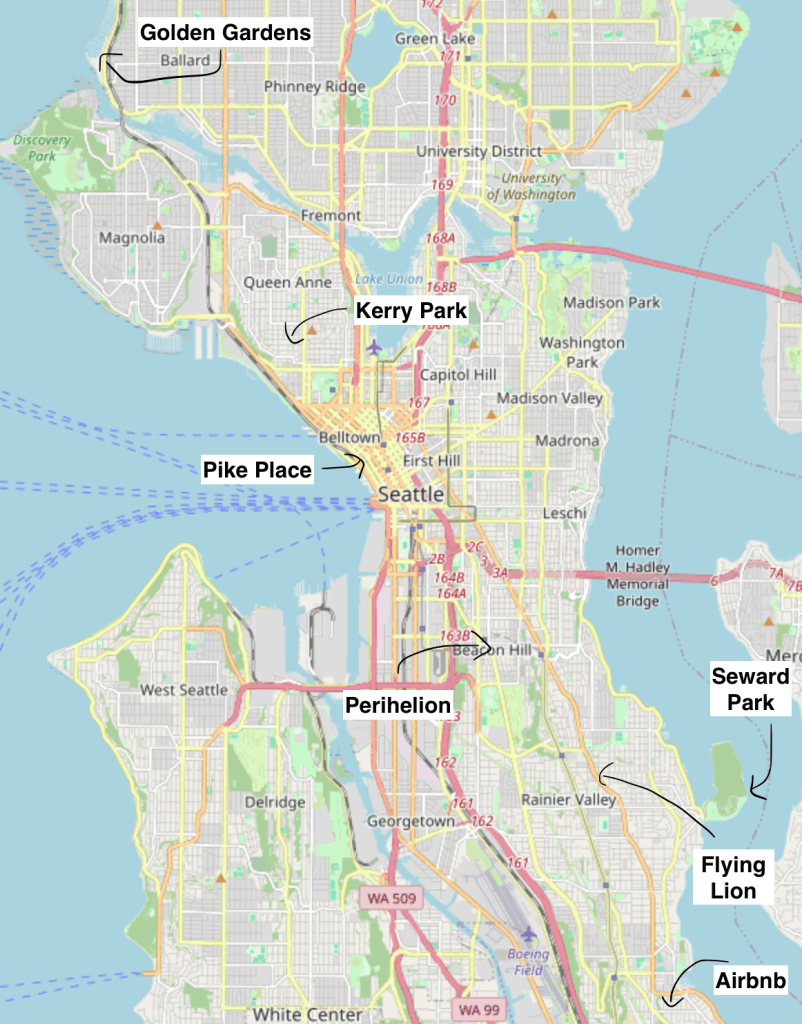
Of course this was before my public transit riding days, so despite staying near the terminus of Metro Route 7 and within a short walk of the Link, we drove everywhere. I recall doing at least some of the driving (I distinctly recall being first in line for the Ballard Bridge opening en route to Golden Gardens), but the location of all the places we went remained unimportant to me.
This is a dynamic that I’ve always found interesting, and its one that I’ve thought (and still think) is endemic to using a car. Maybe it’s just because I’m a bus guy and thus find them memorable, but there’s something about driving places that makes me fail to appreciate the distance and the places in between. In grad school, I recall a reading study where kids drew their neighborhoods from memory. Those who were primarily driven places had little to no ability to draw a coherent map of the spaces they went to. Those who primarily walked drew detailed and roughly accurate maps of the areas surrounding their homes.
My prior trip to Seattle left some impression on me – though future trips would inevitably leave larger ones – but reflecting on it now is deeply strange. I mean we went to Perihelion – just 5 minutes down Beacon the 36 from our current apartment. I probably saw the 36 go by and didn’t think anything about it at all! Can you imagine?
Beyond “Car Bad”
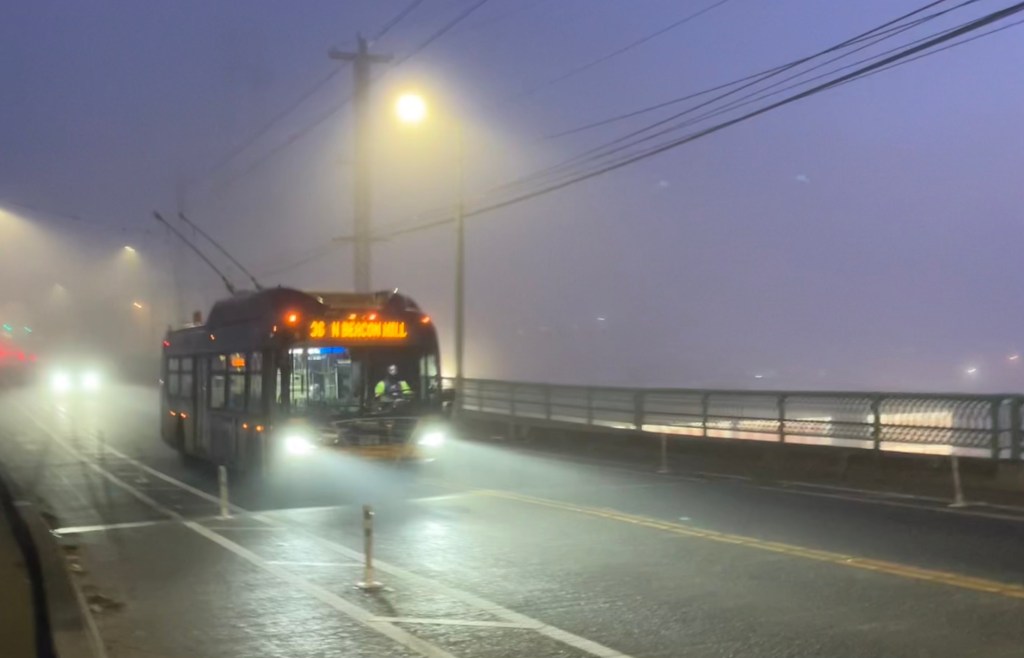
Lately, I’ve been expanding my iconoclast critiques of society from “cars bad” to “phones bad”. Not exactly original stuff, but it has lead me to stop using location services when mapping1. This is a mild annoyance, since I have to scroll around my mapping apps to self-locate instead of pushing a button, but it comes with some upsides.
For one, I have to keep track of where I am. The other day, Olivia and I visited some friends of hers down in Pacific. We took the train down to Auburn and Kobe picked us up. I paid close enough attention to know roughly where we were. Not for any specific reason – we were going to get a ride to the train to get home anyways – but just because I like to know that kind of thing. And I’ve always had an interest in this, so not having my phone tell me exactly where I am at all times helps me cultivate it. It’s more fun to locate yourself via street signs and land marks than it is to stare at your phone.
But it’s also helping me remember that I don’t need to be in control all the time. I’ve never really considered myself a control freak, but I do have a tendency to worry about making transfers on the bus2. I wouldn’t say that this has been some perfect revelation in allowing me to let go of that needless stressor, but I would say that the extremely mild amount of work required to look up a route home on the bus without your location on makes me a little less inclined to continually check and recheck if we’ll make a transfer.
Most of our bus riding is just getting around places that we are capable of walking if need be, and the buses come often enough that a missed transfer is sort of just a very mild inconvenience. Creating a tiny amount of friction between myself and checking a transfer makes me a bit less likely to, and that is good for my sanity (and more importantly for Olivia’s).
It’s Also “Tech Company Bad”

Maybe you don’t read the same news I do, but it seems like every day I read a new story about how Google, Apple, and the like are using their bottomless profit machines to influence our deeply shitty federal government into AI slop subsidies3. And beyond this obvious grift, there’s the other grift that the data you allow your smartphone to use is being used to sell you things you probably don’t really need. Or the impending crises of price fixing that essentially all tech companies are attempting to roll out4,5.
In this context, I simply do not want to rely on any tech firm to provide me with any services. As someone who is deeply interested in the ways that people get around and conceptualize space, having a device in your pocket that always tells you exactly where you are on a map coupled with an app that proletarianizes a taxi driver to take you anywhere at the push of a button seems like a net loss. Others have written about the effect of Uber had on reducing public transit ridership in cities across the world6, but I think the more pernicious aspect of this process has been the way in which it has prevented people from being able7 to choose a different path.
While phones have not yet progressed to handling all steps of navigation (you still have to decide where you’re going after all), I feel that the more control you have over each choice, the more connected you are to the place you inhabit. Outsourcing this process to a tech company may be easy, but I think it’s inherently unsatisfying.
After all, it’s your life. No amount of offloading the mental burden of figuring out where to eat, or how to get places, or what books to read will make any of those choices better. Trusting a tech company to do that all for you just means that someone else makes all the interesting decision about your life. Sure, some level of simplification may be warranted, and it’s nice to look around at menus of restaurants before you make a choice, but is that really any better than it was before?
The Joy of Finding Your Own Way

I’m of the opinion that there’s nothing more satisfying than figuring something out for yourself. I still use my phone to get look up the bus schedule to get places, I just have to know where I am before I can do that. Most of the time, this is a pretty easy thing to know, but sometimes it means I can meander freely through Seward Park with Olivia and not be worried about if the trail we’re taking was the one we had planned on.
Getting lost is a difficult thing to go through, and GPS is an obvious way to prevent that from happening. But if you’re never lost, you can never find any pleasure in discovering where you are. With a pre-planned route and a device telling you exactly what steps to take, life becomes an exercise in determinism. There are times when I want that but for the day-to-day, where so much is already steeped in the routine, does it still make sense?
It doesn’t for me. Besides, there’s no better way of understanding a place than being forced to figure out where to go on the fly. Back when I was new to Portland, I would ride my bike around with the express purpose of trying to navigate on the fly without using my phone. It helped me conceptualize space, and it gave me a deeper understanding of Portland as a city, and of the tortured history of Portland’s bike infrastructure planning apparatuses.
I’m still feeling new to Seattle, and I’m relishing the feeling of new neighborhoods to explore by bus. Doing it without the help of a tech company that is seemingly bent on destroying the planet in the name of the 2026 Q1 earnings report makes it all the sweeter.
Thanks for reading, ’til next time.
Footnotes
- Incidentally, this is a return to normal for me in a way. At least until I was done with college, I found the idea of my phone tracking my location to be inherently creepy. I am not 100% sure when I drifted away from this, but I think learning to drive and needing to navigate via GPS occasionally played a role. Moving to unfamiliar cities certainly did as well. ↩︎
- This extends further than just bus related worries. In the past year or two, I’ve often found myself needlessly checking people’s locations when I’m meeting up with them. And for what? It’s more fun to see someone when you don’t know exactly where they are anyways! ↩︎
- Here’s a great piece on the topic that’s worth your time. ↩︎
- Here’s a particularly galling attempt from Google ↩︎
- Oh and here’s another galling example from Instacart. I’ll leave it at that, but this kind of algorithmic price fixing is at the heart of the ideology of most tech companies – with Uber being the trailblazer in this department. ↩︎
- Here’s a study about California ↩︎
- “Being able” is probably a bit of a misnomer. But “people having the confidence and ability to imagine a new path for themselves” was a bit wordy. And I think you knew what I meant. ↩︎
 City Hikes
Leave a comment