Since moving to Washington, I’ve been noticing a lot of chatter around transit-oriented development (TOD). For the blissfully unaware, TOD is a fairly broad concept which is in a way self-explanatory – it’s development that’s oriented around public transportation. Of course, this tautological definition isn’t very useful, but the broad goals of TOD from a planning perspective are usually to encourage development within existing urbanized areas that have access to high-quality public transit service. Note the phrase “high-quality” here – since this is an essentially arbitrary term, it is one that needs careful consideration.
In the Seattle region, the TOD (and transit planning framework writ large) flows down from the regional planning body, PSRC (Puget Sound Regional Council). And for TOD, there is also new consideration for planning standards in relation to House Bill 1491, which manadated higher density standards in TOD station areas. PSRC also wraps station areas for TOD in with their discussion of high capacity transit, a thorny subject which I have critiqued at length before in Portland1.
PSRC defines high capacity transit station areas as “areas within 1/2 mile of existing or planned light rail and streetcar stations, commuter rail stations, ferry terminals, and within ¼ mile of all bus rapid transit stations.” This differs slightly from the definition used by the state – which excludes ferry terminals and defines the distances in terms of walking distance from station entrances – but they are close enough in spirit that I’ll use them interchangeably2.
The first thing to note here is that the PSRC and state definitions both have a preference for rail-based modes (streetcar, commuter rail, and light rail) over bus rapid transit (BRT). And both exclude non-BRT buses entirely. I think this is a problem, so let’s take a visit to my local bus stop to show why.
What Does “High Capacity” Actually Mean?
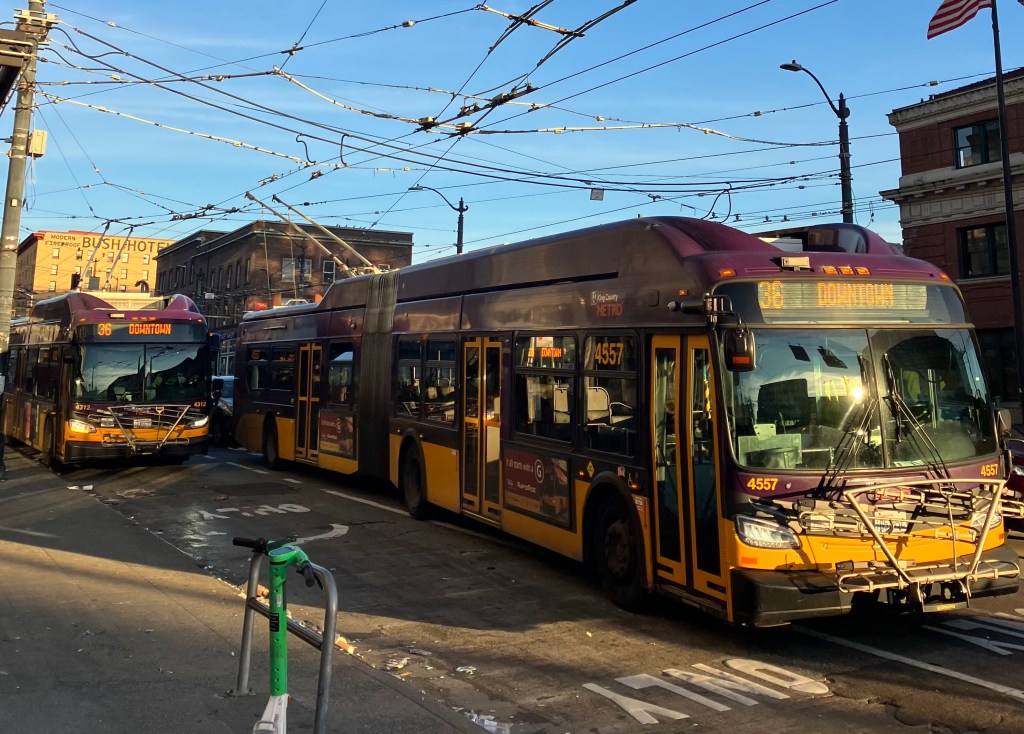
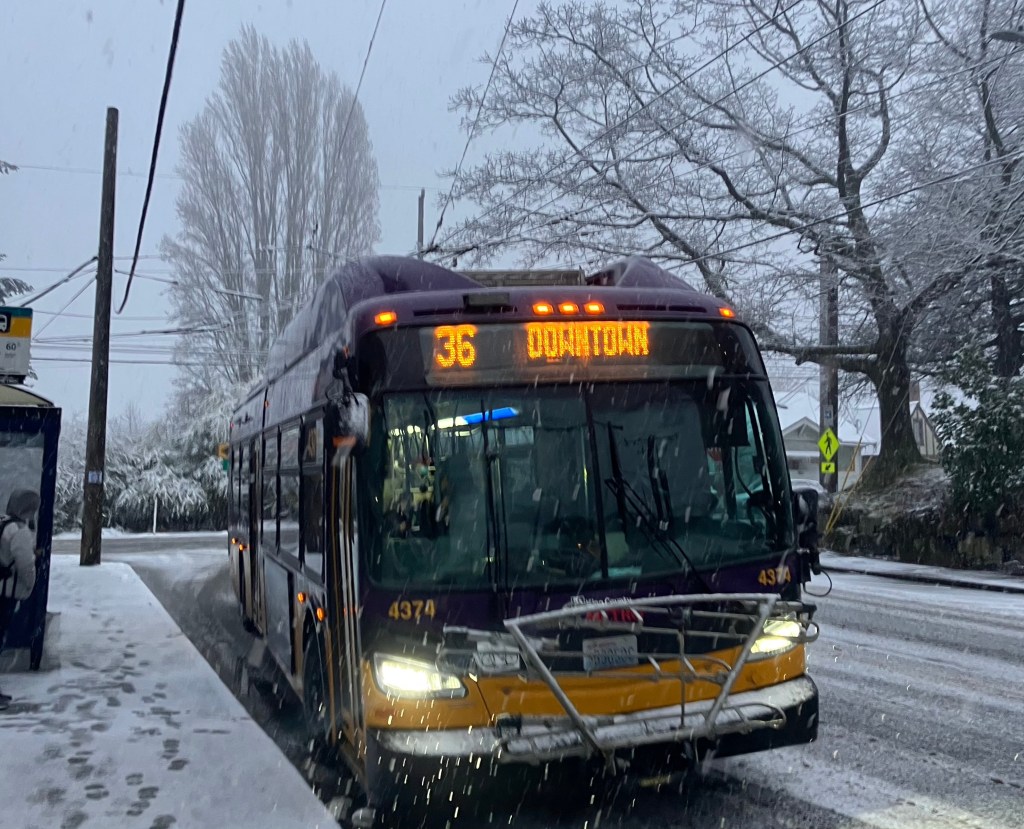
My local bus stop gets 11 buses per direction per hour for most of the day, with five heading to Capitol Hill and six headed downtown. About one of these is usually a 60 foot bus, while the rest are 40 foot buses3. Total maximum capacity on a 60 foot bus in Seattle is about 120 passengers, compared to about 80 on a 40 foot bus. All told, this means that there’s 920 transit seats per hour in each direction from right outside my door.
Down at 12th and Jackson, the First Hill Streetcar connects Capitol Hill and Pioneer Square – two locations the 60 and 36 serve respectively. Modern streetcars have a capacity of around 150 passengers, and the First Hill line comes five times an hour. All told, this means there’s 750 transit seats per hour in each direction on the busier of the two Seattle Streetcar lines4.
Both of the bus routes run in largely mixed traffic, as does the streetcar. Neither the 36 (average speed: 9.4 mph) nor the 60 (average speed: 8.4 mph) are known for their blazing speeds, but then again neither is the First Hill streetcar (average speed: 6 mph). So despite having faster options, and despite being served with more transit service per hour than a high capacity alternative, the area around my apartment is not generally considered a TOD area.
You may say this is cherry-picked nonsense, and in a way it is. Eventually, the 36 is slated for Rapid Ride treatment and will become BRT at least in name. But this is essentially planning sleight of hand. Of all the Rapid Ride lines, only one (the G – we love the G) even resembles traditional BRT with center-running bus lanes and a primarily exclusive right of way. This doesn’t mean the other lines aren’t good buses, but it begs a question: why should we require a station area for TOD to have a nominal facelift into something we all know isn’t really BRT to qualify?
The 7 is a particularly illuminating example. It’s one of the busiest buses in the system, and it has received significant investments in bus lanes and other improvements as a result. It’s slated for Rapid Ride treatment around 2030. But considering that the 7 already has the second most buses scheduled of any route in the King County Metro system, it has extensive bus lanes (though of course I want it to have more), and it’s like the second busiest bus in the system. So the Rapid Ride program would consist of stop consolidation and new shelters, along with a slight reroute. Those are great, and more bus lanes are great, but does it really constitute a qualitative shift that should trigger Rainier being “ready” for TOD since it “now has” high capacity transit?
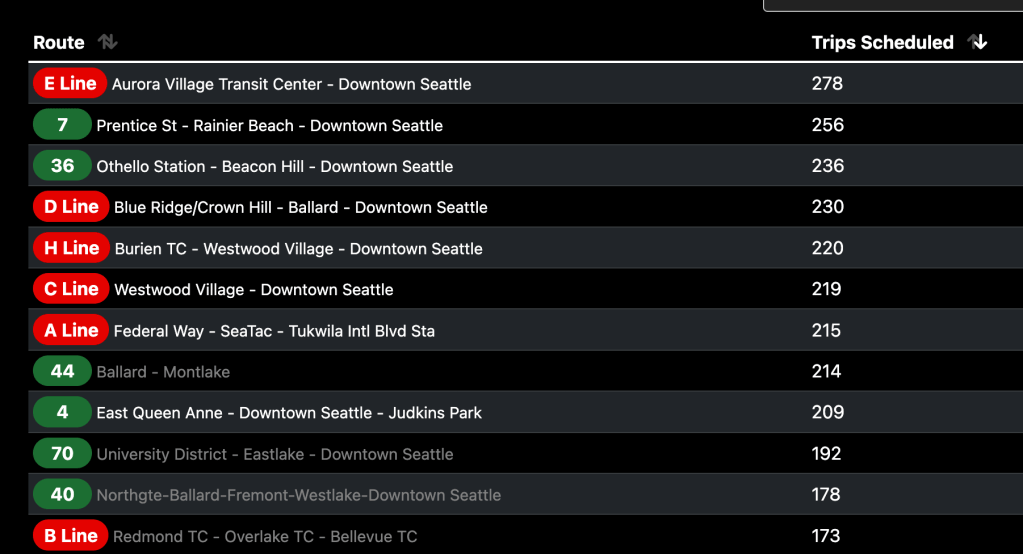
I obviously think that’s a bit silly. The 7 already has better service than all but one Rapid Ride line! Why wait?
Why Not the Local Bus?
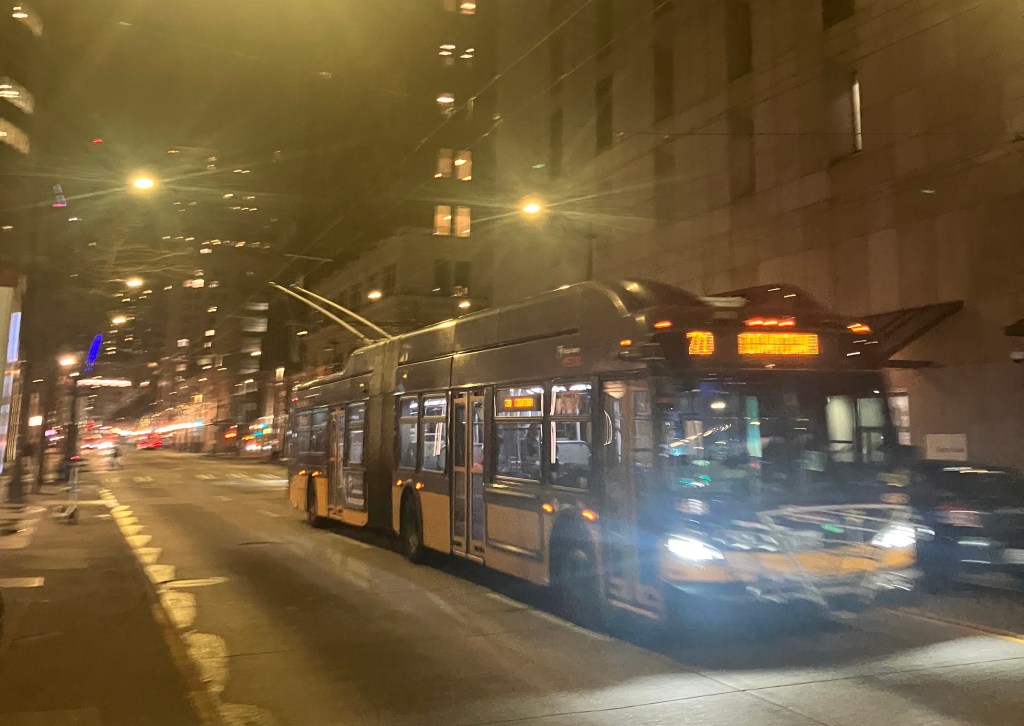
In general, I favor including local buses in conversations around TOD and high capacity transit. In failing to do so, our workhorse local routes (like the 7, 36, and 44) end up in a strange liminal space. They provide essentially the same – or better – service than routes like the Rapid Ride C or D. But since they were lower priorities for Rapid Ride funding ten years ago, there’s no pressure for better transit station policy.
To me, this is entirely silly. A good local bus is pretty high capacity, and in the vast majority of circumstances capacity is not the limiting factor in public transit use. It’s speed and frequency. But of course, since the entire American transit planning apparatus has been built around the commute trip, higher capacity modes are given preference because they are seen as being able to alleviate car traffic congestion.
And even though most transit agencies worth their salt are moved slightly away from this framing as Covid era work from home changes forced them to, the progress is too slow. Whats more, the limiting factor is often not even at the transit agency level. I’ve touched on this briefly before, but there are also cultural barriers to using public transit – especially for White Americans – that are more difficult to unravel than just “run more service, faster”.
In some sense, the entire history of light rail planning in the US can be summarized along these lines: White Americans don’t want to ride buses for a variety of reasons (at least one being essentially racist), so we have to spend an arm and a leg building light rail lines that often only marginally improve the actual transit experience5. But they aren’t buses, so it’s okay to ride them. Streetcars are especially guilty of this line of thought, since they are very rarely better in any meaningful sense than an equivalent bus service.
This isn’t to say that rail boosters engage in tacit racism by boosting rail. But it is to say that people who live in West Seattle who are waiting with bated breath for the West Seattle Link to open so they can start riding transit are part of a broader societal trend which minimizes bus service – even when its very good – for less than savory reasons. In the case of West Seattle, travel times on the future Link line are not really going to be a whole lot better than the existing Rapid Ride lines (the C and H). Maybe you think the buses are rattly and uncomfortable (they can be), but surely that problem is cheaper to solve than a $5B capital project6.
We Need to Do More Than Work
Of course, Seattle has a ton of places where trains probably do make sense. It’s a major city that takes forever to get through. West Seattle may even be one of those places. I’m not against the Link expansions – I just would like us to take some time to improve the social foundations of bus ridership first.
TOD policy could play a meaningful role in this. A quarter-mile station area from all transit stops that get at least 65 trips per direction per day7 (or some other signifier of frequent transit) would be more defensible on “transit which provides a reasonable alternative to other modes of transportation at most times of the day” grounds. I think this is a much more important metric than “transit which can get you to work if you have a peak-time job in downtown Seattle”. To show you what I mean, let’s look at the most egregious example.
Both the PSRC and state definitions of TOD station areas include commuter rail, and while the Sounder S Line is arguably good enough for inclusion, the N Line clearly is not. With just two trips per direction per day and measly two to three car consists, it provides like 1,650 transit seats per direction per day8. That’s the equivalent of a local bus that runs hourly. Hardly high capacity, though it may be fast (and beautiful).
For someone to live in Edmonds – the more transit friendly of the two intermediate stops on the Sounder N Line and rely primarily on transit, they’ll probably end up riding the hodge-podge of local, half-hourly, Community Transit buses much more often than the twice a day Sounder. And this is especially true at the household level. There are other parts of Snohomish County which would be much more convenient to live in for good transit access. And basically all of Seattle that isn’t within a TOD area is likely to have more usable transit service (let alone the areas which are).
Maybe it would be difficult to write policy that fully encapsulates these dynamics. But I think it’s ridiculous that Edmonds and Mukilteo are considered ripe for TOD, while Lake City, Queen Anne, Central District, and Fremont are not. I guarantee that all of those Seattle neighborhoods have more transit commuters on local buses than Edmonds and Mukilteo do on the Sounder9.
Pulling it All Together

What strikes me about all this is that Seattle is a city (and region) which has a rich history of good local bus service, but our regional planners and state politicians are more interested in everything other than this when it comes to planning for the future. To be sure, some of this may boil down to political considerations: Queen Anne has a lot of loyal bus commuters and riders, but it’s also fairly rich and specifically lobbied against having a light rail station on the future Ballard line.
But I don’t find this very satisfying in practice. I think it’s more likely that Seattle is a fast-growing city in a fast-growing region, and that lends itself to a lack of continuity. And there’s a sense in which Seattle was very “behind the times” when it came to rapid transit construction and planning. Portland built 50 miles of light rail before Seattle built one. Vancouver’s space-age world’s fair transit system took off to become a massive success, while Seattle’s has languished as a (beloved) attraction with two stops.
Insofar as these two things defined Seattle’s transportation zeitgeist in the 2000s and 2010s I can only really speculate. But I think the constant agitation and pressure for more and better transit – largely defined as a means to get to work – left planners and politicians with an inability to consider what else people who don’t have cars use transit for. This history is reflected in what routes have been prioritized for BRT or light rail too. Every qualifying route in Seattle serves downtown, while the two circumferential Rapid Rides approved in a 2015 ballot measure (for the 44 and 48) have been delayed indefinitely10.
Maybe the recent bus cuts in Rhode Island can help illustrate the issue. Low ridership lines were targeted for cuts, though something like 75% of buses saw a service reduction in one way or another, all to fill a $4M budget hole. The result is catastrophic for everyone who lives outside of central Providence and doesn’t drive. Because low ridership lines are often routes which serve ancillary job centers. They provide access to non-work trips, and to part-time or lower paying job areas (like shopping malls and the like).
Sure, they are low ridership. But without them, people are forced to quit jobs. They are forced to not socialize. They are literally unable to fully participate in society. Every type of trip that people make in a day – work, shopping, eating, and socializing – needs to be easily achievable on transit for people to choose to live without a car. These aren’t always strictly quantifiable terms for policy makers (especially socializing), but they get closer to the actual need for living a transit-oriented life.
I don’t think it’s too much to ask our policies and laws to reflect the actual, rather than the imagined, needs of the people. If it were up to me, I’d define a transit-oriented community as one which a resident can access some number of jobs within an hour on transit, some access number of grocery stores (defined liberally) and shopping destinations within a half hour, and is within so many other people within twenty minutes. Maybe even something about being within a reasonable distance of a park you can take what is socially conceived of as a hike. On any mode.
Because it’s not about if someone uses a train, a bus, or even a minibus. In order to live a dignified life on public transit, you need to be able to do just as many things as everyone else. A work trip isn’t enough.
Thanks for reading, ’til next time.
Footnotes
- Which you can read all about here ↩︎
- PSRC using “as the crow flies distance” could just be for illustrative purposes. They’re a regional planning body, so the specifics of implementation at that level are often not their highest priority. Walking is obviously the more relevant measure, and I would hope that any recommendations around TOD are in relation to this, but I haven’t read any specific guidance from PSRC on this front (because I haven’t looked very hard for it) ↩︎
- You may be asking why the 36 gets one articulated bus per hour. I don’t have an answer for you, but it’s a consistent trend. Maybe there’s some peak hour capacity crunches this is trying to alleviate. I don’t really ride the bus at like 8:30 when I think demand is highest (and when that articulated bus comes), so this is all speculation. ↩︎
- The eagle eyed reader may note that 12th and Jackson is also served by the 7, 14, 36, and 60. I know this, 12th and Jackson is just the closest stop to me so I wanted to use it. And TOD policy is still in relation to this streetcar stop on Jackson, instead of the 20 (!) buses per hour between 12th and 4th. ↩︎
- This is a bit harsh in general to light rail, but I think of all the light rail and modern streetcars built in the US since the 1970s, more are failures than successes. For every San Diego, there’s a Norfolk. For every Portland, there’s a San Jose. For every Houston, there’s a Dallas. ↩︎
- Give us this day our comfy seats, and deliver us from rattling windows. I’ve ridden local buses on cobblestones in Switzerland that had comfier rides than Metro buses on newly rebuilt pavement. ↩︎
- This is an arbitrary cut-off, but it includes Metro buses like the 150 and 271 that run every 15 during the day and every 30 in the evening, while excluding buses like the 11 that run every 20 during the day and into the evening. ↩︎
- Okay, technically there’s a ticket sharing agreement with Amtrak between Everett and Seattle for the N Line, which allows riders to catch a Cascades train. But this has some accounting issues, since it doesn’t stop at Mukilteo and ↩︎
- Stats for the nerds: Edmonds has between 40 and 160 commuters who use a rail-based mode. All of those neighborhoods have multiple bus lines that go to major job centers (UW, Downtown, etc.). Not much of a competition really. ↩︎
- Of course, the specific geographical constraints of Seattle make this somewhat natural. But non-downtown routes are often just as busy (sometimes busier) than downtown ones, at least in part because they are great transfer corridors. The 8 is the obvious example (even if it does serve greater downtown). Every trip from NW Seattle to Capitol Hill will use the 8 (or 44) rather than going all the way downtown. ↩︎
 City Hikes
Leave a comment