
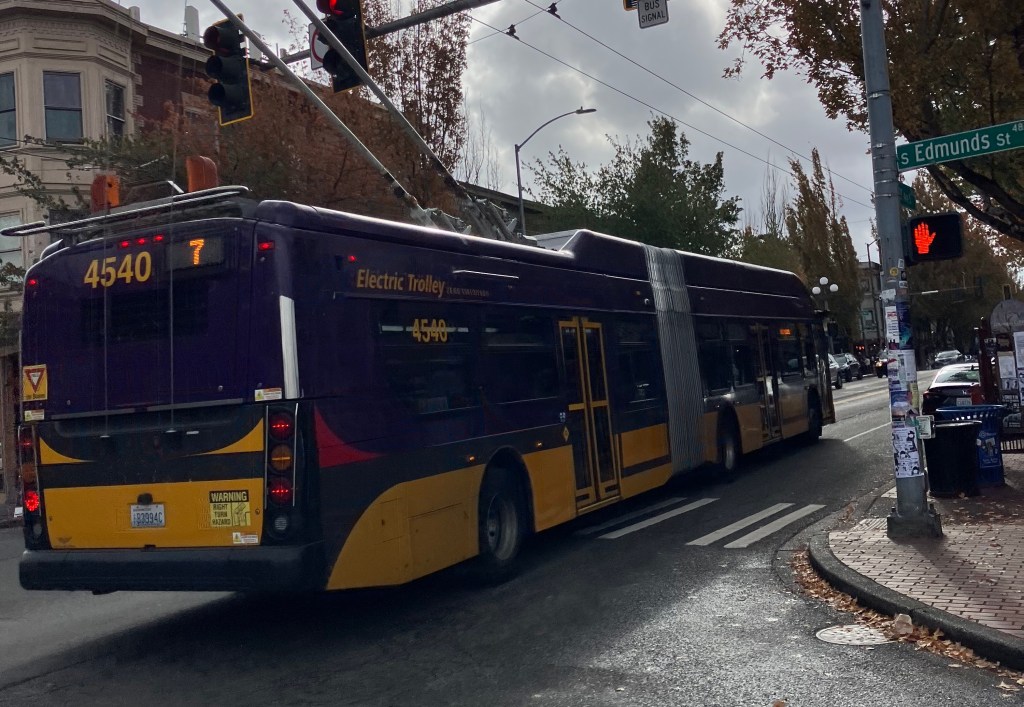
A few months back, I read an interesting piece in the South Seattle Emerald about community pushback to meter rate increases in and around downtown Columbia City. It piqued my interest, but I didn’t get around to writing anything about it for a variety of reasons. Part of my interest is that the general methodology for street parking meter rates in the City of Seattle is right out of a book that I have decidedly mixed feelings about, but which is likely the most important book about parking ever written, Donald Shoup’s The High Cost of Free Parking.
The standard policy is to raise or lower parking meter rates in response to demand1. If an area has high parking demand – as Columbia City consistently does – then rates are supposed to be raised until the observed curb vacancy rate is around 80%. This way, someone driving to the area is likely to find a spot, which reduces the likelihood of folks continually circling the block to find parking.
It’s in this context where Columbia City was facing down a $6.50 per hour charge in the Afternoon, and a $6.00 per hour charge in the evenings. With parking occupancy rates well over 100% during the summer months2, Columbia City is a place where even $12 for two hours of parking isn’t enough to dissuade drivers.
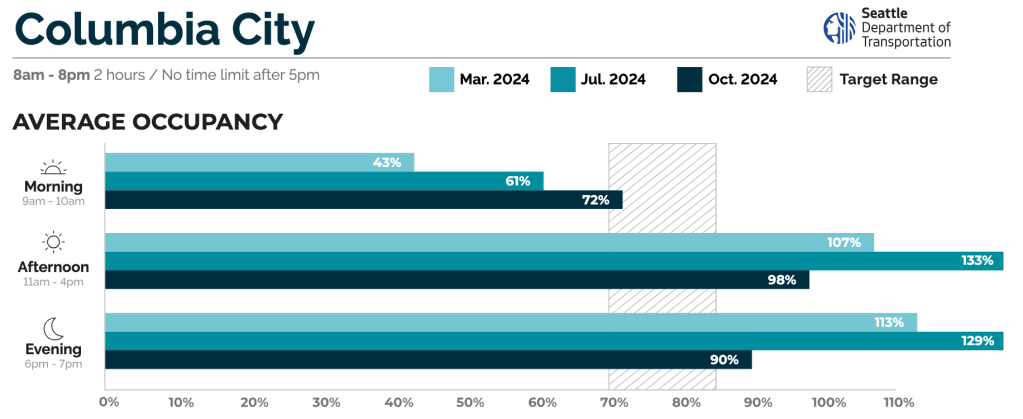
In the article in the Emerald, residents and business owners raise concerns about the cost to park in Columbia City relative to other places. Rates are higher here than they are in most of the downtown core, and this makes a certain amount of sense. The broad expectation is that downtown = expensive.
And this is the first drawback to doing strictly demand-based parking policy – it’s too wonky. Since it depends on both supply of parking and demand for parking, it can defy expectations. There are a lot of parking garages downtown. There are a lot of paid parking lots. I don’t have an exact number, but I wouldn’t be surprised if there was 100x the parking capacity in downtown Seattle than there is in Columbia City3.
Facing fairly broad community pushback, SDOT has acquiesced and is implementing a $2.00 to $2.50 decrease in parking rates in Columbia City, which will lower the afternoon and evening rates to $4 per hour. I find this to be indefensible, but not because it doesn’t follow Shoupian dogma about the charging the fair market price for parking. Rather, with parking rates of $4 per hour, driving becomes price competitive with public transportation (in terms of parking cost versus fares) for most times of day4.
Parking fees are only enforced from 8AM to 8PM, Monday to Saturday. For a two-person trip to Columbia City during these times, a two-hour stay will cost them $8 in parking. Bus fare will be $12 since they will be out of the two-hour transfer window that began when they first got on the bus. Of course, exactly how competitive or not competitive the bus is compared to driving depends on the day of the week and the time of day.
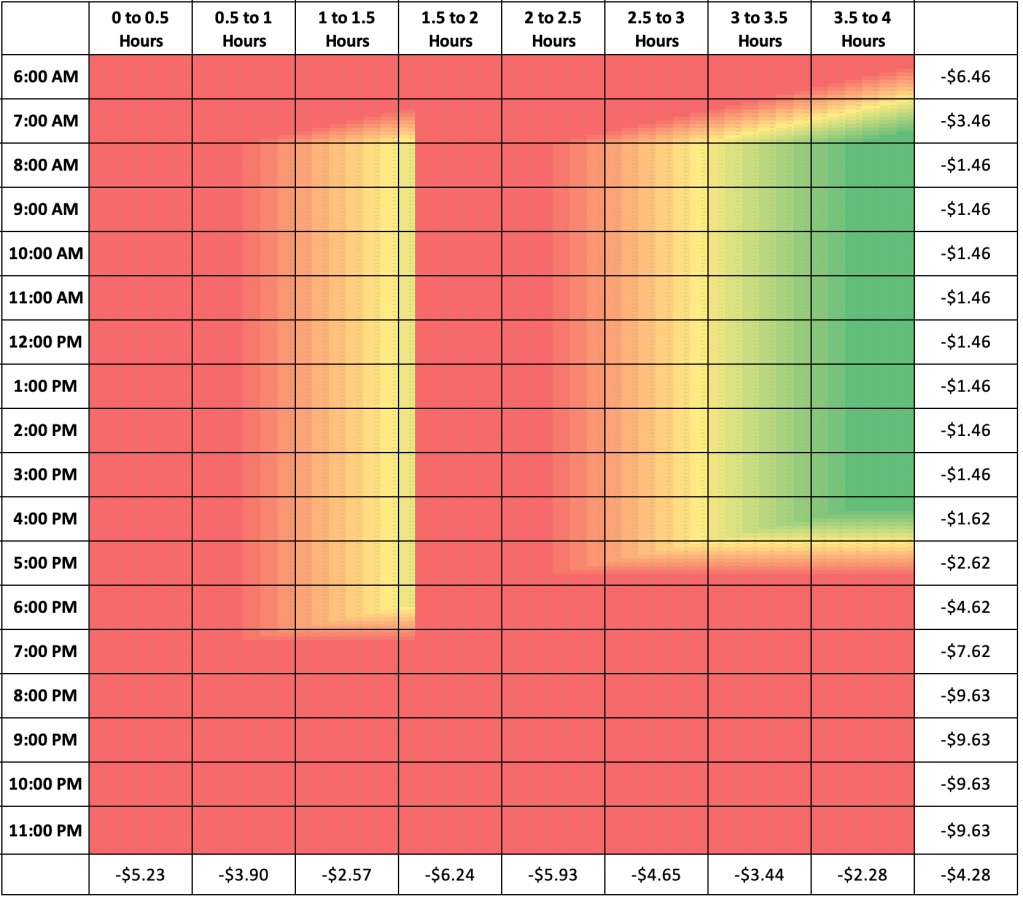
We can see this dynamic in the chart above, which represents the difference in transit trip cost and parking costs to an area with $4/hour parking. The cells in red and orange are more expensive trips on transit compared to driving trips, while the cells in green are less expensive on transit. It’s not until you get to trips over three hours that transit becomes less expensive, and there are no average trip times or trip distances where transit is less expensive. The average trip is $4.28 more on transit than it is by driving. Compare this to the chart below, when the parking rate is $6.50.
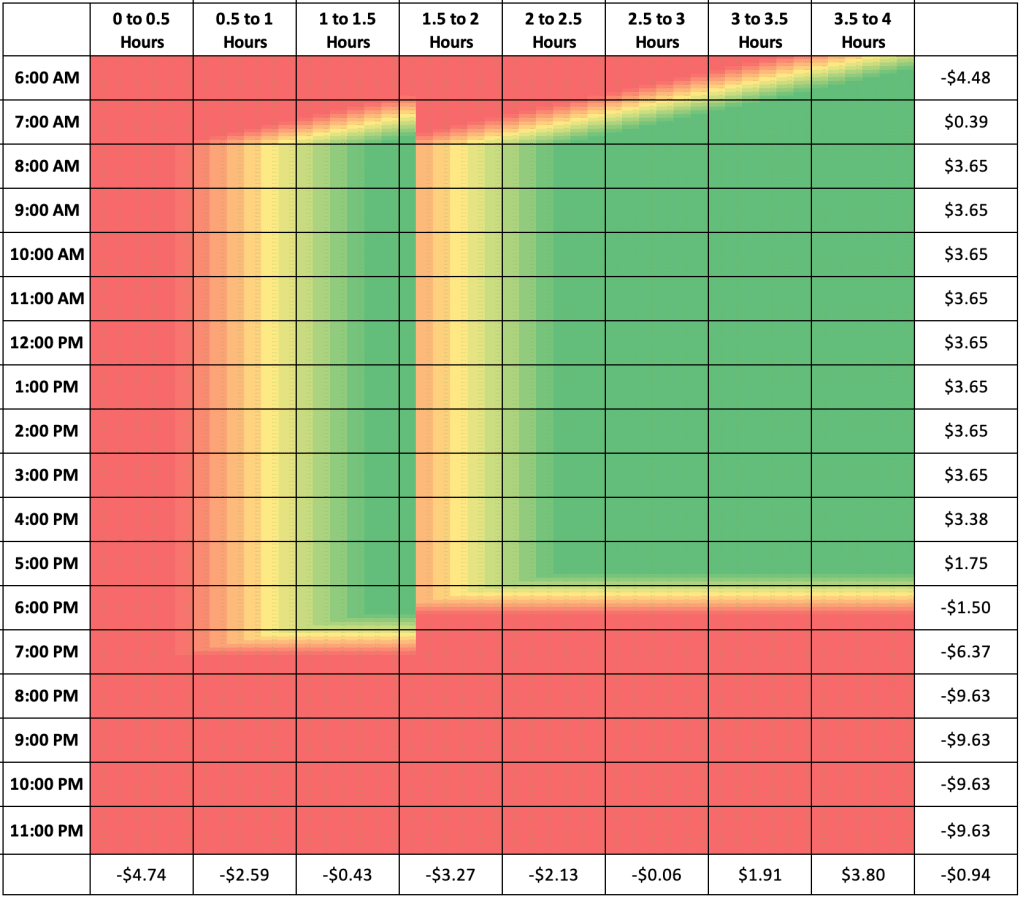
With a $6.50 hourly rate for parking, the average trip has costs just 94¢ more in fares than parking. And there are significantly more times and trip lengths where transit is cheaper. This is good, though it’s still an issue that longer trips around peak hours in Columbia City (dinner time) are more expensive by bus. And crucially, this doesn’t include Sunday at all – where parking is always free and transit is always at least $3.
There are a variety of reasons this is a problem. The obvious one is that transit riders are generally less wealthy than drivers, so charging transit riders more than drivers is on its face unfair. But it also flies in the face of basically all of the City of Seattle’s goals, and it’s hard to see why anyone who has a car would choose to spend more money on fares than they would on parking. And it’s not like Columbia City is a transit desert – it’s served by two great buses (the 7 and 106), a great light rail line, and also by the #50 (which we love, but it’s not exactly frequent). There are real people who will be financially punished for taking transit to Columbia City once the city drops parking rates to $4 an hour.
Framing things in this way – tying how much parking should cost to how much public transportation costs – is better policy for our future than economic efficiency. While Shoupian parking policies may result in economically efficient outcomes, they will always be politically contentious as a result of their lack of moral clarity. As things are set up now, every future parking rate increase in our beloved neighborhood business districts is likely to attract a reactionary “why is our parking rate higher than downtown?”
When the question is asked, economic efficiency isn’t a defensible thing to fall back on. Ensuring parking costs and transit fares are equitably distributed is.
Thanks for reading, ’til next time.
Footnotes
- SDOT will raise (or lower) meter rates in each subarea, for each distinct time period (morning, afternoon, evening) by 50¢, up to three times per year. ↩︎
- An occupancy over 100% implies illegal parking (most likely to be in the form of blocked crosswalks or bus stops) ↩︎
- Downtown is big, and people are likely to be willing to walk further from a downtown parking spot than one in Columbia City. Per area, it’s probably less but that isn’t necessarily the relevant metric here. ↩︎
- Yes, there are other costs associated with driving. But deprecation on a short trip to Columbia City is a rounding error, and gas is relatively minor too – a 5 mile round trip is between 40¢ and 75¢. ↩︎
 City Hikes
Leave a comment