
I recently was up in Seattle, which was mostly to see a Mariner’s game and meet up with an old friend of mine from Wisconsin (well he’s from Michigan, but you get the idea). He was there for a work trip, and part of that involved box seats at said Mariner’s game (I sprung for the $11 nosebleed option). This is all fairly routine stuff, and I hadn’t planned on doing any sort of long-winded commentary about it, but when Noah sent me his itinerary something caught my eye.

Yes, I’m here to write about a charter bus to the Mariner’s game – but it’s not just that. There’s the tweet about the American guy who ordered an Uber in Japan to get to a place served by a fast and direct train from where he was coming from. It’s about how it feels to see everyone waiting around for a cab after getting off the train. Why is everyone always waiting around for a cab instead of getting on public transportation?
When I talked to my sister about it, she said something completely reasonable about how it’s probably easier to coordinate having everyone meet in the hotel lobby. I’ve never had to coordinate a charter bus, and I’m not familiar with the intricacies of being in a sort of corporate meet up so I can’t really deny this. But I would imagine that it’s easier socially. While my advice would have been to walk, but I suppose not everyone in the group is familiar with walking that far. Maybe the 25 odd minute walk to the ballpark is a tough sell, but I mean given that they budgeted 45 minutes for this escapade… why not just walk?
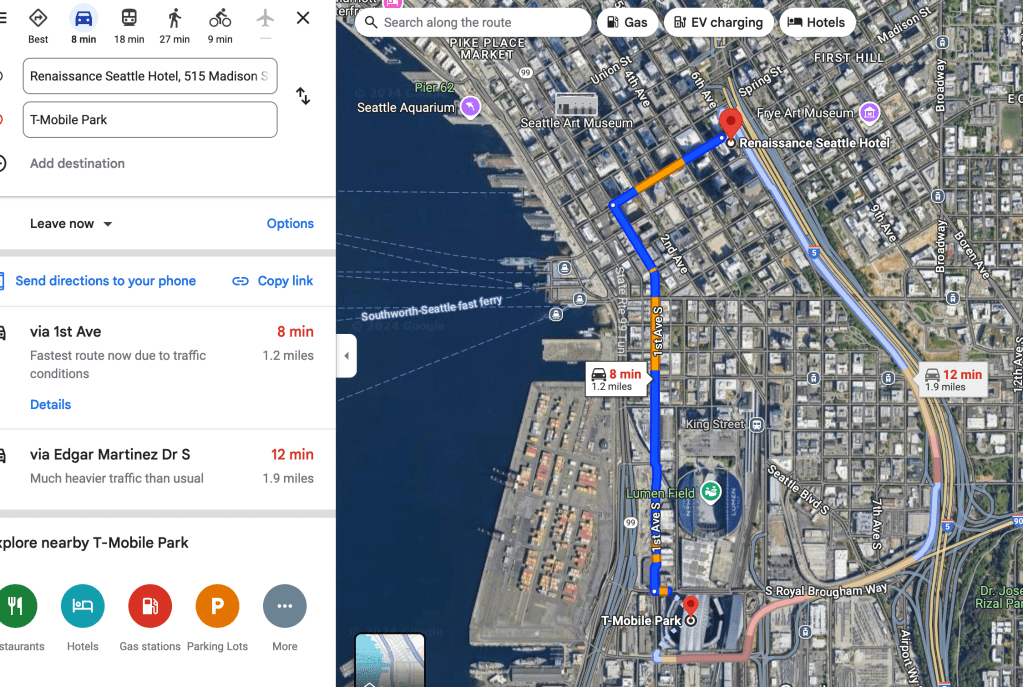
Or you could hop on the Link for a good portion of the walk – even if the stadium station location is less than ideal. It would might even be on par with rush hour travel times. As a brief aside – Google does not show the pedestrian path connecting the Stadium Light Rail stop to the Stadiums! So the actual transit travel time is likely to be slightly shorter than shown here. I reckon I could do it about 15 minutes.

But of course, none of this is all that surprising – while thinking about this I read an article about how to get around NYC as a tourist, and it says: “One of the hardest lessons to learn in New York City is that it’s (usually) faster to take the train than a car”. Other travel guides to much less transit oriented cities (like Seattle) try to hype up the transit as an option for tourists, but I’m skeptical about how many tourists in Seattle are opting for the King Country Metro #8 on their trip from Cap Hill to the Space Needle.
Unfortunately, it’s exceedingly difficult for me to comment on how other Americans tend to get around cities that they don’t live in – I tend to extensively research the history of public transportation in any city I visit before heading there – but in general, the cab still seems to rein supreme (Yes, Uber and Lyft are cab companies. No, Uber Pool-type services aren’t markedly different than a cab – not that anyone uses Uber X Share née Pool anyways). It makes a certain amount of sense given that 91% of Americans who commuted to work in 2022, did so in a car – unless you’re accustomed to the ins and outs of using public transportation, it’s somewhere between difficult and frustrating to learn a new system on the fly.
In my own life, this has all seriously shaped my views on cities. When I was 18 and visited New York to watch my friend run a track race, I felt extremely overwhelmed by the city. This was certainly exacerbated by the experience of being in a cab on a hot day stuck in traffic heading over the Harlem River span of the Triborough Bridge. I recall a subway ride uptown (probably on the Lexington Avenue line), and then a bit of frustration when we realized we couldn’t just walk over that bridge.
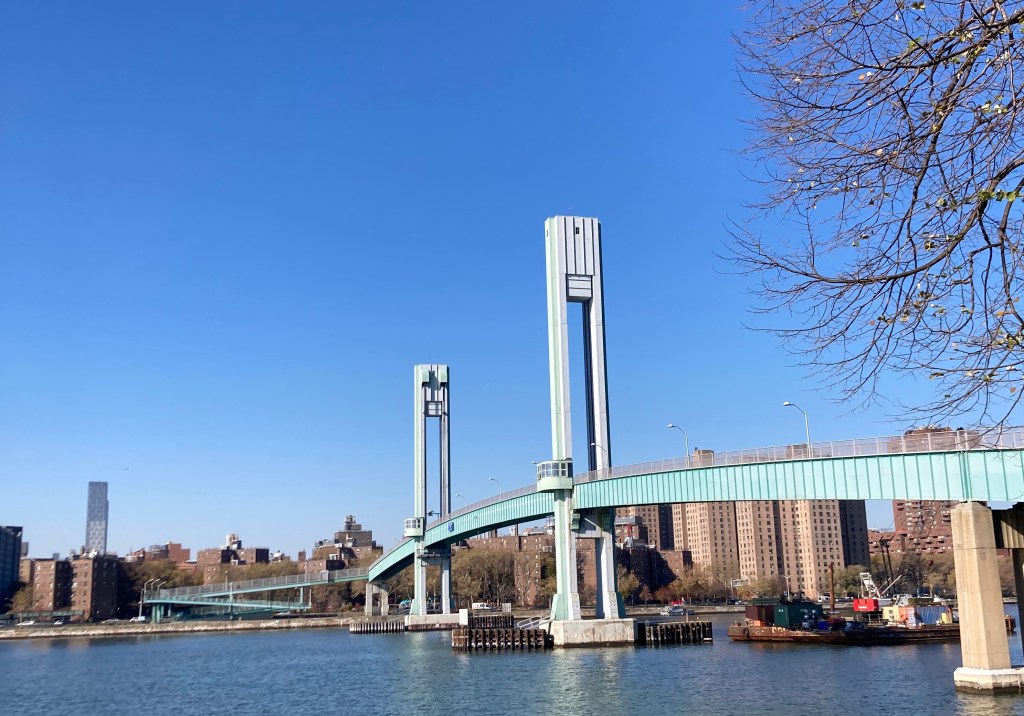
It’s sort of funny to recall this, having read the Power Broker. I mean of course Robert Moses didn’t allow pedestrian access on the crown jewel of his career! How foolish were we to think that there would be a sidewalk connection on the only road bridge to Icahn Stadium? Evidently, on the way out we walked the pedestrian only Wards Island Bridge (opened 14 years after Triborough was opened for cars) and then presumably rode the subway back towards Penn Station before getting on a train to New Jersey (where we were staying).
I tell this story not to brag about how well read I am, or even to mildly embarrass myself. It’s about how my lack of familiarity with the transit of NYC made me feel unable to navigate or conceptualize the space, and this in turn gave me a general hostility towards the city as a young adult. Perhaps it’s obvious to you that metro systems play a vital role in getting around cities, but I think the more pertinent thing at play is how the city is conceptualized by it’s people.
In this Jay Foreman video about the Tube map, he points out that “the Tube map is so much more than just a useful journey planner, it represents London”. I could say something similar to New York (despite not having nearly as useful of an official map). When I returned to the Big Apple back in 2022 after having spent countless hours learning the history of the New York City Subway, it was remarkably easy to understand where I was and where I wanted to go. Getting from the apartment we stayed at to dinner in Manhattan was just a quick ride down the IRT Lexington Avenue Line, with a cross-platform station between an express and a local train to avoid a longer walk.
Does everyone need to know the history of the Subway to get around New York? Probably not – though this RM Transit video will tell you the basics in just 20 minutes – but understanding the structure of the Subway really helps make the city feel navigable. Hostility towards cities that are unfamiliar, hard to fathom, or even intimidating is a natural thing for people to feel; and the lack of cultural familiarity that many, if not most, Americans have with taking transit in general surely contributes to the generally anti-urban tendencies in American society. And while this is a problem in and of itself, it’s more pressing when you consider the political implications of it all.
If you have the unfortunate experience of following transportation policy in Oregon, you’ll know that the two big projects in the Portland region (and the state) are multi-billion dollar freeway expansions. I’ll spare you the details, but the combined projected price tag for them is somewhere in the neighborhood of $12 billion – more than the double total cost of the entire TriMet MAX system adjusted to 2024 dollars (something like $5.3B). And while there is serious opposition to these freeway projects, the way freeways are built and financed in the US precludes any direct voter involvement in the process.

Contrast this with the way that public transportation projects are financed – endlessly scrutinized, and always up for a vote to get final funding approval. This isn’t a bad thing per se; it’s generally good that people have a say in how public dollars are spent. So while it may be tempting to hold highway projects to the same standard, the current cultural landscape would be likely to make this a Faustian bargain. Without some kind of significant cultural shift or catastrophic event, it seems unlikely that a public vote on highway projects would render anything other than a rubber stamp. It’s no surprise that the zenith of opposition to freeway building came during the oil shortages of the 1970s.
Perhaps this is all just wondering if the chicken or the egg came first. Luckily for us, there’s an answer to that question – it’s the egg, since whatever genetic shift that moved us from “chicken ancestor” to “chicken” surely happened when the egg was fertilized. And likewise, it’s foolish to imagine that we can just build our way out of our transportation (and climate change) crisis. While we do need to spend a whole lot of money on public transportation, the issue isn’t if the money exists – it’s how it’s allocated. As such, the primary problem to solve is unfortunately social, cultural, and political. It’s like the classic Onion article says: 98% of U.S. Commuters Favor Public Transportation Use for Others.
And here lies the disappointing conclusion – I don’t have an answer on how to do that. But I do know that I’ll always be passionate about enacting change in this sphere. So far, that’s mostly manifested as getting my friends and family to ride public transportation more often, but I suppose it’s also why I wanted to go to planning school. I won’t lie that it’s been a bit of a downer to learn that it’s politics all the way down, but I’m still hopeful for a future where I can walk to a metro stop in little regional centers like Portland, OR and be whisked away to the places I want to go without much fuss.
Til next time – thanks for reading.


Leave a Reply