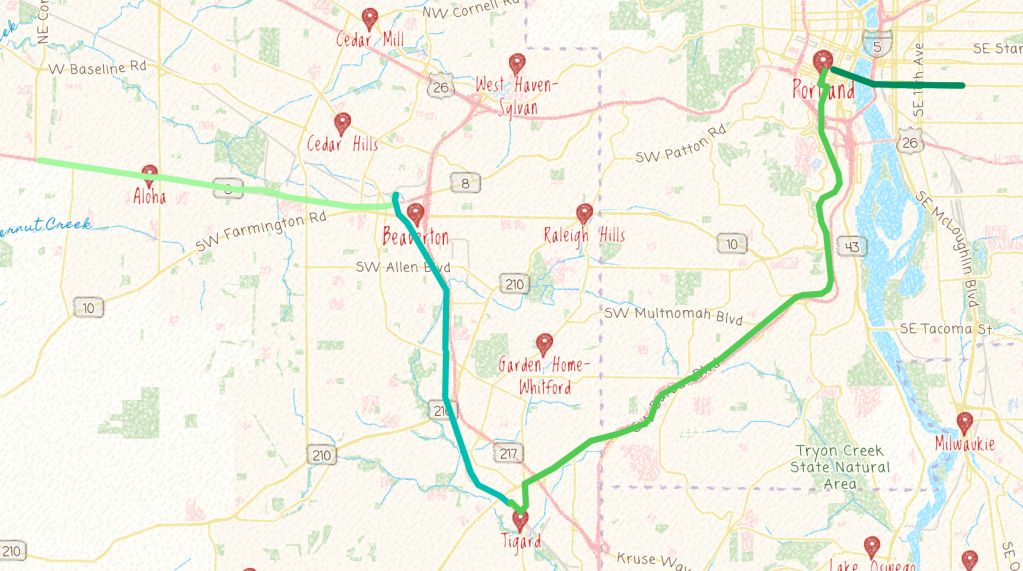
This morning, I woke up at the normal and reasonable time of 4:15 AM. Olivia is off to Redmond (Washington) for a short work trip, and I like to help her out on mornings like this with a hot breakfast and a ride to work. Since it’s just a two day trip, I figured that I’d do the old “leave the car keys with Olivia so she can drive herself home”. This was mostly so I could have a flimsy excuse to walk around suburban Washington County, in the no-mans land between Hillsboro and Beaverton.
Much to my chagrin, I couldn’t find my phone on arrival to drop Olivia off. Not thinking too much of it, I figured I left it at home. This slightly altered my plans though – since what’s the point of doing a weird walk in unincorporated Washington County if I can’t post it to Strava? Well that was part of it. I also didn’t have a good way to navigate or figure out where the nearest open breakfast joint may be. So I checked the bus schedule (from Olivia’s phone) for the nearby 57, and moseyed off to the beautiful corner of Cornelius Pass and TV Highway to wait for my chariot.

1) 57-TV Highway
And what a bus it was – the 57-TV Highway is perhaps the best bus in the region. I’m no lover of suburban Washington County – I find it to be an exceedingly miserable place to walk – but the 57 is a workhorse route if ever there was one. By rides per revenue hour, it’s the second most productive route in the system at 41.8 (trailing only the 73-122nd Ave’s 46.2). In terms of Covid ridership recovery, it’s at over 90% of Fall 2019 ridership – far more than the 75% system-wide figure. Unsurprisingly, it’s also one of the few routes that has seen actual improvements in level of service since the early 2000s.
This is despite running in mixed traffic on one of the most dangerous and miserable roads in the state. Rush hour traffic on TV Highway means peak-hour trip times 1:15 end-to-end a full 47% slower than the 51 minute off-peak time. For context, the 9-Powell traverses a similar corridor (state highway, miserable traffic, deadly for pedestrians) with a broadly similar traffic regime and “only” experiences a 33% delay in end-to-end travel (1:25 in the worst part of rush hour, 1:04 with little-to-no traffic). It was these conditions on the 9-Powell which led to the need for the Powell/Division BRT project, later reduced to the Division Transit Project.
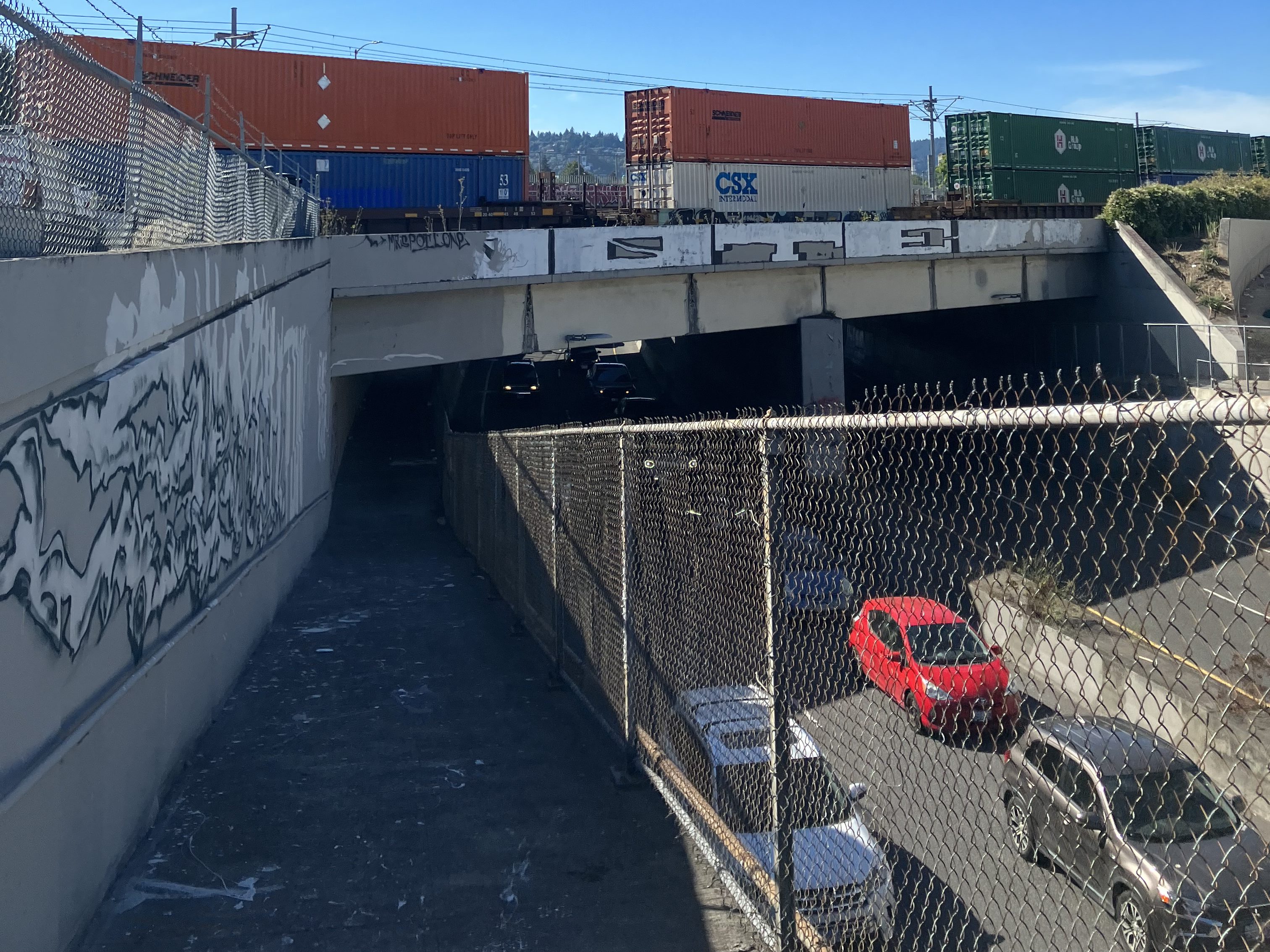
Of course, there are future improvements coming for the 57, but they are still very much in the “speculative” process – more than 5 years away from opening at least. My experience today was a near to standing-room only bus before 6 AM, with lots of regular riders (as evidenced by some chatter between themselves and the bus driver) and certainly lots of workers. It was a nice ride, and since traffic was light I made it with plenty of time to my next destination.
But for now, the kaleidoscopic of racial, income, and class markers that makes up this portion of Washington County will continue to ride the bus, traffic or not.
| Near TV Highway | Portland MSA | |
| % White Alone | 49.1% | 70.6% |
| % of Workers Earning $50k/year or less | 56% | 48% |
| % of Workers Using Public Transit | 6.7% | 4.3% |
2) WES
As the 57 pulled into Beaverton Transit Center, I got to witness the WES in action for the very first time. Friends of the blog know that I love a good train, and the WES is arguably the weirdest and most scrutinized piece of the rail transit in the country. Given that I had nowhere to be, I decided to hop on the silly little diesel multiple unit to head down to Tigard.
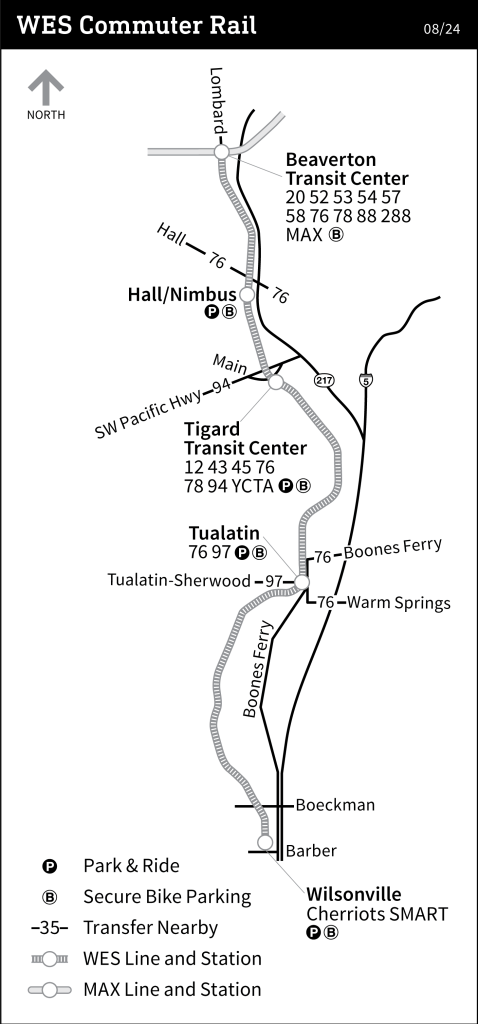
I’ve often tried to incorporate the WES into my public transit repertoire, if only because it’s just so weird. How weird? Well, of hybrid or commuter rail systems in the US, it manages to get the lowest ridership in absolute terms. Now, for the uninitiated just taking a glance at the route (suburb-to-suburb) and schedule (10 trips/direction/day, no weekend service), perhaps it doesn’t come as much of a shock.
But to those of us aware of the truly miserable state of commuter rail services in the US, it sort of is shocking. I mean the Nashville WeGo StarRide does exist, and it somehow gets less service (just 6 trips/direction/day), and I can assure you the transit is far worse in Nashville than it is in Portland
Now, to be fair, the difference in ridership between the WES and the StarRide is a rounding error (116,316 vs. 118,835 for Oct 23 to Sep 24). But it’s also worth talking about how the WES manages less ridership than the Twin Cities anemic North Star commuter line (130,554 riders) and the Denton County A Train (261,518 riders). The North Star is notable since it somehow manages just 4 trips/direction/day, while I bring up the A Train since it’s also a weird suburb-to-suburb connecting line relying on a light rail connection to reach the main regional CBD.
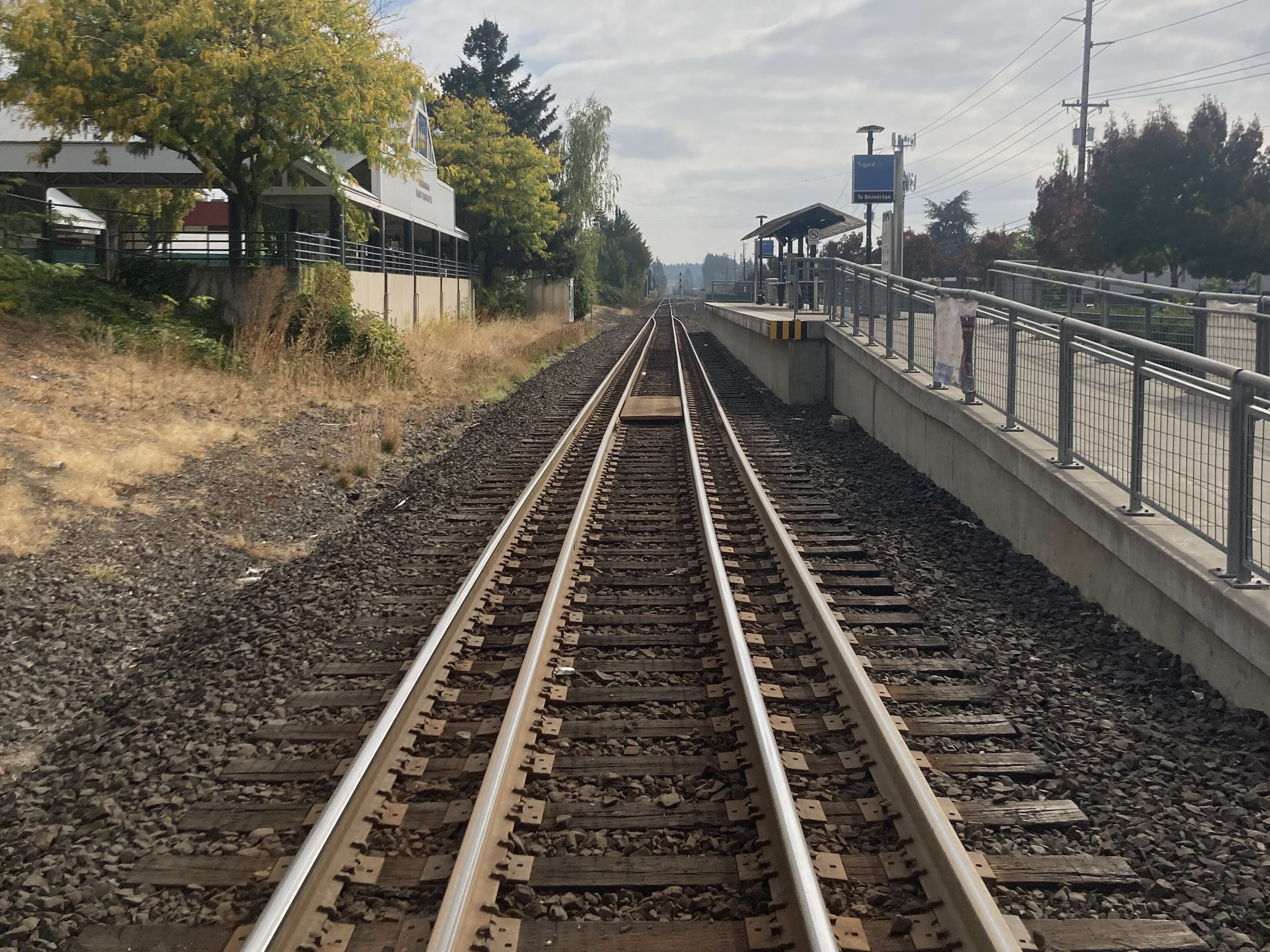
Now, based on this long ramble about how wacky and low the ridership of WES is may seem like I’m a big WES hater. This couldn’t be further from the truth. The issue with the WES isn’t that it exists, it’s mostly that it’s administered by the wrong agency (should be run by the state in some capacity) and is too short (extend it to Salem already). And of course, riding a weird DMU manufactured by a company that TriMet had to bail out of bankruptcy just to ensure delivery of said railcars (worth reading the story about it honestly, even if I loathe the Oregonian) is the sort of thing I find to be genuinely fun. That it provides a genuinely useful and fast connection when it’s running is a nice treat.
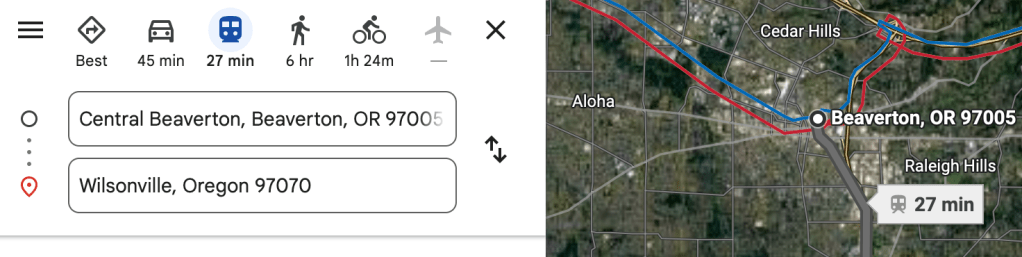
I’m sure a critical analysis of a budget would show that the WES is an expensive boondoggle that “nobody” rides if you wanted it to. But if you browse through the strange land of Clackamas County transit districts, you’ll find connections to WES embedded within schedules. Or if you look at Cherriots, you’ll find two separate express buses terminating in Wilsonville made far more useful thanks to the WES. Where a so-called free market capitalist sees some budgetary hole that needs trimming, I see a critical service that provides unappreciated value – especially for critically underfunded minor state transit agencies (Cherriots amazingly survives off of just disbursements from the state 0.1% transit payroll tax).
I want to dwell on Cherriots for a bit longer here. They have historically used Wilsonville as a terminating point on regional routes because of its historical status as the closest point of regular TriMet service to Salem. Without the WES, I find it exceedingly unlikely that TriMet would enthusiastically re-extend the 96, given that it’s one of the least used buses in the region (which made the choice of prioritizing the SW Corridor even stranger, but I digress). Cherriots could focus heavily on turning regional trips at Woodburn or Canby (to connect with existing Canby Area Transit services) but this would be a strict downgrade in terms of travel time, and the net result of cutting back on the WES would be to starve transit-dependent Oregonians in the mid Willamette Valley.

The point here is mostly that every transit line – especially ones that connect between regions – cannot be accurately judged in a vacuum. As our country, state, and even city continue to move to double down on neoliberalism to solve the issues of brought about by neoliberalism, I’m cautiously optimistic about the WES after riding. It was busier than I expected (at least half full for the first train southbound on a Monday morning), it was comfortable, and it was fast. Was it a good idea to spend precious resources planning and building it? I’m less certain about that, but since we’ve made it this far why not extend it down the line to Salem?
3) 12-Barbur
The penultimate ride of my morning was an old enemy – the 12. When I worked in Tigard, I rode this bus back from work most days, and nothing makes you curse a bus more than relying on it. From dropped trips, to late buses, to clearly ancient stock in need of replacement I saw a lot of the miserable underside of being a transit rider in my year or so working out in the burbs. As far as I could tell, the biggest issues always happened crossing OR 217 just after the bus leaves the Tigard TC (I boarded a few stops after that for my commute).
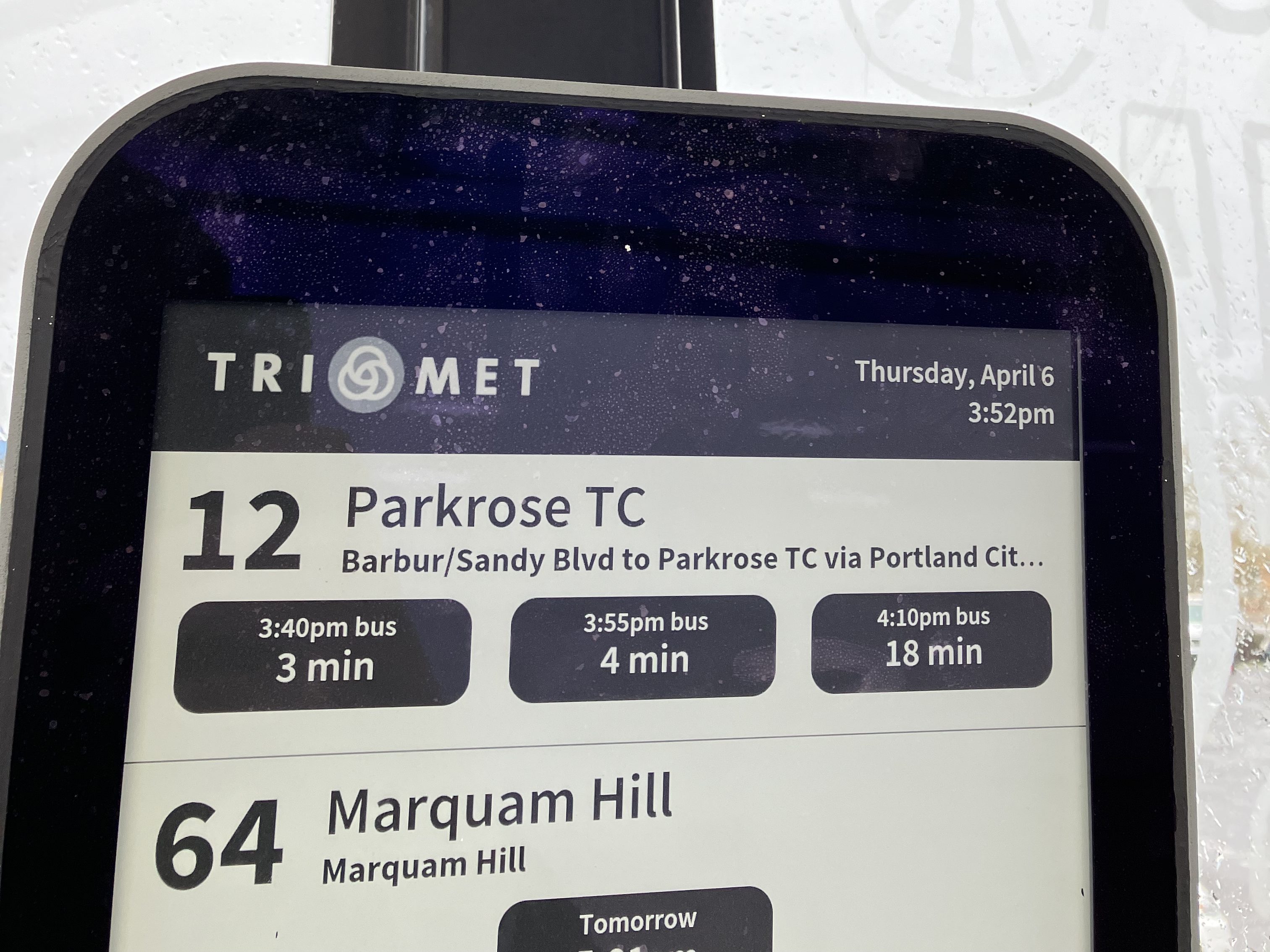
But the issues didn’t materialize today, as they often didn’t materialize when I relied on the 12. It’s status as my enemy is only a result of some kind of negative confirmation bias, generated after two consecutive days of dropped trips back in 2023. So I happily read my book, and thought about how fun it was to not have my phone with me.
I thought about getting off at the original Original Pancake House, but since I didn’t have my phone I wasn’t sure if it was open. I figured since it wasn’t yet the magical 7 AM time when the City of Portland has collectively decided should be the earliest anyone ever eats breakfast that it wasn’t worth it (some post facto research shows they aren’t even open on Monday, so I guess I was right for the wrong reasons). So instead, I drifted into a still-sleepy downtown Portland to catch my final bus of the morning home – the ever reliable #14.
4) 14-Hawthorne
The 14 hasn’t been in my repertoire as a regular rider for very long. Five of my ten rides on this route this year have come since November 11th, and its seen a meteoric rise thanks to our move to its neck of the woods.
And speaking of woods, while I waited an indeterminable length of time for the 14 to roll around, I was treated to what had to be the loudest group of crows I’ve ever heard. If you ride TriMet often, you know you’ll end up downtown for a transfer sooner or later. For better or for worse, the hub-and-spoke nature of the system has made downtown the primary transfer hub for most routes for a very long time (even if the existing crosstown routes also get excellent ridership). I’ve never been a huge downtown Portland booster, but when you’re waiting for a bus on a cold Monday morning with no idea on when it will show up next, it’s nice to have the company of seemingly thousands of crows.
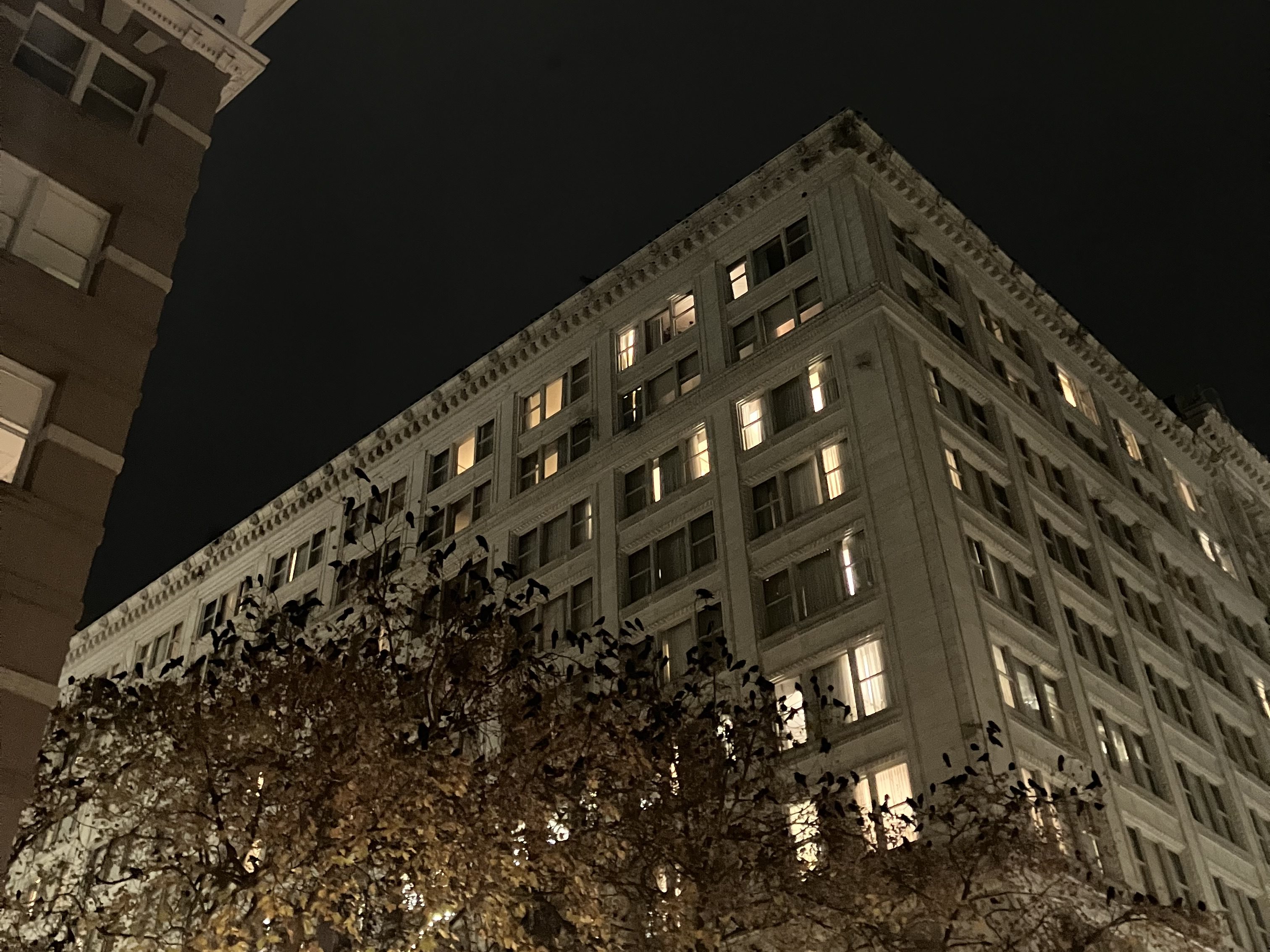
Since I didn’t have my phone, you’ll just have to trust me on this when I say that it was shockingly loud. And since it’s winter and the leaves are down I got to just stand and look at them while the honked the morning away. Maybe it’s because our new place doesn’t have nearly as much bird action to observe (which reminds me: I need to buy birdseed), or maybe it’s because I was on the end of a strange liminal roundabout trip home, but I found the birds to be comforting in a way I didn’t expect. No matter what ails the world, I can take some solace in the crows roosting in the trees.
Eventually, I was ripped away from my musings about crows by the arrival of the 14. It was a quick and easy trip, just a straight shot over the bridge and up Hawthorne to my new home stop on 23rd. I took a pit stop to finish my book and have a coffee at Grand Central since I had judiciously managed to kill just enough time for them to open, then walked home to find… not my phone.
Turns out I actually just left my phone in the car in Hillsboro!
Epilogue
So what did I learn from all this? Taking a detour on the WES via Tigard, rather than the MAX to Goose Hollow was a nice little time. It’s not often that I find myself in the situation of having limited distractions and just get to ride around the city without a care in the world. The extremely comfy seats on the WES were nice, but the extremely efficient nature of the route meant I spent more time on not-very-comfy bus seats. If only TriMet could learn from the example of our enlightened neighbors in Canby and put comfier seats on buses.
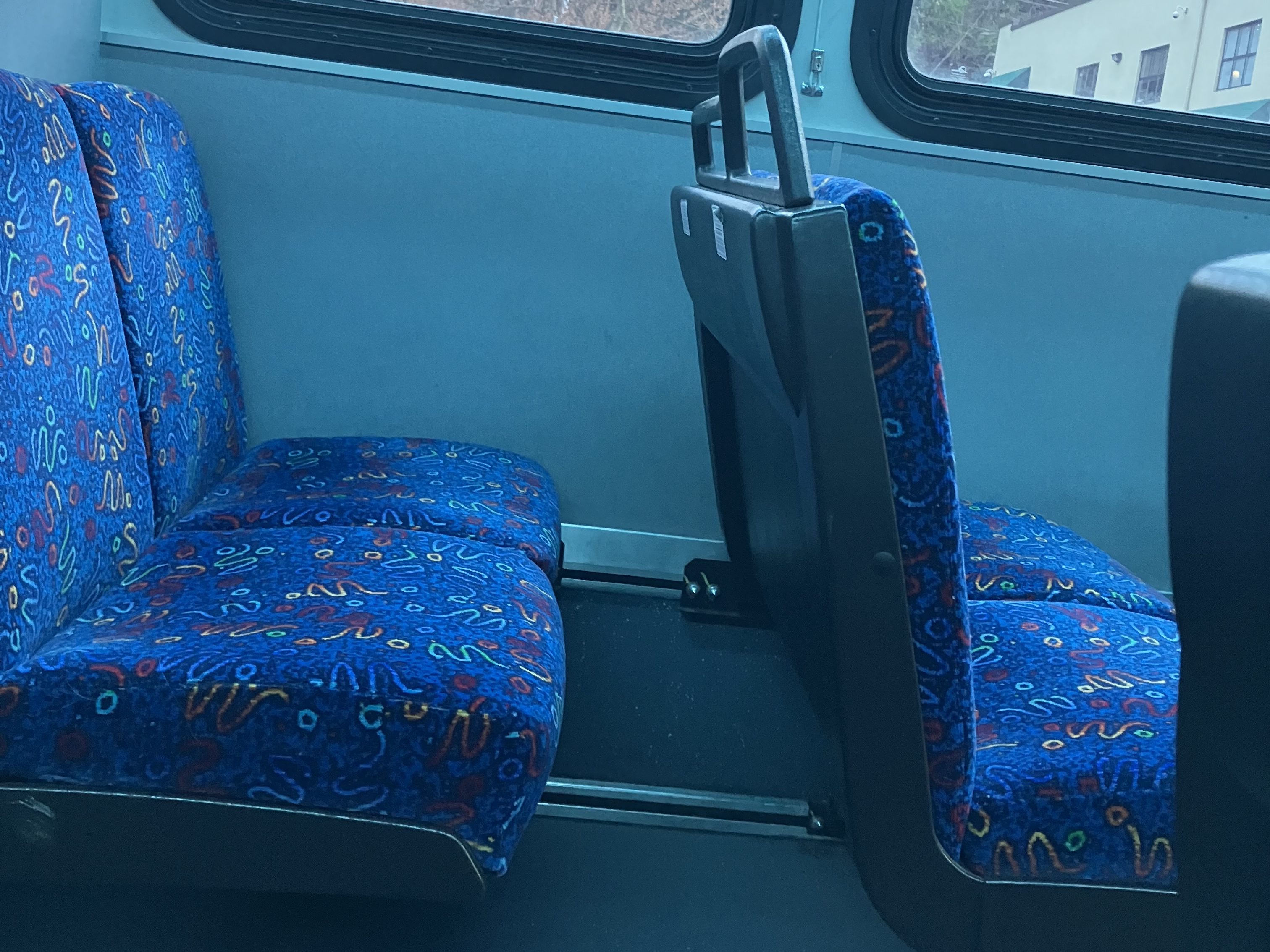
Now that I’m home in the cold light of day, it’s sort of ridiculous that I managed to leave my phone stranded in Hillsboro until tomorrow night. I don’t think many other people would have decided to take transit home from Hillsboro before 5:30 AM rather than driving, and I certainly feel like I maybe should have looked a little bit more closely for my phone before leaving. But it turns out I don’t actually need my phone for that much (though if I get logged out of my accounts for school, I won’t be able to get back in. When will we as a society learn that mutlifactor authentication is a bit pointless?), and not having it was liberating. Or I can tell myself that at least.
Was it annoying to not know exactly when my buses were coming? Yes, absolutely. Especially since I have the choice of the 14 or the 15 to get from downtown home, it was a bit annoying to not be able to cross-check which bus is coming first without a mobile device. But of course, if I had done that and taken the 15 instead, I may have robbed myself of the simple joy of listening to the birds.
Ultimately, this morning was an antidote to the creeping miasma of frustration I’ve felt over the past few months. I’m sure I’ll still go into planning after all this, but it’s been deeply frustrating to have classes where the nominal focus is on solving a huge entrenched societal issue (like lack of meaningful community participation and power in political processes) and the solution is presented as creating a framework of how to write a report if you are a consultant. Maybe it’s just me, but I don’t feel like that’s a very good solution.
But when I ride the bus (or the silly little train that everyone loves to hate or hates to love), I feel the fog clear. The creeping dread is replaced with a hopeful joy best described in a quote from LA Bus Riders Union organizer Martín Hernandez (by way of Mike Davis’ Dead Cities and Other Tales): “Since deindustrialization, buses are among the last public spaces where blue-collar people of all races still mingle.” This morning I lost my phone, but at least I had a warm bus to carry me home.
Thanks for reading – ’til next time.


 City Hikes
Leave a reply to cityhikes Cancel reply