
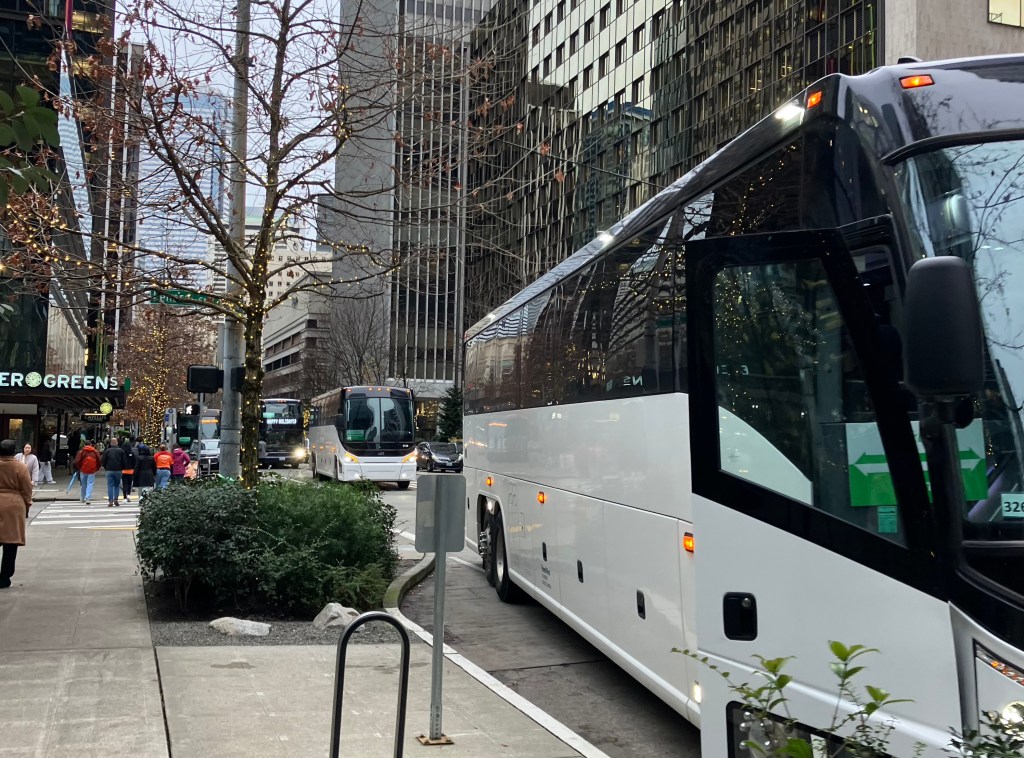
I work about a block from the Amazon headquarters, or at least its spiritual heart (the Spheres). Amazon has long been known as a place that attempts to encourage “alternative” modes of transportation to work (read: not single-occupancy vehicle), and as such it runs an extensive private commuter bus operation1. While the general idea of a commuter bus operated by an employer isn’t new, the specific dynamics of tech employment in Seattle (and elsewhere) has made them a particularly visible indicator of the accelerating inequality present in US cities.
Since tech wages are so high, and driving alone is genuinely horrible, a tech bus serving a neighborhood or suburb is a sure sign that it’s an area with high rents and an Arc’teryx store. But what strikes me about the buses isn’t how they essentially open up specific areas to massive amounts of tech workers, though that is a major factor in why I dislike them. It’s more about how they erode the social fabric of our society, all while not providing a time-competitive commute. Let’s look more closely to see what we find.
Part I: The Colman Dock Shuttle

When I first started paying attention to the Amazon shuttles (on my first day of work – they are hard to miss), I figured it was primarily a suburban system. After all, King County Metro is fairly extensive and good and Sound Transit is fast (if less extensive). This was partially confirmed when I saw the Snoqualmie bus – since that’s a part of the Seattle metro area not served by an express Sound Transit route. I figured they must be that kind of thing.
But then one day I saw a minibus signed for “Colman Dock – SLU”. For the unaware, Colman Dock is the ferry terminal in downtown Seattle shared by the state ferries and various foot ferries, and it’s directly served by the Metro Rapid Ride C – which also serves South Lake Union. In essence, to connect ferry riders to South Lake Union, Amazon runs a shuttle that fully duplicates an existing bus. The only difference is that it’s less frequent and slower2.
Indeed, the only benefit a service like this provides is that it’s exclusive to Amazon employees. It shouldn’t surprise anyone that I think this is bad. And for the particular case of the ferry dock, it’s hard for me to see much of an argument for it reducing car traffic – it’s not like a reasonable person would drive their car on to the WSF Bainbridge Ferry so they could use it to drive 1 mile to a parking garage in South Lake Union.
Part II: Suburban Routes
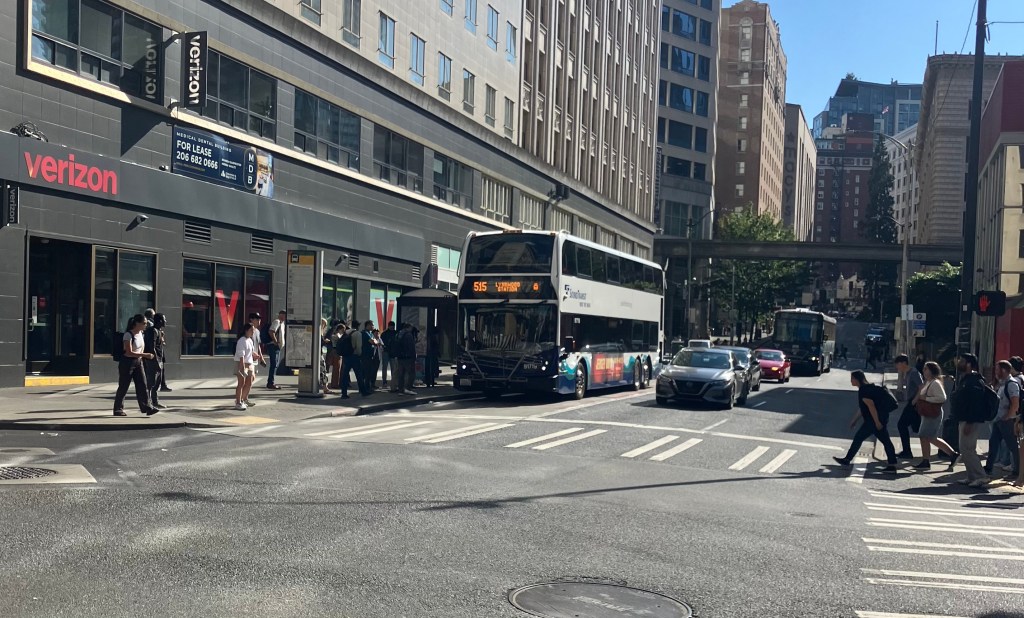
The Colman Dock and related International District (serving King Street Station) shuttles are what I would call “obviously bad”. They are short services that are covered better by existing public transportation (provided you don’t consider exclusive to Amazon workers as a metric). The only reason someone would take them is because they think poorly of riding on a regular bus (or even the light rail in the case of the final leg of a Sounder – SLU trip).
I initially thought that my critique of the Amazon shuttle buses would end there – with pointing out the classism inherent to operating a service that is worse by any objective measure other than “doesn’t have to interact with the general public”. But it turns out that the major suburban routes are just as guilty – if not more – of this than the last mile connectors in Downtown Seattle. To show this, I pulled together a comprehensive guide to each suburban route terminating in South Lake Union and compared them to a reasonable alternative3.

Of the 30 total stops served, just seven offer faster travel times than the existing suburban buses4. Of these, the one with the most justifiable existence on transportation planning chops is the Renton one. Of the major suburban cities in the Seattle area, it and Burien are the only two that lack a direct Sound Transit connection to downtown Seattle.
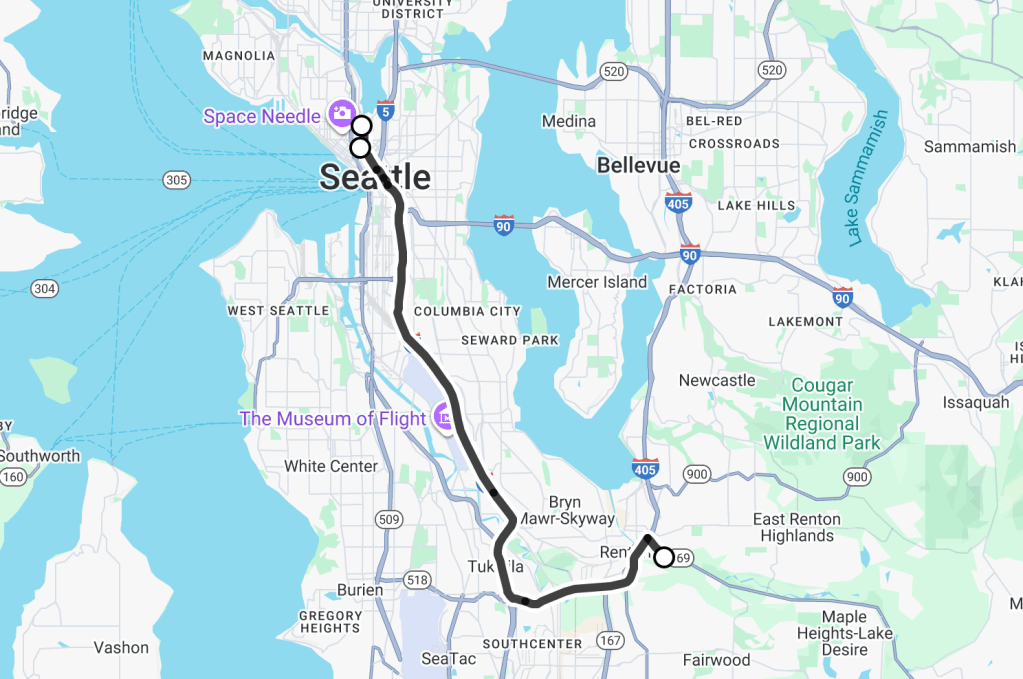
Maple Valley and northern Bothell also have potentially justifiable existences, but in some sense Amazon providing these services creates housing demand for Amazon workers in those communities – so I’m not really fond of them on those grounds. This is a bit besides the greater point I want to make, but that is still an issue worth considering5.
But the real issue at hand is the commuter buses which are slower than existing express and commuter buses run by the various Seattle area agencies. The worst offender here is a White Center – West Seattle service that makes three stops, each of which is slower than taking the corresponding Metro route.
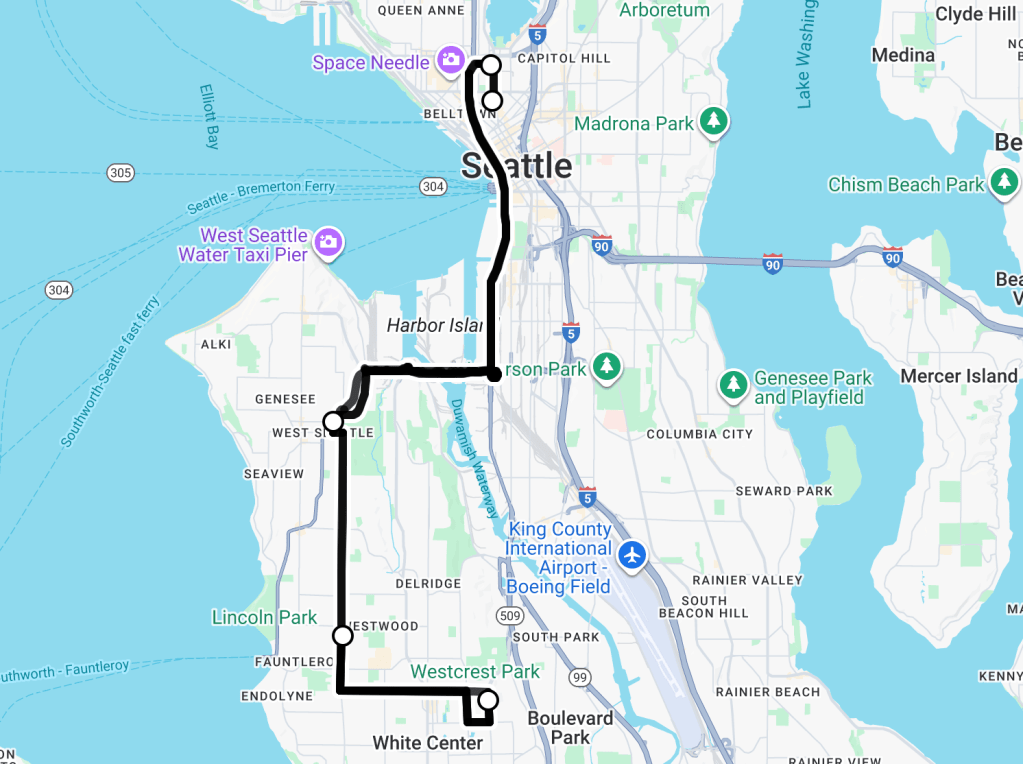
For the first stop, taking the Rapid Ride H is more than 30% faster! For the second, the mixed-traffic route 21 is still a couple minutes faster than the shuttle. And for the final stop, the Rapid Ride C is 3 minutes faster on a 30 minute trip6. Beyond this one, other annoying ones include: South Lynnwood (picks up across the way from the Lynnwood stop on Link, which is faster and more reliable to downtown Seattle), Redmond/Bear Creek (more than 30% slower than taking the Sound Transit 545), and Ballard (just take the Rapid Ride D man).
From my brief analysis of the routes and their time tables, I don’t see a big reason for these buses to exist (outside the “Amazon workers are afraid of the bus one”). They don’t fill a gap in the existing suburban bus network, since Seattle has a very extensive and good suburban bus network. They don’t even offer a faster travel time.
The Class Element

If you spend any time researching this topic, you’re likely to come across a whole lot of propaganda chatter talking about how cutting edge, climate friendly, and awesome it is that Amazon does all this. The primary reasons cited range from saving money on parking, to saving so many grams of CO2, to being able to work from the bus7. Within these, you’ll also find plenty of references to how the commuter buses are “clean”, with implication that other buses are dirty.
Saving money and reducing emissions are great, but also something that is done more efficiently by utilizing existing buses. And I feel strongly that being able to work on your commute is not a benefit for anyone other than your boss. On the one hand, it would seem that it could open the door for less time in the office and more time at home – if those 2 hours of commuting each day count towards your 8 hours a day. Even if you took this for granted (which you shouldn’t), it’s not clear to me that this would lead us to a better society, or that it would lead you to a better life. The commute is a constraining element in most people’s home choices, and we shouldn’t discount the ways in which a policy like this would directly induce more sprawl8.
But we should all know that the most likely thing to happen is that you are just expected to work longer hours. From what I’ve read, almost everyone who uses the Amazon shuttles mentions that you can (but don’t have to) work from them. Still, if you got on a bus filled with your coworkers who were mostly working, how would you feel about shooting the breeze with your seatmate or just idly looking out the window?9
Part of the social benefit of public transportation is social, and by turning the bus into a de facto work space, that benefit is lost. In the landmark book Times Square Red, Times Square Blue, author Samuel R. Delany, makes a point to emphasize how cross-class contact is the essential element of a pro-social society. A shuttle bus for the rich is obviously bad on this front, but even within the context of just Amazon workers (who have some level of internal stratification), quietly working on the bus is worse than idle chatter with your coworkers.
The essentially public nature of a bus is part of why I find them so interesting and compelling. And even though I have a million and one reasons for riding, the best part is always just being among the body politic of the city. In a world that is becoming more and more surveilled, paranoid, and downright anti-social, riding the bus and having little interactions with your neighbors goes a long way in dismantling that. Friends of the blog know I’ve got mixed feelings about Jane Jacobs10, but her “eyes on the street” idea of safety is as right as rain.
Is Good Enough Good Enough?

By this point, you’ve probably thought “yes, but the alternative for most of these people isn’t existing transit – it’s driving alone”. This is probably accurate, but I still don’t fund it very compelling. If the only way we as a society can get the wealthy techies to ride the bus is by making it an exclusive perk that allows them to have a laptop fully charged and an empty inbox by the time they get to work, then we have vacated our responsibility to leave our society better than we found it. We can and should push for more.
As distasteful as I find driving alone, I find employer run buses to be equally so. This is mostly because I just do not view the pollution/traffic benefits of public transportation to be the primary benefits, something which I recognize puts me at odds with the entirety of the history of the transportation planning apparatus in the US11. Focusing narrowly on how the transportation network could be more efficient misses why people don’t ride the bus in the first place.
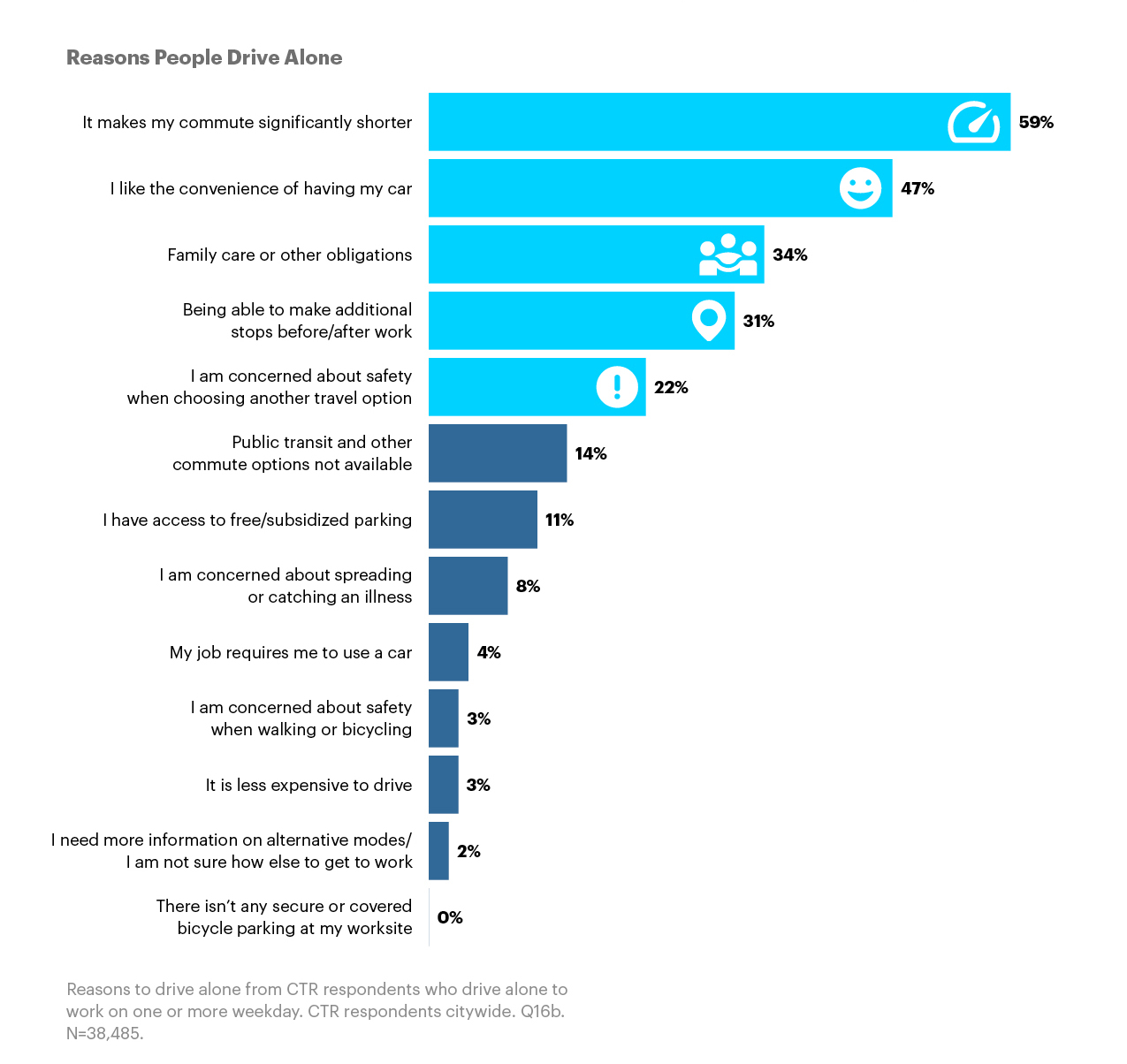
Looking at Seattle in 2024, Commute Seattle found that 59% of downtown Seattle workers who drove chose to do so for time saving reasons – while 47% mentioned convenience and 34% mentioned other obligations that require a car. Having public transportation from home to work be faster would cover some people, but not all12. In reality, the pervasiveness of car culture means that people have regular social obligations 20 miles away from home and have no real choice but to drive or not participate.
Undoing these kinds of social patterns isn’t as simple as getting someone to take the bus to work, since only a small fraction of daily travel consists of getting to and from work. An employer-run shuttle bus that comes only during commute times prevents the kind of flexibility most people want by preventing users of the service from becoming broadly familiar with their local transit agency as riders. On the other hand, riding public transit to work can be a gateway into being a regular transit rider – something which can fundamentally change the way you live.
If we take stock of our looming catastrophes, it’s clear that we need people to change their ways – and that means a whole lot more than just taking the Amazon shuttle to work. It means completely rethinking the way our cities function from the bottom up.
I had hoped to finish this post of with a scathing indictment of the tech world, and how the shuttle bus is just one aspect of a deeply anti-social and anti-democratic outlook, but I just don’t have it in me. I’ll save that for another day. Instead, I’ll close by saying that most of these issues are fixable, but they can’t be fixed by big projects alone. I feel that the path to a better society always lies at the feet of the people who live in it, and you (yes you!) can help to make the world better simply by acting in ways that you feel are just13.
If you’re like me, and you feel that more people need to be riding the bus if we’re ever going to have a society that even loosely resembles a sustainable one, then you have to ride the bus. Or if you’re like me, and you feel that the comically addictive anti-social media short-form video apps (and their predecessors) have succeeded only in making us all more miserable and lonely, then you have to try to get off them. If our society is the sum of all of us, then we can’t make a difference unless we change as well.
Thanks for reading, ’til next time.
Footnotes
- It may be worth noting that companies of Amazon’s size in Washington are required to do this. And as we’ll get into later, other tech giants in Seattle (namely Microsoft) also have extensive private commuter shuttle operations. ↩︎
- It’s 20 minutes from an SLU office building to Colman Dock on the Amazon shuttle in the afternoon, compared to 13 minutes on the Rapid Ride C. The C comes every 10 minutes, while the Amazon shuttle comes every 15 to 20 minutes. ↩︎
- Here’s a link to a map showing stops. The description has the sources. ↩︎
- It’s worth saying: one of these is a technicality – a West Seattle route that stops near the Water Taxi dock. The Water Taxi isn’t that fast, but is very cool. But there’s another technicality the other way – Snoqualmie’s closest downtown Seattle bus originates in the Issaquah Highlands and I didn’t incorporate travel times to any of the bus stops (since I have no way of knowing where specific trips originate anyways). So seven is fair enough. ↩︎
- I think this comment on a 10+ year old blog post summarizes how I feel pretty well ↩︎
- All of these trips are leaving ~7:30 AM. I get the impression that Amazon has a much more conservative schedule with regards to traffic, but I can only really compare the schedules. And for a multi-stop route, surely the bus waits until its departure time if it’s running ahead anyways. ↩︎
- This breathy LinkedIn post is a good example ↩︎
- Incidentally, this broader point makes me somewhat less excited about high speed rail than I used to be. Of course, I’m still excited about it, I just think the distortion of urban housing pressures on other markets needs to be considered too. ↩︎
- Even if I like to imagine myself as not caring about this, I know if I were actually in that situation I’d feel some pressure to conform. ↩︎
- I love The Death and Life of Great American Cities. But her other stuff isn’t as interesting to me (I hated the book Dark Age Ahead), and I think planning as an institution is still relatively dismissive of some of the more democratic ideas contained within her work even if it consistently valorizes her. ↩︎
- This is part of why I don’t work in transportation planning ↩︎
- The “wanting to stop off somewhere else” aspect of driving to work is part of why I’m so dogmatic in my opposition to the “stock up” grocery trip, which I feel drives a large portion of this trend. ↩︎
- It’s worth saying that some people are more or less constrained by circumstance in what they can and cannot do. But we can’t expect things to change without some kind of concerted effort, and that will necessarily involve changing the base assumptions about your own life. Maybe it means forgoing the white picket fence in favor of a smaller place closer to your social life. I can’t decide what makes sense for you, but I hope you can find some time to think about what does. ↩︎

 City Hikes
Leave a comment