

Every summer, Olivia and I try to get a trip to the Wisconsin in. It may not be the most glamorous of destinations, but it’s where my family is from and as a result it carries a lot of meaning to both of us. This year, that took the form of a wedding outside of Columbus, Ohio and my eternal desire to got to Downtown Books Bought and Sold in Milwaukee meant that a trip on the Flixbus from Columbus to Milwaukee was inevitable.

Well perhaps inevitable isn’t the right word – but we have been trying (and failing) to fly less and the thought of a flight from Columbus to Milwaukee via Detroit or Chicago made my skin crawl. And as you are all surely aware, Columbus is the largest city in the US without rail service of any kind. So this leaves us with the humble intercity coach bus as the carrier of last resort.
And yes, you’ve seen the title referencing Greyhound, but it is true we were on a Flixbus. The difference between the two is ministerial. Flix bought Greyhound for $78 million in 2021, then promptly sold all of Greyhound’s real estate for $140 million, which is indicative of the gloomy state of intercity bus service in the US. When the largest bus company is being bought and sold for parts in between bankruptcies, it doesn’t paint a good picture1.
Despite this, and despite Greyhound’s deservedly awful reputation for bad customer service (that I can only assume Flix is maintaining) travel by intercity bus is worth the hassle. Let’s investigate why.
On Going a Bit Slower
The biggest reason people give for flying is surely that it’s the fastest (and therefore most convenient) way to get between two places2. This is true in a sense, but I think the biggest impact this has is simply to expand the universe of places you consider worth going to. Maybe that’s an obvious observation, but it’s a place I want to dwell.
Choosing to travel via slower means like the bus really just means making the choice to go places that are physically closer to you. This may sound limiting, but within a days journey by bus and train from Seattle there are more places to visit than one could reasonably do justice to in a lifetime. Travel can (and does) expand your horizons and makes you aware of other ways of being, but perhaps our society is too quick to find surface level solutions gleaned from only brief observations of other places.
I think this tendency is most relevant in the urbanist world in relationship to Europe. Everyone and their mother will gush about how excellent bike infrastructure is in the Netherlands and Denmark, or how walkable [insert European city here] is, or how great the trains are in Paris, or how cool it is that Italy is building new trolleybus lines and systems in 20263, but if we lack the context to understand the political culture of these places on a deeper level then the lessons end up feeling like hollow caricatures that lack the clarity we need to actually deliver lasting change.
To determine what needs to be done to fix what ails us is not as simple as finding examples far away of where things ares better; indeed, this is trivial. What we need to make lasting change is a vision of a better world and the ability to make that vision our own – specific to the context of where we live. I think that for all the good travel and tourism does for people it risks creating a social environment where everything is only ever skin deep. We can in fact just follow Paris’ example on [insert urbanist goal here], but to create the political movement to enact those changes is not trivial.
I bring this all up in the context of intercity bus travel to say that going slowly and limiting the scope of where you go or what you do allows you to more deeply explore the local. Yes, I-70 from Columbus to Indianapolis is still as dull as I recall from my first ride down it at 18, but stopping in the northwest fringe of Dayton and seeing trolleybus infrastructure still sparked joy. It wasn’t pleasant to see massive data centers under construction, but it beats not seeing anything at all from the plane.
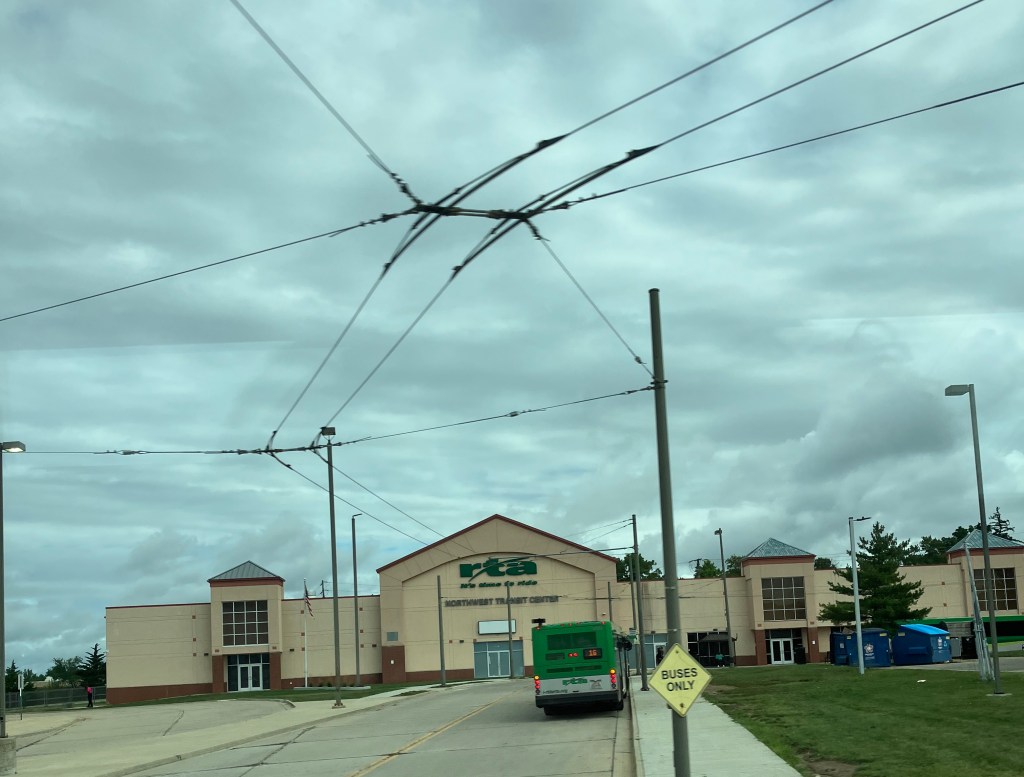
I’ll save the ragging on tourism as a concept for another post, but what you get out of traveling is probably proportionate to what you put in. If you want to go fast and see everything briefly, you can do that. But I think we are all too wrapped up in checking of items that looked cool or that we heard good things about and not wrapped up enough in a long existential ponder about the meaning of the places we’re in. And there is no better way to get an existential ponder in than taking an intercity bus.
The Relationship Between Community, Memory, and Places
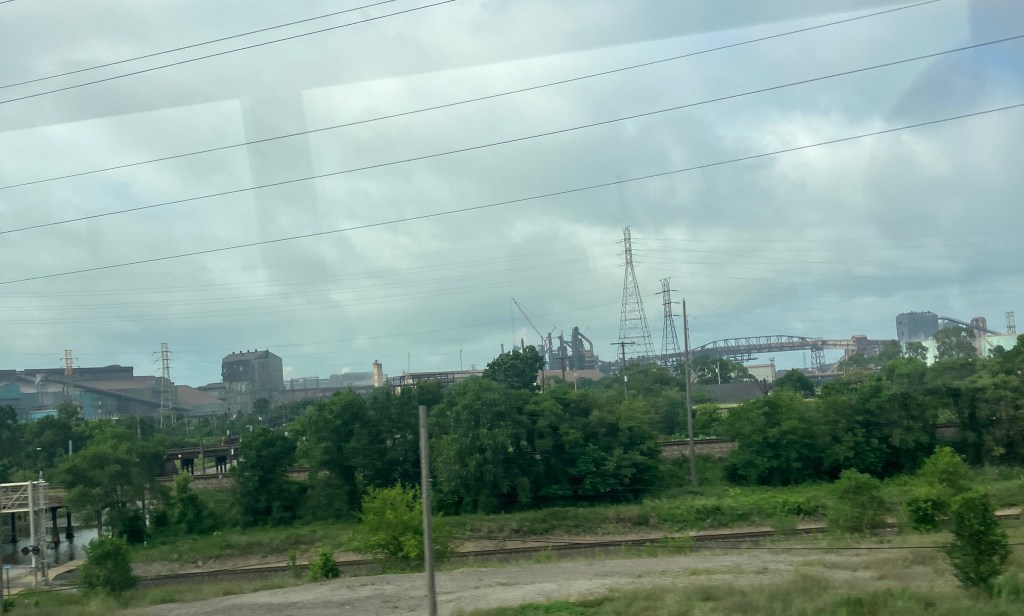
This desire to go more slowly is ultimately tied up in wanting to feel like I belong somewhere. Even though my life has taken me far away from my Midwestern roots, the meaning I derive from watching the corn fields pass by on I-70 is not some trivial part of my life. On some level, it will always be the place I belong and this feeling of belonging is wrapped up in how it feels to see the land from the ground.
When I first read William Cronon’s magnus opus, Nature’s Metropolis, I was brought to tears by his description of family trips through Chicago and the description of the landscape:
Only after a long while does one appreciate the very plainness of this countryside is it’s beauty: the farms with their fields of yellow corn and stench of fresh manure, the great fence-line bur oaks recalling long-vanished prairies, the dark lakes and woodlands of the hill country to the north, the small towns with their main streets of stores and bars and bakeries.
Of course, the specific feeling that the landscape of my home brings can be captured in many ways – it is certainly not exclusive to the Greyhound – but if my childhood and early adulthood had been spent flying between Madison, Columbus, and State College4, I surely would have lost any nuance or appreciation for the places in between.
While my love for the landscapes of home has certainly grown in absentia, I think there’s something to be said about how the places I cared for as a kid were almost exclusively places I spent significant time. Like any good Wisconsinite, I had a strong dislike for Chicago – but I realize now that my constructed memory of Chicago was basically just O’Hare, traffic, and office parks off of I-294.
It wasn’t until I left the Midwest that I realized how much the land, the places, and the people define who I am. And while this may all read as idle nostalgia bait from a perennially homesick fella, I think the lesson I take away is that you cannot understand a place if you don’t understand how it relates to other places. How I understand Wisconsin is deeply tied with Wisconsin’s economic and social relationship with Chicago (which is surely why Nature’s Metropolis resonated so deeply with me).
The intercity bus is an imperfect tool for developing an understanding of these connections, but it’s a tool nonetheless. In the same way that riding public transit has played a critical role in understanding how places are connected within cities5, going by intercity bus leaves you with a deeper understanding of the places in between. Our bus to Milwaukee was very quiet from Columbus to Indianapolis, only to completely fill up in Indy. Then, almost the entire bus turned over in Chicago and it was pretty busy to Milwaukee.
Maybe it’s obvious to you that there would be strong ties between Indianapolis and Chicago, and between Chicago and Milwaukee, but it’s another thing to physically experience that. If we would have flown, there would have been no way to make that observation.
Wrapping Things Up
Of course, these are all esoteric reasons to ride an intercity bus. Most people seem to make decisions about how to travel based on a combination of convenience and price. And on that front, I’m not entirely different. It was way cheaper to take the bus and it was fairly convenient too. But if there’s something I want to impress on you, it’s that we all need to be more sensitive to how where we think we can travel influences where we end up traveling.
I know I promised I wouldn’t get into a broad critique of the tourism industry, but it’s hard to avoid when considering the differences between riding a bus and flying. For the most part, the bus can’t take you far away. It can’t whisk you away to another continent to fulfill all the items on your bucket list. But it’s worth asking before you see this as a drawback if there’s places closer to home that are just as interesting and worthy of your time. I’ve been living in the Pacific Northwest for over five years now, but there are still so many places I’ve never visited.
Ironically, this year has been one of more travel by plane than I care for (and an upcoming trip to Italy will continue that trend). But this really just makes the feelings I have towards all of this so much stronger. There’s nothing I hate more than stepping off of a plane in a place far away from where I started with no clear picture of what was in between, and I’ve been feeling that feeling far too often.
Travel by Greyhound6 may not be the most culturally relevant or immediately interesting way to get from point A to point B, but it’s not without its merits. At least you get off at the end with an appreciation for how A relates to B and all the other points in between.
Thanks for reading, ’til next time.
Footnotes
- I’ve talked about the sorry state of intercity buses before (this article) and it’s not really surprising that things haven’t gotten better. If you want an update on that post from before, Northwestern Lines seems to have picked up the Boise – Portland line, but I still think Greyhound/Flix are skipping Medford for what seems like no reason (the bus stops in Grants Pass!). ↩︎
- I realize this is presented without evidence, but I hope you agree that it’s a fairly reasonable take. ↩︎
- To be fair, I am the only person doing the last one. ↩︎
- As an aside, can you imagine how silly it would be to try to fly between Madison and State College? Like two tiny little airports bookended by O’Hare just seems weird. ↩︎
- You can read more about my thoughts on that here. ↩︎
- Or FlixBus, or Baron’s Bus, or Badger Bus, or Trailways, or Jefferson Lines, or Northwest Lines, or Amtrak Thruway … (you get the idea) ↩︎


Leave a Reply