
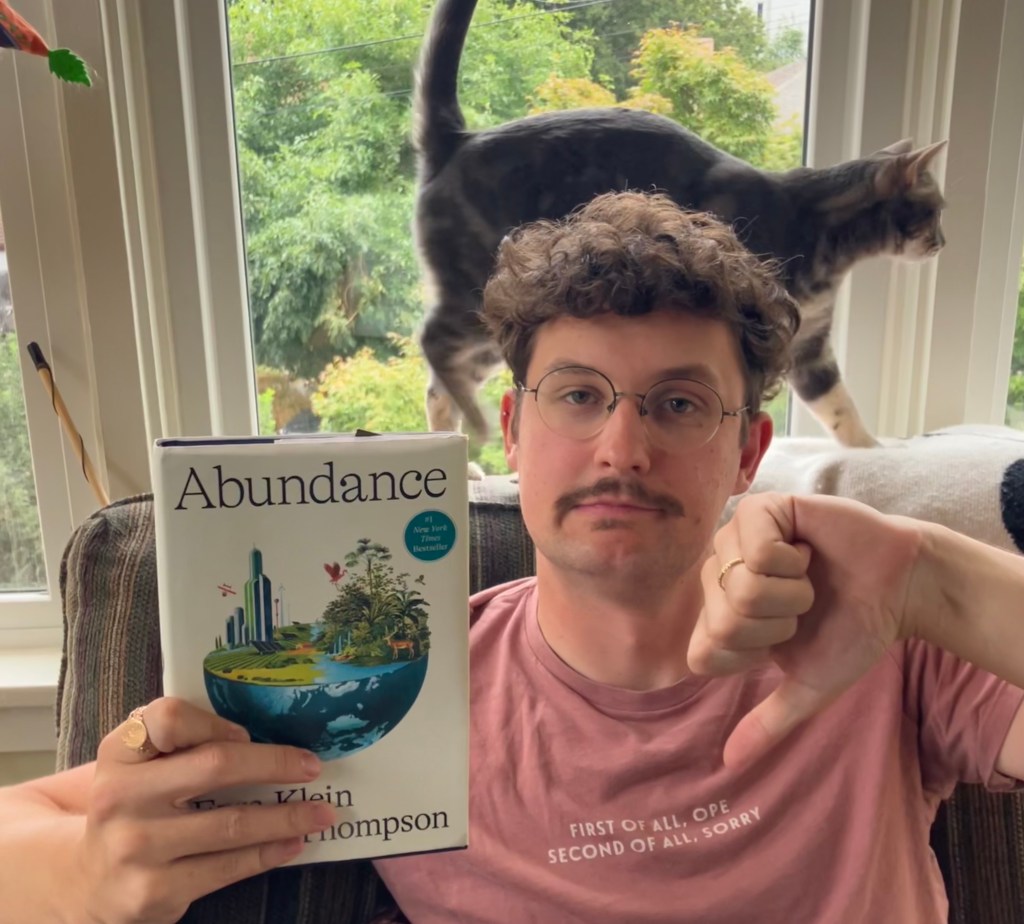
In June, Olivia and I took a nice little train ride down to Sacramento. On the train, we shared dinner with a young couple from Saint Louis who, upon hearing of my job as an urban planner, insisted that I should read Abundance by Ezra Klein and Derek Thompson. It happened that I had been planning to read this book for a while and though I suspected that this couple did not quite understand my politics, it was a nudge. A nudge that was completed when I saw it on the shelf at Dog Eared Books in San Francisco a few days later.
As you can probably surmise from the title and subtitle, I did not like this book. While it’s approachable style is a plus and I broadly agree with many of the general goals, there is just so much that is terrible that it’s genuinely hard to know where to start.
1 – Housing
We have to start somewhere, so let’s being with Klein and Thompson’s discussion on housing. From the jump, the framing is around how zoning (and other forms of land use regulation) have distorted and skewed the housing market in ways that have artificially increased scarcity, which has in turn “naturally” caused prices to go up.
In a broad sense, this is a fine general heuristic, but it misses two critical aspects in its analysis: if the evidence presented reflects this reality, and if using supply and demand is the only way to distribute housing. On the first point, Klein and Thompson do not present what I could consider to be compelling evidence. Instead, they prop up Houston as an example of land use regulation done right because it lacks a zoning code.
It’s true, Houston does lack a zoning code but it still regulates things like lot coverage, parking minimums, historic preservation, subdivisions, and more1. And moreover, if Houston’s land use regulation framework is so great at increasing housing affordability, we should see some kind of positive result. To their credit, Klein and Thompson cite the fact that it’s $300k for the median home in Houston and $1.7 million in San Francisco.
But this opens at least two cans of worms. The first and most obvious one is that wages in San Francisco are way higher than they are in Houston. The second, much more subtle issue is that city limits are always – and I mean always – the wrong geographical level to do comparisons on. Houston is more than 10 times larger than San Francisco by area. We don’t need to dwell here for long, but it’s worth saying that in the Houston MSA, the median home went for $327k in 2024 compared to $1.1 million for the San Francisco MSA2. Still a massive difference, but at least it’s a fair comparison.
For housing affordability relative to income, the standard bit of analysis everyone does is to look at housing costs as a percentage of income – commonly referred to as housing cost burden. The table below shows the share of owners and renters in each MSA who pay more than 35% of their income towards housing3.
| Place | Owners | Renters |
| San Francisco MSA | 28.5% | 40.0% |
| Houston MSA | 25.9% | 46.1% |
While homeowners in the Houston area are relatively less cost burdened than in the San Francisco area, renters are relatively more cost burdened in Houston. 40% is still a soul-crushing number, but given how laudatory Klein and Thompson are towards the state of housing in Texas, it’s concerning to me that they seem to have not even briefly considered the differences between tenants and homeowners.
And throughout the book, Klein and Thompson consistently talk about how blue cities and blue states do worse on housing affordability, but this is just not corroborated by the facts – especially for renters.
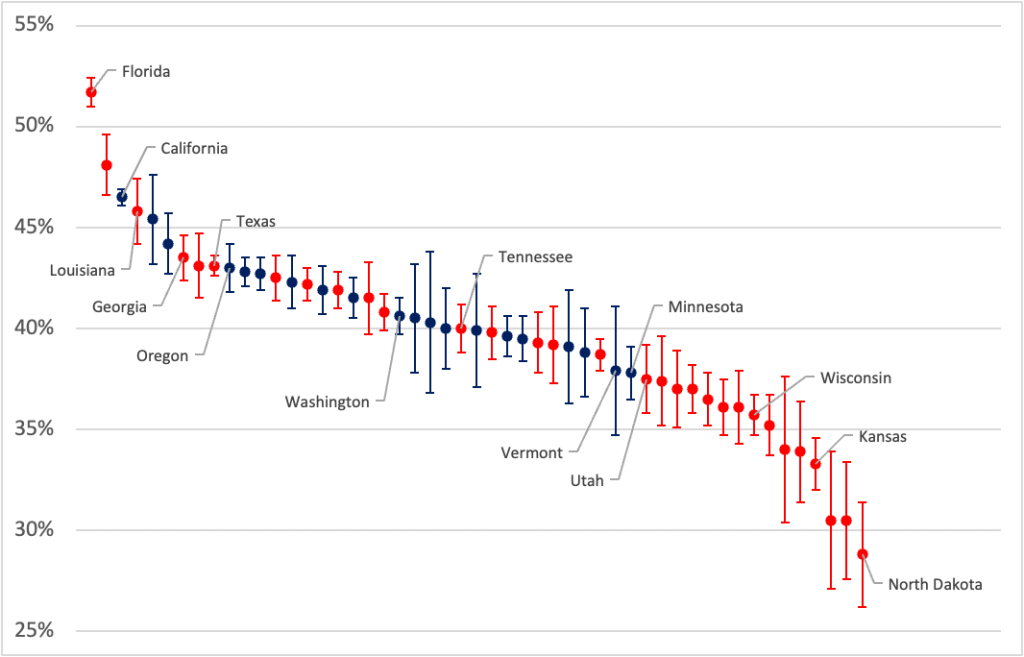
At the state level, there is some trend of “red” states doing better (colored by how the state voted in the 2024 presidential election), but also Florida is the state with the highest rate of cost burden. And while the stated trend exists along political lines to some extent, there’s a much clearer geographical and cultural observation to make: renters are doing relatively better in the Midwest. Outside of Michigan (#15 at 42% of renters paying more than 35%), every Midwestern state is in the bottom half of that chart. If you’re a snobby coastal elite, I’m sure you see this and say “Well that’s evidence of the blue/red dichotomy! All those flyover states are governed by conservative assholes!”, but the Midwest is pretty purple in reality4 and in my experience has stronger cultural traditions that eschew the wealthy.
And while Florida sticks out, this book boldly refers to “the Texas housing miracle”. The only miracle present in the Texas housing market is the ability for developers to churn out single family homes in Frisco, Plano, The Woodlands.


This may keep the median sale price of a home down, but it does so at an incalculable environmental cost. This is clearly offensive on its face, particularly given the McMansion hell character of theses suburbs, but the cost burden numbers for those of us who do not have the capital to buy property and thus do not qualify for permanent rent control subsidized by the Federal government aren’t even better in these bleak suburban wastes. There is just no excuse for this kind of drivel. There is no Texas housing miracle, you just know people who can buy homes in Frisco but not in Concord.
Klein and Thompson propping up Texas as an example of doing housing well is a particularly pernicious example of elite projection. Even before we get into how the politics of Texas are often outwardly violent towards Latinos, women, LGBTQ+ folks, Black folks, and anyone with pro-union sympathies, the focus on the cost of purchasing a home – rather than rent burden – is telling. It tells me that they are wholly unfamiliar and uninterested in the specific ways rent is used to extract from those of us who cannot own property. If you care about housing policy, this is simply not a blind spot you can afford to have.
2 – Governance
Throughout the book, Klein and Thompson make no secret that they view the functional failure of California High Speed Rail (CAHSR) as a deeply shameful and unacceptable occurrence. I don’t disagree with the conclusion, but I do take issue with a specific way they frame the problem. To them, CAHSR would be done by now if it weren’t for the pesky environmental regulations that have come with doing a project of that magnitude.
While the California Environmental Quality Act (CEQA) is a particularly onerous and often self-defeating piece of legislation, the issue with CAHSR isn’t just that the planning review has taken nearly 20 years for certain segments. That’s an issue for sure, but a lot of the problems are ultimately issues regarding decisions made at the conceptual level. Planners and politicians could have chosen a more expeditious route from the jump – like one that didn’t take the longest possible mountain crossing between the Central Valley and Bay Area, or one that made modest speed concessions to avoid property impacts in the Central Valley.
This is a moot point now that the alignment has been chosen, and I’m obviously broadly supportive of CAHSR, but if we take stock of the program’s apparent failures, we need to consider more than just the strategic mistakes that have plagued the agency since it’s inception. It is fair to conclude from the CAHSR debacle that the combination of US environmental regulations and private property regimes doom any large-scale Shinkansen project unless they are very carefully planned, but what we should do about that is an open question.
My preference, as always, is to try to work within the confines of our existing system. It’s tempting to take a page out of US railroad history and give railroads massive subsidies and exemptions from existing land use regulations – Klein and Thompson seem to make this allusion with their comparison point to the timeline of the construction of the transcontinental railroad – but we need to recall that this was only really possible in the American West through war, genocide, and dispossession land targeted at Native people. It also came with almost comical levels of corruption and is not really a model we should look to with reverence.
And while high speed rail is commonly touted to have environmental benefits in comparison to air travel, it’s worth pointing out that the European HSR projects haven’t really made a dent in total air traffic5. Spain has an extensive HSR network, yet passenger numbers rose by 20% on domestic flights between 2018 and 20246. Overall numbers are relatively steady, but the claim that HSR will crush the domestic air travel market isn’t strictly accurate. In Europe, the trend has been for low-cost carriers to rise as business and wealthier travelers have shifted towards HSR with only certain markets trending towards fewer flights7.
We’ve gotten a bit away from governance here in general, and Klein and Thompson do make an interesting case for how our legalistic governing preference towards strict interpretation of the law is often problematic. But to create a system that isn’t so lawsuit heavy will almost certainly involve challenging private property and how our most fundamental resource (land) is allocated within our society. This book is silent on how, if, or under what circumstances anything amounting to serious land reform should be undertaken8.
3 – Resource Allocation

While the specifics on housing policy and high speed rail were difficult for me to get past, the core thesis of the book isn’t any better. Klein and Thompson posit throughout that with enough innovation, new technology, and moxie, we can simply solve all of our current problems. This is typically accompanied by some statistic showing that this is what happened in the 20th century. Incomes rose, prosperity was shared, and it was all going reasonably well.
But anyone who knows anything about the history of labor movements, civil rights, or who just has two brain cells to rub together knows that this sharing of prosperity would not have happened without a lot of political struggle. Working class (White) people did not share in the prosperity of mid-20th century American because of our string of technological innovations funded by the Department of Defense; they did so by demanding their share.
Analysis of this kind is unfortunately entirely missing from this book. Even a Luddite like myself can admit that there are plenty of new technologies that would be massively socially beneficial, but the question is always how they will be deployed to that end – not if they exist or not. If we do not ask how the resources our society currently has should be allocated and instead gesture endlessly towards the economy going up, we will never be able to deliver anything even vaguely resembling a fair society.
And to make things worse, this book was written almost entirely with California in mind. Because of the bias towards California (and really the Bay Area in particular), there is no way the authors would reject the ethos of “move fast and break things”. Unfortunately for them, in our reality, move fast and break things just means using technology to roll back social progress. Silicon Valley capitalists subsidized Uber and Lyft for long enough to bankrupt the cab companies they hoped to replace, and now cabs cost about what they did back then but they’re driven by an increasingly precariously positioned driver. You don’t pay any less, the driver certainly gets paid less, and a bunch of the worst people in the world make a bunch of money. That is what innovation brings without accompanying political movements to give workers their fair share.
There is no reason to think that the so-called Abundance movement will avoid these missteps, because it has nothing to say about these issues. It lacks – I would argue by design – a coherent ideology that can empower working people to take what is theirs by right. In short, it has nothing to say about capitalism, except perhaps to imply that it works. This isn’t a serious way to address any of the issues that plague us.
4 – Capitalism
Littered through the book are countless examples of dogmatic adherence to markets as the fairest way to allocate resources. This is most obvious in the piece on housing, where they go out of their way to say “Housing follows the laws of supply and demand”9, but it is a constant undertone. The Soviet Union’s collapse proved “the supremacy of the American model”. You get the idea.
I would have been willing to look past this – I don’t need every book I read to be a Marxist critique of neoliberal political economy – but the title of the book is Abundance, and capitalism thrives on scarcity. To Klein and Thompson’s credit, they throw old Marx a bone in the conclusion – stating that “Marx’s aim was not to turn the production machine off, but to direct its end towards a share abundance: to unburden the forces of production and make possible that which had been impossible to imagine”. I don’t think I fully agree with the latter half of the sentence – or at least the part saying “unburden the forces of production”, but to have an abundance agenda should mean rejecting capitalism to at least some extent.
At a minimum, Klein and Thompson need to grapple with how to create a regulatory state that encourages the destructive forces of competition to fall on the side of the capitalist rather than the worker (or consumer). But they don’t have much to say on this front. There is no discussion of monopolistic practices that screw us all over, the ways that the law favors capitalists and land owners, or anything else of interest. Of course they do plainly state that things follow the laws of supply and demand, but that isn’t an interesting observation.
This blind spot is crippling to the book, as it is the artificially constructed scarcities of our current economic system that lay at the heart of so many of our issues, and this angle would actually work within their analysis of housing markets. But it would require recognizing that these scarcities did not emerge from early 20th century zoning codes – they are part and parcel of a political system oriented around private property and wealth accumulation10.
Emerging beyond the realm of market oriented, private property respecting solutions is something I view as critical to reforming our society into something that works for everyone. Because there are plenty of options to solving something like the housing crisis – from rent stabilization to increased tenant rights to socialized housing – that do not rely on maximizing the scale of new private development.
And on climate, it may be politically expeditious to say that more abundant everything is needed to both solve the climate crisis and provide “the life Americans want”, but I view this as both silly and deeply irresponsible. By any metric, the US is a deeply flawed and ecologically damaging society. We cannot just do everything we want and then invent our way out of the crises we create.
How strongly you feel about this is a personal question, but I have a hard time seeing how our current society can become ecologically friendly though innovation alone. EVs may be better for greenhouse gas emissions, but they still encourage sprawl and cause tire particulate pollution. Perhaps this is an improvement over the status quo, but it’s really not enough of one. I believe that we need more than just technical fixes – we need to alter the ideas of what “the good life” is at a fundamental level if we are to fix climate change.
Wrapping Things Up
I knew I would hate this book before I got ten pages in, but I finished it because I see how influential its ideas are within the broader urbanist movement that I’ve called my political home for the last five years. And I think we need to take better stock of what solutions will help us all thrive, and which will only help the New York Times-employed podcasters of the world maintain their status.
The book begins with Klein and Thompson’s vision of a utopic world powered by clean energy, where society has simply solved all the technical issues that prevent us from living the lives we feel we deserve now. It’s a vapid passage, one that makes me cringe so strongly I hesitate to revisit it even to find quotes to critique, but it’s important to return to their stated vision of the world to understand their politics.
In Klein and Thompson’s future world, farming is now something that occurs in a warehouse, with “banks of LED lights [that] deliver the photons the plants need in precisely timed increments”, with the land spared from this food production now available for forests and parks. No longer does 25% of the earth’s surface need to be dedicated towards animal husbandry, that land has been “rewilded”.
I found this to be profoundly arrogant. At a basic level, our culture is made up of the places we inhabit – the crops that do best, the animals that we tend, and the lay of the land itself. A maximally efficient system as described by Klein and Thompson may provide the most output per unit input11, but what’s lost is a foundational relationship with the lands we call home12.
It may not surprise you that 200-something page book purporting to come to profound conclusions about how our society is structured would be profoundly arrogant. It wasn’t a surprise to me. But what is surprising is that so many people clearly enjoyed this. The woman who talked to me on the train really did find it to be a profoundly interesting analysis of our current political moment.
It’s not hard to say why – it offers easy solutions to complicated problems that do not fundamentally challenge the status quo. But it’s this status quo that is itself the issue in so many cases. Our sclerotic political society is in desperate need of a refresh, but if that refresh only demands more of what we currently have, will it have achieved anything at all? My gut says no.
Thanks for reading, ’til next time.
Appendix – Surely They Didn’t Say That
I want to highlight a few ridiculously stupid things that I can’t let slide, but that aren’t strictly related to the topics above. These are quotes that sucked the life out of me and made we want to throw the book out the window of a moving train. Luckily for everyone, I would never litter and most trains in the US don’t have operable windows.
- “[Elon Musk] is a walking advertisement of what public will and private genius can unlock when they work together”.
- I can’t believe I have to tell them that Elon Musk is a hack and a con man, but most of his genius is really just marketing.
- “Desalination is a major contributor to the water supplies in Israel” and “Israel, one of the world leaders in desalination”.
- This book was published while Israel commits genocide in Palestine. Water policy plays a major role in both the ongoing apartheid and in Israeli propaganda about “making the desert bloom”.
- “The US has more Nobel Prizes for science than the UK, Germany, France, Japan, Canada, and Austria combined”.
- Hilariously, this is both a stupid thing to say but also factually wrong. By my tally, the US has 312 Nobel Prize winners in the sciences (Physics, Chemistry, Medicine) while those six others have 314. It’s also funny to not include Switzerland, which has more than Canada or Austria. It’s also funny to include Austria at all for obvious reasons (no Soviet Union?). And of course, using the Nobel Prize is stupid on its face – the US has 23 Nobel Prizes in Peace, but it would be weird to conclude we do great at propagating peace throughout the world.
- “The AI revolution makes the cause of energy abundance even more urgent … in the next few decades, trillions of dollars of AI infrastructure could be built somewhere in the world. The biggest question is where.”
- At least they say “could” here, but the biggest question isn’t where to spend $1 trillion on data centers, it’s if that is a good idea. To which the answer is a clear “no”. We could spend that $1 trillion on something socially useful, likes homes. But of course, that would involve “distorting the private market”, so Klein and Thompson are allergic to it.
- “Elon Musk has led some of the most innovative companies of the modern era”
- Again, Elon Musk’s companies are mostly innovative at exploiting subsidy loopholes and making cars that suck.
- “The right is abandoning many of its success to embrace a politics of scarcity”
- Come on man. It’s the American right, you think they both have successes and are just now embracing a politics of scarcity?
- “That means building AI and its energy source here, in America, where it was invented”
- I would belabor this point, but this is a shallow and useless framing of AI from people who clearly have no understanding of what it is or how it has been created in the first place. Every AI company relies heavily on human labor to tune and tweak their models, and this labor is universally performed in the Global South. That’s like one of about 1,000 issues with this one sentence.
- “In the 2024 election, Donald Trump won by shifting almost every part of America to the right. But the signal Democrats should fear the most is that the shift was largest in blue states and blue cities … Wayne County (Detroit) shifted nine points right”
- This is presented unironically. I was not living under a rock during the 2024 election, but I seem to recall the lack of urgency or moral clarity on the US’ role in the ongoing genocide in Palestine being a key issue. The authors use more data points than just Detroit, but given that it has the highest share of Muslim Americans of any large city, and I am certain this played a major role. Reading this as a “voters moving to the right” is a moronic thing to say. New York City “moved right”, then elected an openly socialist mayor! Maybe the issue is that the Democratic Party is wack!
That’s all for now. If Ezra Klein or Derek Thompson ever read this, I’d like to state now that I’m not sorry and I deeply disliked this book.
Footnotes
- You can read about these regulations here if you want ↩︎
- From ACS Summary Table DP04 ↩︎
- Sourced from the same table as footnote 2 ↩︎
- Except for Indiana of course, which is governed by conservative assholes ↩︎
- If you want an interesting perspective on HSR in Europe, I’ll provide this piece for context. ↩︎
- EU-wide flights are down, but this is likely attributable to Brexit. Because of the way these sorts of statistics are handled, it is not easy to dis-aggregate to remove the UK in 2018. And of course, Brexit happened right before Covid so there isn’t a good baseline of comparison. ↩︎
- It’s worth pointing out that the only domestic market where this seems to be happening is France, and they had to literally ban air travel in certain markets to make it happen. ↩︎
- Lucky for you, this blog with dozens of readers isn’t! ↩︎
- I want to stress something: it does, but that’s only because we allow it to. If France let the free market play its role, a croissant in Paris would cost way more than 1€. But that would probably cause a riot, so they don’t. All socially important goods are subject to these dynamics, much to the chagrin of economists who know nothing about the world. ↩︎
- I think this is most clearly illustrated by simply recognizing that cities as they existed pre-zoning had extremely obvious and pressing issues relating to housing. ↩︎
- If this can even be reasonably achieved is highly debatable and the economic impacts on rural communities of the factory-ization of farming would be existential. Of course, for the yuppies who write books like this that view rural areas as charming places to visit on the weekends, this doesn’t matter. ↩︎
- Within this passage, the assumption that “wild” is better than “tended” is barely hidden beneath the surface, but the fact that two White guys who orient their politics around California would believe this is hardly news. ↩︎


Leave a Reply