

It seems like every week, I read an op-ed that supremely bothers me. Most of the time, I just complain about them to Olivia but this piece from The Urbanist about giving Ballard a Sounder stop as pittance for the unacceptable delays on the Ballard Link project demands a response. And I want to talk about this not just because I think the op-ed is poorly argued, but because there are bigger issues facing Sound Transit’s Sounder N Line that we need to figure out in the next decade.
First, a bit of context. Sound Transit’s Sounder N Line is a lightly-ridden commuter service connecting Everett, Mukilteo, Edmonds, and Seattle. It gets less than 1,000 riders per weekday on four daily round trips and costs a about $1821 per rider (compared to a little under $50 for Sounder as a whole). By this metric, it might be the least financially efficient commuter rail line in the country2. These are bleak numbers, but I don’t think they are necessarily inexcusable. Seattle has high costs and fewer rail lines than a lot of other places which would make you expect something like this. San Diego’s relatively higher ridership Coaster service costs $102 per rider. That said, high costs really do matter when we are considering what we should do in the future.
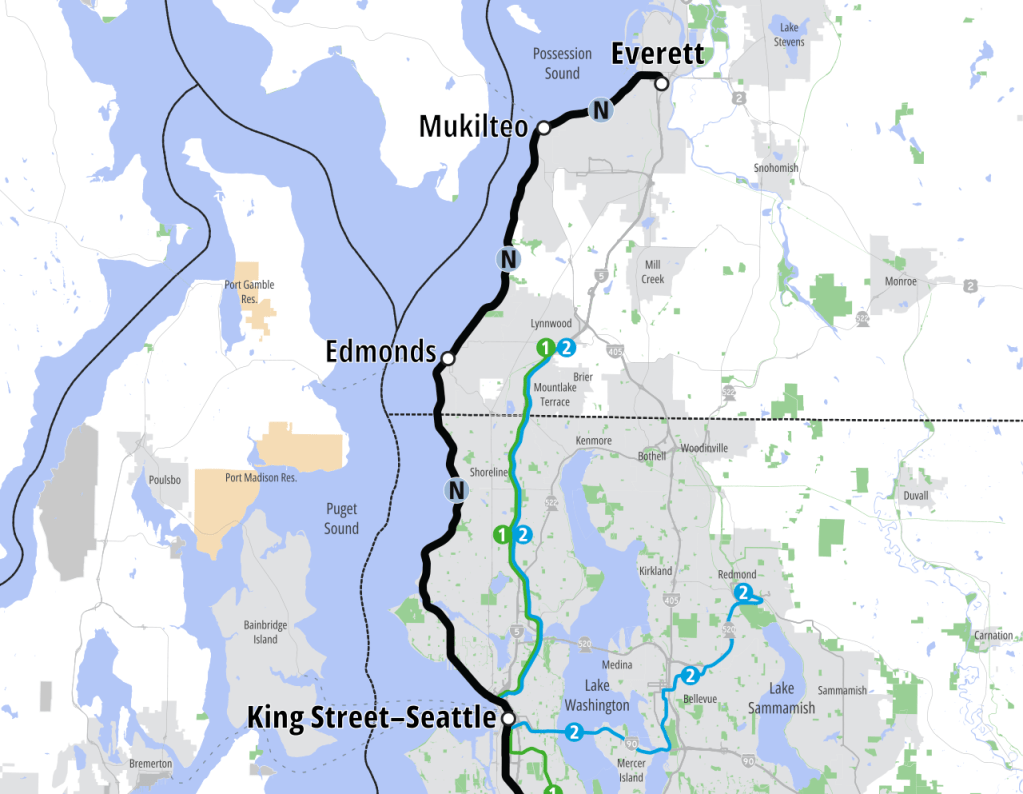
With that out of the way, let’s return to that op-ed. The crux of the author’s argument boils down to Ballard deserves something while it waits for Link, the Sounder N already passes through the neighborhood, so it’s only fair to put a stop in. At a high level, this is a fine enough idea, and Ballard certainly does deserve something while it waits. A new commuter rail platform should be a low-cost project, and there would be some transit benefit to the service.
Unfortunately, the transit benefit is extremely small – much smaller than the op-ed would have you believe. Since the Sounder N Line only runs peak-hour, peak-direction to Seattle, the only real commute benefit for a Ballard resident would be heading to Seattle. And this benefit is nearly zero. Route 17 – an existing peak hour only bus that likely costs about $10 per rider – is scheduled for 26 minutes to the heart of downtown from the nearest stop to the theoretical Ballard Sounder stop.
For every other trip mentioned in the op-ed (outside a frankly useless one to Paine Field), travel time improvements on Sounder are grossly overstated for the average Ballardite living closer to a stop on the 17, 40, or D than near the theoretical Sounder stop. Quoting 45 minutes from Ballard to King Street Station in the AM versus 15 minutes on Sounder is bad enough (it’s 30 minutes on the 17 and that 15 minutes is just train travel time from a poorly located stop), but it’s just factually wrong when it says it takes 80 minutes to get from Everett to UW. The 512/Link combo takes under an hour.
It’d be a little over 15 minutes on the Sounder plus a 5 minute backtrack on Link or on another bus to get to the heart of downtown – working out to about 5 minutes of savings for the Sounder. But very few people will live closer to the theoretical Sounder stop than they do to a stop on the 17 (or the D, or the 40). If you are traveling closer to King Street Station, that’d be in favor of the Sounder, but keep in mind that the distribution of jobs in downtown Seattle skews away from King Street Station.

Since a Ballard Sounder stop would be purely additive – the Sounder stop being built would not take away from any existing Metro bus service – there’s no reason to be against it (other than cost). But we should be truthful when talking about the benefits. The travel time benefit for most commuters simply does not exist. It may still get some ridership on account of being a train, but transit riders in Ballard need better buses a lot more than they need 8 trips a day on a nearly useless commuter rail line.
To illustrate just how little this service would benefit Ballardites, I calculated the travel times on each existing Ballard-Downtown bus (the 17, 40, D, and 28) to three representative points in downtown Seattle (3rd/Bell, 3rd/Union, and King Street Station) and compared this to the theoretical travel time on the Sounder N Line. Then, from each bus or train stop, I calculated walk travel areas based on proximity to the given downtown stop3.

Visually, it’s clear that it’s not until you start traveling to the south end of downtown that using the theoretical Sounder N Line stop in Ballard even saves you any time. If you’re going to any place north of downtown (like to Amazon in SLU), it will never be faster to ride the N Line. And using population data from OFM, we can see that of the approximately 70,000 people who live in my greater Ballard boundary (bounded by 3rd Ave NW in the east), just 20% of residents would be closer to King Street Station with an added Sounder Stop.
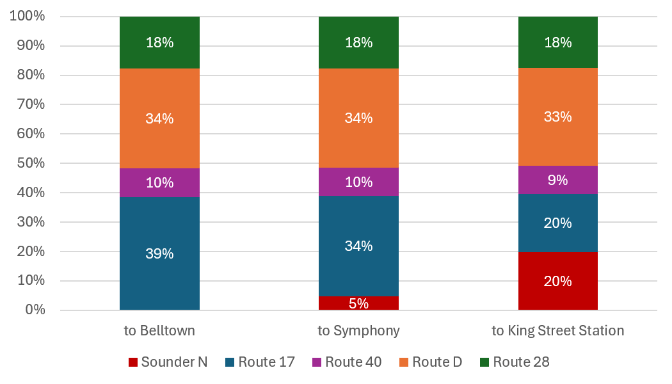
To be clear, that isn’t nothing. But given what we know about the distribution of jobs in downtown Seattle, does it really make sense to favor the 5% of Ballardites who will get a faster trip? I don’t think so – especially considering that these folks already essentially already have an express bus to downtown in the form of the 17.
So if we concede that maybe a commuter rail with a horrible span of service isn’t the transit solution Ballard needs while it waits for Link, it’s worth asking: what is?
Better, Faster Buses
Given that Link may not arrive in Ballard until 2060 and transit access can be pretty painful to Ballard, better bus service should be delivered in the interim. There are two key corridors to consider for this – Ballard/Downtown and Ballard/UW.
For the former, simply running the 17 all day would be a good place to start. If direct service to 15th/Market is more important than the 34th Ave service that the 17 provides, Sound Transit could resurrect the currently suspended Route 15 and run it all day as well. The 17 is seven minutes faster from the foot of the Ballard Bridge to Belltown than the D, so running an all-day express that skips Uptown and Interbay would provide legitimate value to riders.
For the latter, extending the current 542 (Redmond/UW) to Ballard (and renaming in the 544) would greatly improve access between Ballard and the East Side. And while it would run on Market and 45th between UW and Ballard like the current 44 (hence the rename to the 544), it could still a bit of time for Ballard/UW trips.
And finally, simply making speed and reliability improvements for the RapidRide D would be the simplest and most direct way for Sound Transit to address their 25 year delay with Link. The D is a very bus busy that often gets bogged down in traffic, and Sound Transit could pay for upgrades to move it closer to real BRT.
None of these are particularly sexy choices. But there is obvious precedent here. When Sound Transit nixed the First Hill station on the UW Link project, they built and operated the First Hill Streetcar as penance. We should demand more of Sound Transit if they are going to insist that they cannot redesign the Ballard Link project into something more reasonable4.
Parting Thoughts
Ultimately, while the op-ed in question misses a ton of key points, it’s clear that Ballard deserves to get something while they wait for Link to arrive. And as someone who currently travels to Ballard almost exclusively outside of when the Sounder N Line runs, I’m naturally biased against that specific option.
But there’s good reason to be skeptical that downtown-commute oriented transit is the solution Ballard needs. That won’t help transit riders from other parts of town get to the Ballard Farmer’s Market, nor will it help Ballardites who work something other than a downtown office job. It’s not even clear it will genuinely help Ballardites who do work a downtown office job – except to move them from a relatively cheap bus to a relatively expensive train.
And the key thing that Link will eventually deliver is fast, high-quality, all-day service to Ballard. While issues like the Ballard Bridge will always limit how well buses can deliver this, until we are confident that our current bus network is as good as it can be, that will always be my focus. Buses aren’t subject to draconian terms and conditions from BNSF5 that practically prevent service expansion at any point in the near future and they have the benefit of being the least expensive option too.
As advocates, urbanists, and transit riders we should be clear: we need Link to get to Ballard, but we also need better buses. Bread and roses as they say.
Thanks for reading, ’til next time.
Footnotes
- Calculated from the revenue per line in the 2024 fare report. The N Line makes up about 18% of train miles on Sounder, so I assigned it 18% of the $90M in operating costs. With 91,000 riders in 2024, that works out to the $331 per rider. In reality, this may be somewhat lower (since the N Line runs fewer train cars than the S Line), but still. Sounder’s average cost per rider for both lines was $48.26 in 2024 ↩︎
- No other commuter rail system costs more per rider, but I can’t be bothered to look up or distribute costs to each line. Data from the NTD if you’re curious. ↩︎
- This is a type of voronoi diagram. I used osmnx and networkx in python to do these calculations – I’ll share my code with you if you ask (don’t really feel like publishing it unprompted though). Note that this is only walking time and doesn’t account for potential transfers from the 44. This would make things look a bit better for the Sounder, but only very marginally. ↩︎
- To be clear, I think they can and should do this too. But it should be easy to get some “sorry we didn’t give you trains” buses. ↩︎
- As an aside here, I was going to touch on how Amtrak should have always been the operator for the Sounder N Line based on their right to run trains for only the incremental cost of service (compared to other operators who must pay whatever a train company charges), but felt it sort of distracted from the main point. I’ll expand on that at some later date – but by my estimations Sound Transit pays about 10x per train mile what Amtrak would for track access. ↩︎


Leave a Reply