
Trailhead Direct is King County Metro’s seasonal shuttle from Seattle to select busy trailheads. Trailhead Indirect is a column written by Seattle resident Andrew Lindstrom, whose desire to explore the outdoors knows no season.
One of the little joys of being a bus rider in Seattle is that there’s a nice assortment of large (but not absolutely massive) parks with nice hiking and walking trails. Of these, Discovery Park may be the crown jewel. It’s over 500 acres of mostly second- or third-growth forest with a few large meadows and a very nice set of beaches. It’s also host to Daybreak Star Indian Cultural Center – a unique and critical institution that’d be worth checking out even if Discovery Park wasn’t also lovely (more on that in a bit).
Arriving by transit is easy enough. Both the Metro 24 and 33 directly serve the park, though the 24 is a weird little bus so you’re probably better off taking it to a stop that only gets a few blocks away instead of to the end of the line.
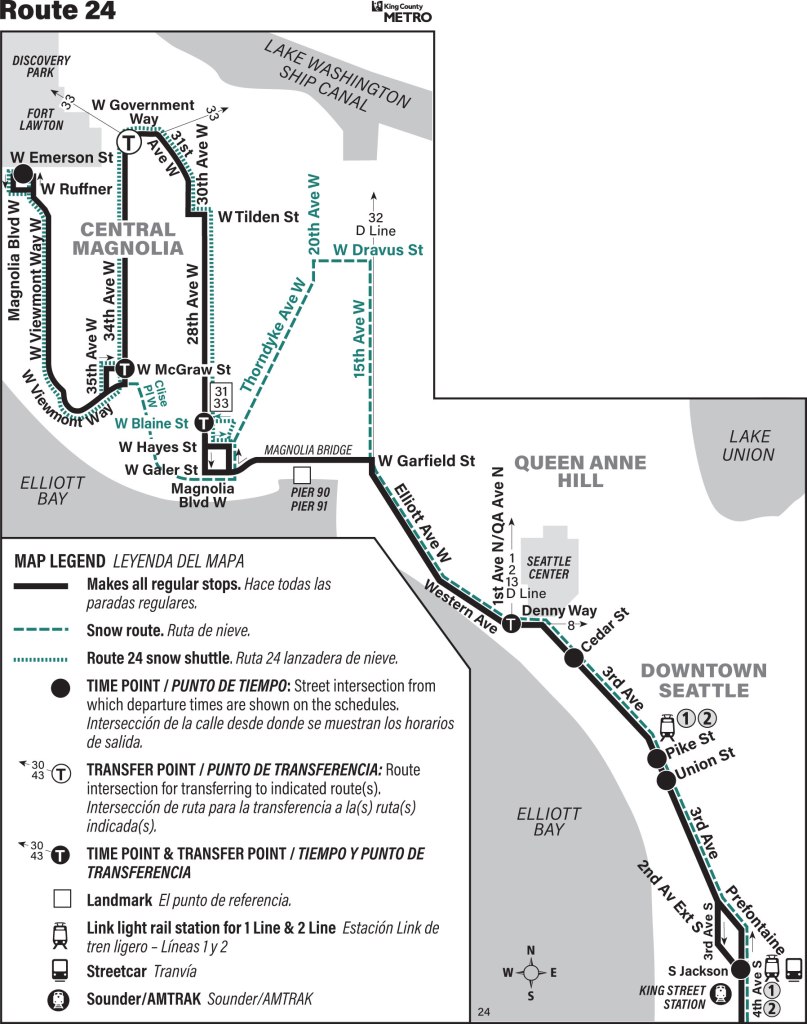
While neither the 24 nor the 33 have the best schedule (especially on Sunday), and they are often not scheduled with each other in mind, with a bit of planning it’s not too hard to make it work. Hourly service on Sunday isn’t ideal, but half-hourly service on Saturdays is absolutely serviceable for a walk in the park. If you miss a bus, you can always continue enjoying the park.
From downtown Seattle, it’s about 25 minutes to the park on either the 24 or 33 – board at 3rd and Pine1, de-board at W Government Way and 34th Ave W (for the 24) or at Discovery Park Blvd and Texas Way (for the 33 – also the final stop). If you’re up for a longer walk to the park, you can also make the trek from the Ballard Locks (accessible via the 44 which runs every 10 to 15 minutes). That’s a 25 minute walk, but the Locks are worth a visit either way so it makes for a nice longer adventure2.
During the summer, there is also an intra-park shuttle that run from the parking lots to Daybreak Star and the beach. If you aren’t up for a walk, this could be a good way to get from the stop on the 33 down to the beach, but a brief look at the schedule (every 45 minutes) doesn’t inspire a lot of confidence.
Park Highlights
The highlight of Discovery Park for me is definitely Daybreak Star Indian Cultural Center. Established by the United Indians of All Tribes after a long struggle with the federal and city governments, it provides cultural and linguistic resources for the Indigenous community in Seattle. United Indians of All Tribes occupied the recently vacated and surplussed Fort Lawton, which the Army gave to the City of Seattle. After a series of occupations, the city agreed to lease the grounds of what is now Daybreak Star to United Indian of All Tribes.
I’m certainly not the best resource on all the comings and goings of what’s happening at Daybreak Star, but it is a space worth spending time in. Just down the way from Daybreak Star there are ponds where Olivia and I have seen the resident beaver and a river otter. The series of trails between the terminus of the 33 and Daybreak Star is also particularly nice (the Wolf Tree Nature Trail).
The main trails of note at Discovery Park outside the lovely little Wolf Tree ones are the Loop Trail and both the North and South Beach Trails. You can reach the most westerly point in the City of Seattle via the two beach trails. On the Loop Trail you can expect to see a wide variety of habitats including a lot of old growth Big Leaf Maples (Acer macrophlyum). The meadows have some oaks growing in and a smattering of flowers even in late August (we saw goldenrod and Douglas aster the other day when we went). There’s also plenty of blackberry for the picking and eating.
The Why of it All
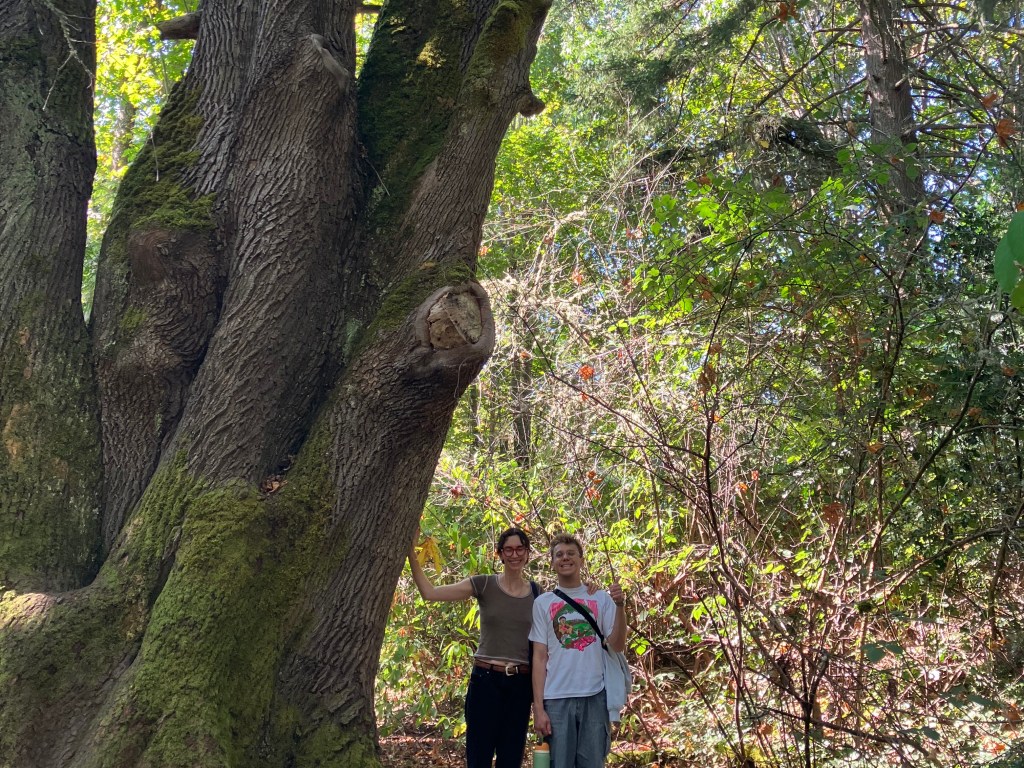
When Olivia and I first moved to Seattle, Discovery Park was one of our first transit adventures. It’s easy to get to on the bus, it’s got a lot of interesting flora and fauna, and it’s host to a significant center for Indigenous culture in the Northwest. Despite this, I feel that these aspects of the park fly under the radar.
On the transit access front, even though groups like the WTA do mention when trails are accessible, they spend a lot more time describing how to get there by car than by bus. I won’t say it’s performative per se, but it does feel like the bus directions are written by people who do not actually ride the bus to the trailhead. They do provide a really neat trip planning option3, but I think qualitative descriptions of the routes are important too.
When I’m planning transit-oriented hiking trips, the first point of consideration is how often the bus runs. There aren’t many parks with hikes of note accessible directly by very frequent routes, but the fact that Discovery Park is close enough (for the person willing to walk a mile) to a bus that runs every 15 minutes or better even on the weekends (the 44) matters a lot if you’re interested in doing transit to the trailhead.
One of my least favorite things about Trailhead Direct is that the buses don’t come frequently enough to make the return trip pleasant. Having a high-frequency bus line a little further away is often more convenient than an infrequent bus directly to your destination. And I know plenty of people who plan 6, 7, or 10 mile hikes for themselves on the weekend.
So why not embrace the bus to get creative with routes? The simple joy of being untethered from the tyranny of having to start and stop at the same place demands more planning, but it’s more rewarding than you realize. Discovery Park, by virtue of being reasonably served by 3 buses offers so many good options. Below I’ve mocked up a nice 5.5ish mile route that starts at a stop on the 44 and ends at on the 33.
The broader point here is that even when outdoor-oriented websites talk about transit access, the specifics are typically left as an exercise to the reader. But if you’re unfamiliar with the ins and outs of doing this, you may be nervous or unwilling to give it a try. It feels like the Onion headline of “Report: 98 Percent of U.S. Commuters Favor Public Transportation for Others“. Most people in Seattle broadly agree that at least busy trailheads should be accessible via transit, but that desire rarely extends to the realm of personal decision-ing.
To that end, you won’t find the most sublime piece of untrammeled wilderness where man is but a visitor, but maybe if that’s the only way you can value being outdoors, you should reconsider your own relationship to the outdoors. Wilderness is just as much a human construct as a city, and the park you can get to by bus has just as much to offer if you have the right frame of mind.
Incidentally, this makes the entire goal of Trailhead Indirect much broader than those of Trailhead Direct. Here, we seek to reevaluate the social basis of both how we get around and where we’re going. There, they seek to merely reduce peak parking loads at a series of trailheads at first with a pivot to focus on outdoors access only asking people what they use the service for. And to each their own; bloggers with no functional power over how the world operates have fewer real constraints than those who have to justify their political existence.
And it should be no surprise that a visit to Discovery Park should elicit these considerations. Its history of Indigenous activism makes it a space where reimagining what our relationship to the natural world feels natural, and its position in the public transit network makes it one where reimagining how we all get to the places we want to go easy enough for anyone to try.
Thanks for reading, ’til next time.
Footnotes
- The 24 and 33 also serve other stops on 3rd Avenue, but I trust you can figure out which one makes most sense for the transfer of your choice. ↩︎
- The park is also accessible via the 31, though this is a longer walk than from the Locks and a less interesting one too. And for most trips, the 44 will be more convenient than the 31 by virtue of coming at least twice as often. ↩︎
- Honestly the trip planning option linked on WTA is extremely cool, I just don’t plan trips in this way. I need to figure them out on my own – but I could be a weirdo on this front so here’s a link to it if you’re interested in a good transit trail planner. ↩︎


Leave a comment