

I recently had a random person reach out to me via my “contact me” page. This person saw that I was featured on a website called Indefinite Adventure1 and asked how I “arrange placements like these” and if I do them myself or via an agency. Incidentally, the answer to that question is that I don’t do anything to place myself on any website. This site is, always has been, and always will be an outlet for my thoughts about the world.
But of course, that’s not a very interesting conclusion. The reason this all was interesting to me is because Indefinite Adventure is very obviously an AI slop accumulator. The post that I was “placed” in is titled 13 Reasons Why Visiting London Is Better Than Living There. It, and my placement in it, offer a glimpse into the black hole of an internet where both pages and traffic are essentially automated. And maybe, just maybe, it links in with broader issues with our AI oriented economy.
This all began a while ago when I noticed that one of my posts from 2024 (Is London Worth a Visit?) received a strangely high amount of traffic. So much so that it’s my most viewed single post of all time.
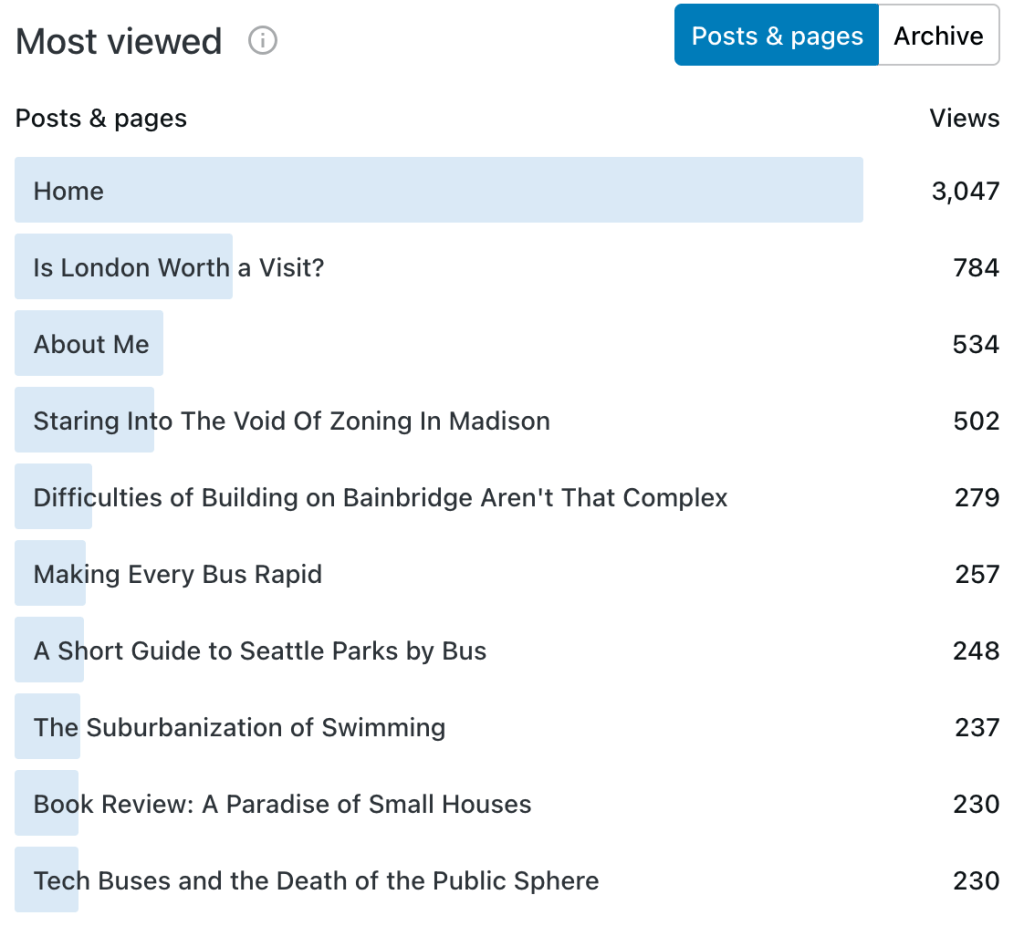
But unlike my other top-viewed posts, it never garnered any kind of obvious attention. Other well-viewed, like Staring Into The Void Of Zoning In Madison, got that through being shared amongst people I know. Still others, like Difficulties of Building on Bainbridge Aren’t That Complex, ended up being shared outside of my direct social circle (but I still heard whispers of it being shared). Because of this, I’ve always been suspicious that the traffic to this particular post was artificial.
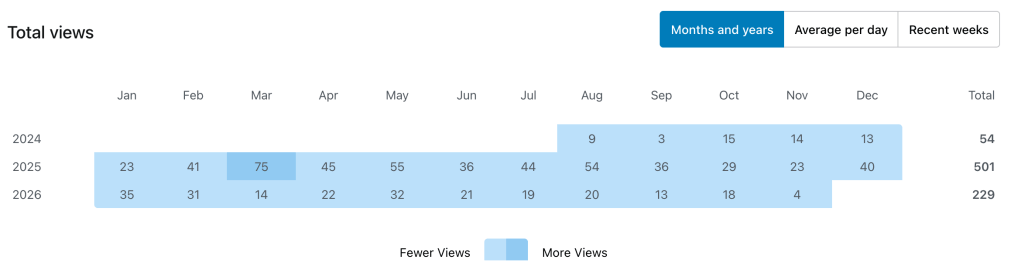
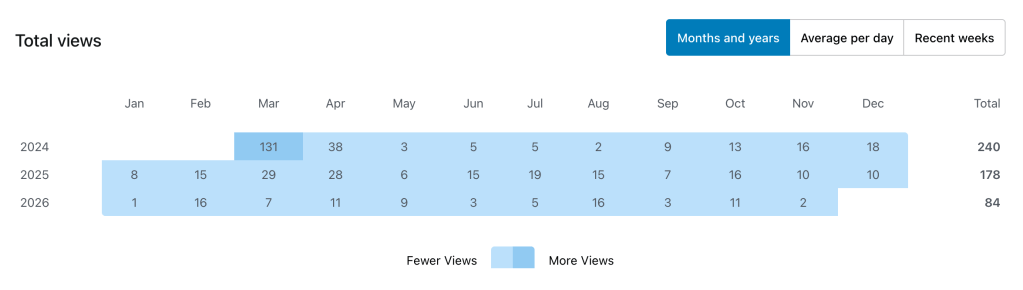
Views came in one or two at a time and since posting that I’ve gotten a view unscrupulous and very obviously low-effort AI slop machine type sites following me. I was vaguely curious about the nature of this, but since I didn’t know exactly where anything was coming from I didn’t look into it any further. But now, thanks to some other (presumably bot) response to my site, I have an excuse to look into it further.
The AI Future Sucks
The thing that immediately jumps out upon reading 13 Reasons Why Visiting London Is Better Than Living There is just how painfully wrong it all is. They manage to say that a Visitor Oyster Card is cheaper than what residents pay. This is dumb and anyone with a functioning brain can sort out that its dumb. A Visitor Oyster Card is just a normal Oyster Card that Transport for London (TfL) will mail you with a pre-loaded amount of money (that you choose and pay for) on it. It offers no cost savings.
TfL has very high fares in general, but if you’re over 60, you are eligible for free fares if you live in London. I think that’s the most notable discount on offer and it directly contradicts the point this “post” is “trying” to “make”.
They also manage to say that if you don’t live in London and just visit, you won’t have to pay the “dreaded council tax”. As if the place you are living instead of London somehow doesn’t also have an equivalent tax. Sure, tax rates may be higher or lower elsewhere, but come on. It’s lazy slop!
Though the claim that bicycles dominating traffic makes things “more hectic for residents” certainly raises an eyebrow or two, I won’t litigate the entire piece2. It’s just not worth my time to dissect why a stupid AI slop website is stupid and wrong. But let’s look at how my post is referenced:
The city’s integrated transit system makes international travel seamless for visitors and travelers alike.
Now let’s look at my post is actually saying. While I naturally spend a lot of time in my post talking about transit, I really don’t talk about how the transit system makes “travel seamless”. I mostly just gush about how there’s like 220 trains per day per direction between Woking and London, say that we rode the Tube a bit but didn’t ride any buses, and complain about the British Empire. It’s a standard City Hikes post.
Ironically, the least enjoyable part of our visit might have been getting into Heathrow, being screwed over the baggage retrieval system, missing the coach bus to Woking (that had a non-refundable ticket), and resorting to a cab. It was certainly not seamless for these international travelers! There’s just something sinister about being misquoted by a machine in this way.
But this is what the AI slop internet is made of. When quotes and citations are made, they are entirely vacuous and fully lack context. If whatever AI model that was used actually looked at my website, it did an objectively bad job of summarizing even the broad purpose of my piece. This is one tiny example of how bots and AI slop rule the modern internet. It can’t be the most interesting example, but it still fills me with a creeping sense of dread. It feels like the internet is dying.
Does It Matter If The Internet Dies?
Back when I was younger, Google was the gold standard of both improving access to information and providing a quality service. There’s a reason “google” made it into the vernacular as the word for internet search and it isn’t strictly a story of corporate power. While the power of language means that this is unlikely to change (“I’ll DuckDuckGo that” really sounds wack too) no matter the level of negative press that Google gets, I can’t help but feel that Google (along with the other mega tech companies) are destroying the place that is ultimately responsible for their unholy gobs of cash.
Everyone I talk to is increasingly jaded with the prospect of social media and AI. I have no doubts that self-selection plays a large role in this, but when entire social movements are cropping up around not being online, one gets the feeling that maybe, just maybe, the modern internet isn’t worth being on.
Of course, the irony in posting something like this on the internet isn’t lost on me. But I think it’s worth reflecting on if the death of the internet at the hands of tech (or AI) companies is something that ultimately matters. The ultimate social promise of the internet and all related technologies is improved human connection (other benefits like increasing bureaucratic efficiency aren’t exactly sexy). It’s not hard to see that even the pre-AI slop internet had a deeply cynical way of achieving this.
Pre AI3, tech companies sought to increase user engagement and retention through algorithmically generated endless feeds. I distinctly recall my own annoyance with this trend. It shifted social media from something that was fundamentally about relationships that I already had (i.e., people I followed) into something I consumed4. This was a form of AI, machine learning if you prefer to be old fashioned about it, and it represented a clear break in the social/user-driven focus of older forms of social media.
You’re probably aware of all the social issues that came about from this age of social media. The American Psychological Association noted in 2022 that the body of research on social media use more or less concluded that it had negative impacts. And these studies mostly predate the meteoric rise of short-form video content like TikTok since 2020.
But at least that content was largely made by people. These days, you can’t throw a metaphorical rock online without hitting some feckless AI grifter selling a class on how to make a bunch of money automating a YouTube slop machine channel5. Things then may have been filled with an abyssal horror, but at least it was our collective abyssal horror. Now, its the abyssal horror of what the techno-fascist culture vultures of Silicon Valley pass through an absurdly expensive machine whose data centers are currently destroying a neighborhood6.
To consider the ramifications of this, let’s consider some Steinbeck:
“When a man comes to die, no matter what his talents and influence and genius, if he dies unloved his life must be a failure to him and his dying a cold horror.”
The internet is not a man, but the companies that have built their empires are made of them7. If the kill the internet, the thing that has brought them their riches and lavish lifestyles, it will cause the end of their lives as they know it. And I believe that this dying will be a cold horror. No matter how clever, impressive, or otherwise neat the technological advancements of the internet age have been, they have served, above all else, as engines of division.
Who amongst us would use “love” to earnestly describe an AI chatbot? Only the people who have been caught in a bad situation and who need real human connection to lift them from their sycophantic nightmares. And who amongst us would use “love” to earnestly describe their relationship with Instagram, TikTok, or any other social media app? I found one longer post from someone who claimed to love Instagram in 2015. Looking at their account now, they haven’t posted since 2024.
Sure, that’s a sample size of exactly one. But searching the internet for the literal “I love Instagram” yielded me just three results – all from the 2010s. And you may ask yourself: isn’t love a pretty steep bar? Does this also mean that all the milquetoast businesses where people are motivated by little more than a quick buck should also feel that their dying will be a cold horror? In some sense, I do think the answer is yes; you should do things that you believe will improve the world, and the emotion of love can be associated with that.
Incidentally, internet projects run by volunteers – things like Wikipedia and OpenStreetMap – endear much stronger emotions than the advertising companies in a trench coat masquerading as social media companies we have these days. Wikipedia has a page dedicated to passionate editors who have passed away. It’s clear from reading any number of these profiles that the people who edit Wikipedia care very deeply about both the subjects they write about and the project writ large. Can we say the same about the people who have developed more efficient ways to sell ads on the internet?
Maybe the profit motive inherent in corporate tech sucks the life of people who work for them, or maybe my time in Seattle has made me cynical about the world of big tech, but I can’t help to feel that somewhere we’ve lost the plot. I won’t say that AI destroying what’s left of the internet is a silver lining, but I do take solace in the deepening unpopularity with big tech.
The False Promise of Knowing Everything
A year and a half ago that I Despise AI. Back then, my issues were oriented more closely around social norms and the banality of tech companies blatantly stealing. Those points still stand. But things have gotten undeniably worse since then. To quote Gramsci: “In this interregnum a great variety of morbid symptoms appear.”8 As was the case in Gramsci’s time, the time we live in now is marked by uncertainty, instability, fascism, corruption, and more. But these “morbid symptoms” we live with now did not emerge from the void.
Our society – one that can create and destroy the internet in a span of mere decades – is one wrack with contradictions and difficulties. I can present no solutions to these, since my inclination is that grandiose solutions that impose a knowable order on the world are ultimately unable to deal with the beauty and complexity of the world in its entirety. But I can say that making the world a better place involves living by the values you hold dearly.
If you’re like me and you believe that all people, regardless of who they are, deserve to live a life filled with joy in the pursuit of things they love, then you have to consider the way that our current economic system produces outcomes that are hard to feel good about. Poverty is still endemic and our state institutions haven’t prioritized much in the way of head-on solutions since the 1970s.
But what’s ahead is still worse. We should take AI grifters seriously when they say things like “AI will create a permanent underclass“. I question the ability of AI technology as it exists now to do this, but its undeniable that its purpose is to do this. And the dizzying amount of investment serves to create this proposed world; the build out of this system is part of creating that world. This is bad, and it should be resisted in every way possible, but it’s ultimately not the larger point that comes to mind. To explore that point, we have to consider how people interact with AI systems as they exist now and why that’s bad.
And to be clear, I don’t fault people for using whatever AI system they prefer. I can see the appeal in certain niches. But those niches are almost universally places where I lack expertise or confidence. It’s tempting to go to the seemingly all-knowing source of knowledge to whet this thirst, but it can ultimately only ever instill you with false confidence. I once read that YouTube channels like Real Life Lore and Wendover Productions were great until the topic was something you had a deep familiarity with, because once they are talking about something you know a lot about the issues are glaring9.
I think there’s some of this dynamic in what tasks people consider to be “AI-able”. It’s easy to imagine AI as a coding tool if you don’t relish at the prospect of writing a poorly factored piece of spaghetti code to solve some niche problem with an existing solution. And perhaps you think coding is a bad example – after all, wasn’t the whole tokenmaxxing vibecoding shift predicated by programmers? Well I’m not the authority on the culture of coding, but I think reality is more nuanced than this10. AI tools ultimately are good at something like a middling summary of any given topic, the accuracy of which will be unknown to most users.
It’s this subtle issue of overconfidence in unfamiliar topics that fills me with the sort of morbid dread relevant to the discussion at hand. I don’t think anyone was clamoring for more armchair experts without much in the way of practical experience before ChatGPT was first released, but it seems to me that that will be its lasting impact. But ultimately, that’s what the culture of Silicon Valley encourages, so we shouldn’t exactly be surprised.
Nothing has driven this home for me more than watching You Can See Everything. Elizabeth Holmes’ insufferable husband watching biochemistry videos on 3x speed and refusing to condemn AI porn of his wife on the site formerly known as Twitter (despite bragging about how he knows higher there!). I think there’s a relationship between thinking you know everything about the world and being an insufferable person and everything about AI makes it easier for people to feel like they know more than they really do.
Bringing things back to London, I feel like that encapsulates the absurdity of the titular situation. The entire economic and technological system that we call AI encourages the sort of slop that imagines me, someone who has visited London for all of three days and who stayed in Surrey, as qualified to speak on how “Visiting London Is Better Than Living There”. Even the least scrupulous human author wouldn’t stoop to this level. Maybe there are larger issues to unpack in the oligarchic economy of 2026, but this false confidence is endemic to both AI as a product and AI companies as institutions. I think that’s a problem.
Thanks for reading, ’til next time.
Footnotes
- It’s not important to the rest of this, but I think it’s hilarious that the email listed on this obviously AI slop website is “info@company.com”. I sent them an email to see if they’d respond, but as of writing this has not happened. ↩︎
- But on the bike question: I know for a fact that this study is concerned with just the City of London (the historical medieval city). Most tourist attractions are in the West End, as the City is primarily financial office buildings and other things like that. ↩︎
- NB: I’m using “Pre AI” loosely. I know that AI is a field that has a longer history than just ChatGPT, and I know that machine learning has existed for quite a while now. ↩︎
- I’m not the first or last person to complain about this. I recommend Technology Connections’ (quite long) YouTube video on the topic. ↩︎
- Here’s the first link I found for this. I think if you do things like this you should be banished from polite society. ↩︎
- This is unfortunately not an exaggeration. The xAI Colossus Data Center in Memphis is powered by gas turbines and has caused deep environmental harm in a working class, majority Black part of Memphis. Some reporting on the subject. ↩︎
- To be clear, they are made of men and women and non binary folks, but Steinbeck wrote in a time where “men” was used to refer more broadly and I felt that this sentence flowed better as written. ↩︎
- In Italian: “In questo interregno si verificano i fenomeni morbosi più svariati.” And for the recordI was hoping to use what I thought the quote was (“The old world is dying, and the new world struggles to be born: now is the time of monsters”), but apparently he never said that. It’s unclear what that line came from, but it’s recent. So I’ll stick with the less dramatic (but still relevant). ↩︎
- Long-time readers may recall my one-sided beef with Wendover Productions over their laughably bad analysis of I5 in Oregon. Also, just got to say that I was cooking with that one! ↩︎
- Here’s a Business Insider piece highlighting this. ↩︎


Leave a Reply