As promised in my review of The Fellowship of the Ring, I’ve returned to review The Two Towers. I said in that review that my memory of Fellowship is that it was my favorite of the movies, but when I watched it a few weeks back it was hard to contain my disappointment. I’m sure that came through in the review.
But after watching The Two Towers, I feel the need to apologize for being so harsh to Fellowship. If Fellowship has too many ham-fisted action scenes that serve no real narrative function, The Two Towers may as well be one long ham-fisted action scene devoid of broader narrative purpose. The gratuitous use of violence is disorienting, and it’s a good place to begin with my broader thematic issues with the film. And while it’s easy to be a naysayer, I want to be clear that I think these issues are primarily relevant because they end with a story that resonates less. The movies tell a different story than the books, and while it’s not always worse, my gripes are not that they are different, it’s that they are worse1.
And moreover, these changes lead to broader issues in the films. They feel (to me) incongruous as a result of keeping certain unavoidable aspects of the thematic core intact while changing characters to a degree that makes the thematic beats feel out of place. But more on that later, for now we will start with the glaring.
On Violence
Roger Ebert began his review of The Two Towers with the following: “it’s clear that director Peter Jackson has tilted the balance decisively against the hobbits and in favor of the traditional action heroes of the Tolkien trilogy.” And while Ebert is willing to (somewhat begrudgingly) accept this, I find the gratuitous violence to be, well, gratuitous.
One could probably create a plot of screen time for each character compared to how often they are doing something of note in the book. I won’t go into that level of detail, but even a cursory glance at screen time by character is revealing. In the theatrical cut of The Two Towers, Theoden gets more screen time than Merry or Pippin. Returning again to Ebert:
If Tolkien had wanted to write about a race of supermen, he would have written a Middle-Earth version of “Conan the Barbarian.” But no. He told a tale in which modest little hobbits were the heroes. And now Jackson has steered the story into the action mainstream. To do what he has done in this film must have been awesomely difficult, and he deserves applause, but to remain true to Tolkien would have been more difficult, and braver.
This is ultimately why I find the use of violence to be so disarming. The original stories are about how small, modest, and ultimately relatable hobbits (standing in for the every man) have a crucial role to play in the saving of their society. A work that centers fantasy action above all else is just not capable of telling this story. Lord of the Rings is a work interested in subtlety, but action sequences are, perhaps definitionally, incapable of much of that. Let’s consider how the film portrays Gandalf talking with Theoden to lift him from his sloth to how the book portrays the same thing.
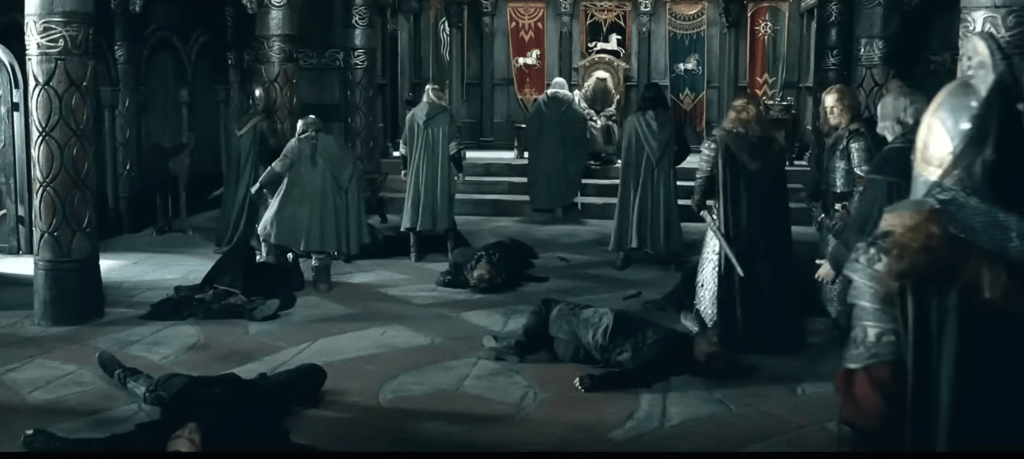
In the film, Theoden is literally possessed by Saruman. Gandalf must draw him out “as poison is drawn from a wound”, and this culminates in Gandalf striking Theoden with his staff (but in fact injuring Saruman).
In the book, Theoden has been subtly manipulated by Wormtongue into believing that Gandalf is an omen of bad news, that action against the dark powers is hopeless, and that delay and caution is prudent. Rather than a literal possession, Theoden has simply been cowed by bad council. While Gandalf engages in a bit of sorcery, this is more of a dramatic moment of darkening the sky before allowing the light to come through again. Theoden ultimately is moved by the counsel that Gandalf provides, concluding on his own terms that “it is not so dark here”.
Perhaps this wouldn’t have made for as dramatic of a scene. But its important to note that Gandalf’s primary role in the books is counselor and he is still framed as the ultimate source of counsel above all else in the films. Rather than physically removing Saruman, he simply provides better counsel. The power to make the decision and the agency still remains with Theoden. So even though Theoden receives an undue amount of screen time in the film, his role as an active participant in the plot in the film is still diminished.
The action scenes in the film generally create this dynamic. Characters whose strengths lie with subtlety, counsel, friendship, or anything other than physical violence go one of two ways. They are either changed into action heroes (as Gandalf is) or removed from the story (as Merry and Pippin are). And while not all changes to characters are bad per se, I can’t talk about the role of violence, strength in arms, and lack of subtlety without touching on Faramir.
On Power
Due to some pacing changes, the Two Towers ends about 3/4ths of the way through the book2. So rather than the climactic moment of the book coming when Sam and Frodo face Shelob and deal with the fallout, a wholly new narrative climax is created from the corpse of the book they are adapting. This narrative tension is provided by Faramir being a radically different character than he is in the books.
Rather than being a source of shelter, counsel, wisdom, and love who provides Sam and Frodo with a much needed reprieve from the hard road, Faramir imprisons the hobbits and marches them to Osgiliath to send a “mighty gift” to his father. In the books, Faramir and Frodo have a long conversation about the nature of Frodo’s journey. Faramir intuits that whatever task he has been entrusted with – Isildur’s Bane – involves a “fell weapon, perchance, devised by the Dark Lord“3. Knowing his brother’s love of valor and glory, he realizes that Boromir must have been sorely tempted. But he ensures Frodo that “I would not take this thing, if it lay by the highway. Not were Minas Tirith falling in ruin and I alone could save her“.
Later, when he learns from Sam that the fell weapon is, in fact, the ring of power he is tempted to take it – “to show his quality“. But he is bound by his word that he gave Frodo earlier (“I should take those words as a vow, and by held by them“). This is part of a larger choice made in the film to make the power of the ring to tempt and corrupt all consuming, rather than subtle and patient. Indeed, the Two Towers is almost wholly composed of shots of Frodo looking longingly at the ring. Its power is all-consuming, rather than corrupting in reference to the subject’s character.
This is a small change of framing, but it is a significant departure. Faramir isn’t corrupted by the power of the ring in the same way that Boromir was because he does not seek glory in arms. But in the films, characters are almost entirely defined by their ability to seek glory in arms. Thus, the ring is as tempting to Faramir as it is to Boromir. But because Faramir ultimately cannot follow through on delivering Frodo and Sam to Minas Tirith, he simply has to decide to let them go. His change of heart (at least in the theatrical cut) is simply not earned though. He has shown no signs of being wise, learned, or otherwise sympathetic towards the hobbits.
It’s not just that Faramir is a better character in the books, though he is. It’s that his choices as a character in the film are ultimately incoherent. Is he someone who resists the temptation of the ring, or is he not? In the books, he swears to Frodo before knowing the entire picture, but ultimately honors his word. In the film, he is clearly tempted by the glory the ring would offer him, but then goes back on his word to his men for undisclosed reasons.
The promise of power is a corrupting force in the world and as a result, having media that engages with this seriously matters. The comparison between Faramir and Boromir should be an example of this done well – of how power and glory are tied up in selfish pursuits, but that it is ultimately better to not seek glory as an end. Instead, the films cannot seriously engage in the topic, and are left much weaker as a result.
On Thematic Dissonance
Perhaps this exercise feels tedious to you. And it’s worth asking if it’s really realistic to expect a faithful adaptation of a book like Lord of the Rings (a book ultimately about the First World War). But I think the relationship between power and war lies at the heart of why I find Lord of the Rings compelling to begin with. It is a story that is substantially different from the standard sword and sorcery stories that saturate the fantasy media landscape.
Within the books, characters can roughly be divided into the good and evil camp through their relationship to war and their desire for power and dominion over others. Faramir’s line of “I do not love the bright sword for its sharpness, nor the arrow for its swiftness, nor the warrior for his glory” from the books is just the most concise way of describing this. I think that is a story worth getting right. Having the shell of the characters from this story enact something resembling the plot isn’t compelling to me.
It may be compelling to you. I recognize that my criticism of this films is grounded in my love of Tolkien’s writing. But it’s more than that too. When I look at the themes presented in the films, I see too much love for the bright sword for its sharpness. And this is ultimately why I take such issue in the way that characters are changed between the books and the films. I don’t expect an adaptation that mirrors it source, but I do expect an adaptation to be thematically consistent.
Because, the themes of a story are what the story has to tell us. I am frankly not interested in the story the movies are telling me. That story is ultimately that brave men save the day through violence. Our culture is rife with this and the appeal that Lord of the Rings offers is that it’s something different – something more grounded in fellowship, love of the land and its people, and in the power of the small folks to save themselves (and us all).
Of course, these themes are still present in the films. But I feel that they’re cheapened and remain only as necessary references to the source material. In the second film, this is most obvious in the way that Aragorn is treated, downstream of the way the films as works are uninterested in interrogating class. Sam is no longer Frodo’s servant; Aragorn is not nearly as ennobled. While this change is broadly understandable – Aragorn’s status in the books is essentially the divine right of kings – the choice to lessen the extent that Aragorn commands the love and adoration of the other characters through his words and status leaves holes in its wake.
When Aragorn, Gimli, and Legolas meet Eomer in the books, they are travelers in a strange (and somewhat hostile) land. Aragorn is able to command the respect of Eomer in part through the sheer power of his name: “I am Aragorn son of Arathorn … the heir of Isildur Elendil’s son of Gondor. Here is the Sword that was Broken and is forged again! Will you aid me or thwart me? Choose swiftly!“. It is this name, sword, and legend that Aragorn carries, of his rightful place as a king of men, that endears Eomer to him. Watching the film, it’s not clear to me why on earth Eomer would trust them, let alone give them horses. Choosing to put Aragorn on a different path gives him a stronger narrative arc that surely resonated more with modern audiences, but it does so at the cost of something.
That something is ultimately the narrative cohesion of the story at large. Taking away Aragorn’s essential character as the righteous and rightful king of men but leaving the rest of the story in place leads to situations like this. We as the audience may know that Eomer and Aragorn are on the same side, but in the context of the story as it’s happening that isn’t nearly as clear. It’s a small issue, but it’s an issue nonetheless.
On Hobbits
I’ll close by echoing Roger Ebert’s review: “I complained in my review of the first film that the hobbits had been short-changed, but with this second film I must accept that as a given, and go on from there“. Unfortunately, I am a lesser film critic than Ebert and am incapable of going from there. Replacing the hobbits as the emotional core of the film with Aragorn is profoundly upsetting to me. Merry and Pippin reduced to comic relief is unbearably frustrating; Sam and Frodo’s hammed up tension is a sort of psychic damage.
When I read Lord of the Rings, I’m reminded that the smallest of us have great power to do good and that not seeking glory in war is a virtue. When I watch the films, I see hobbits half-heatedly put in this role as the narrative demands, but robbed of agency, bravery, or anything resembling the characterization that I know and love from the books. I see battle scene after battle scene after battle scene4, but there’s no time for the central characters of the books to develop their relationships with each other.
Perhaps my feelings after watching Fellowship of the Ring should have been a warning. After all, the key decisions of Frodo (both to take the ring and to leave the fellowship) are both grossly mishandled in favor of scenes filled with additional drama. But in the Two Towers, it almost feels like there’s not even an opportunity to ruin great moments – they’re just cut altogether.
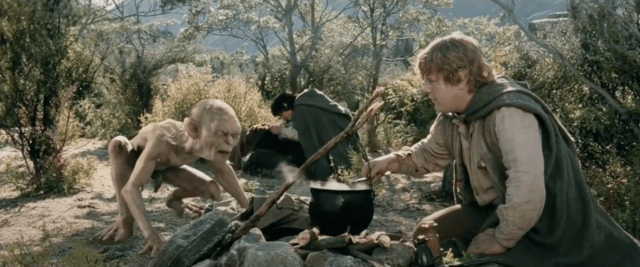
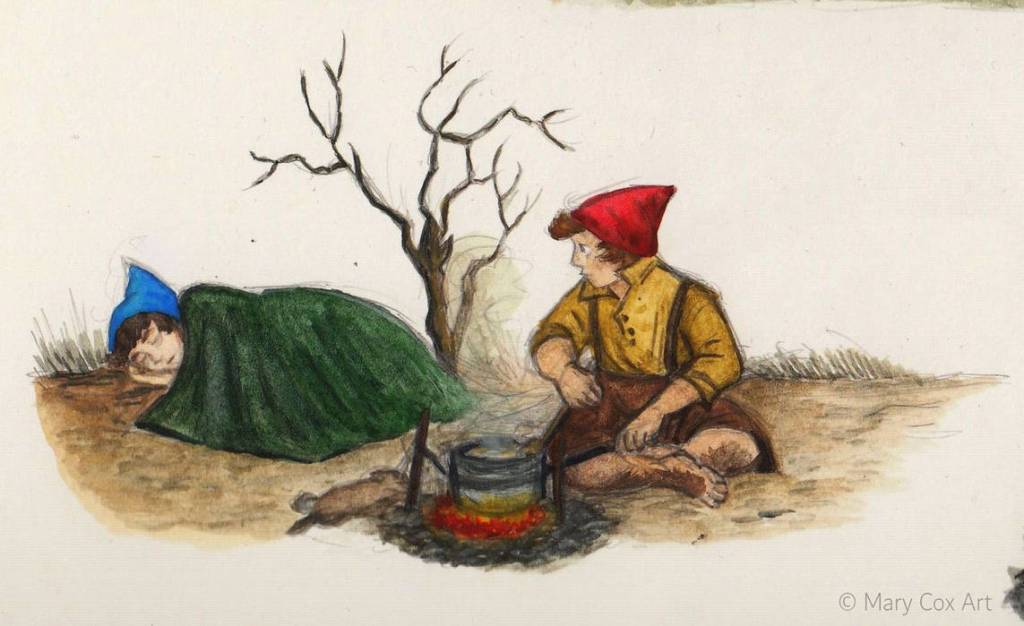
Maybe I should listen to Ebert. I’d probably be happier if I accepted as a given that the films are the films and the books are the books. But it seems to me that all the best moments in the films are the ones that come out of the books. It could be my Tolkien apologia coming through, but I cherish the moment where Sam is cooking rabbits in Ithilien. It’s a small moment, but the movie does capture the spirit of the book – it captures Sam’s frustration with Gollum in an earnest and thoughtful way. And it’s funny! I mean it was a meme at the dawn of the internet meme era.
Is it too much to ask for more of that and less of Aragorn being dragged off a cliff in a wholly contrived battle scene? The popular consensus for this movies has seemed to say that it is, but I cannot accept that. These movies – and The Two Towers in particular – could have been more faithful to the books and been much improved as movies.
Thanks for reading, ’til next time.
Footnotes
- I found this Reddit post where someone nitpicked the whole film. I largely agree with them, but I do think this kind of line-by-line critism can miss the forest for the trees. My issues are that the films miss some important emotional beats, not that they are different. ↩︎
- I’ll say that this change is bad, even if I get it. Shelob’s lair happens after the main army leaves Minas Morgul so the timing is off. But it also is a nice little preview to what is coming! They could have kept the pacing from the book, but it would have meant focusing on the hobbits at the expense of Aragorn et al. as Shelob’s lair is obviously the place to end The Two Towers. ↩︎
- Part of why Faramir knows this is that he has a dream and a riddle of Isildur’s Bane and Imladris (Rivendell). Boromir insists on going and that is how (and why) he arrives for the Council of Elrond. ↩︎
- Seriously, so many battle scenes. I’m sick of watching battle scenes. ↩︎


Leave a Reply