

In my day job, I do a bit of finance and economic analysis for the local governments my firm contracts with. I don’t consider myself an expert in any way shape or form, and these thoughts are more closely related to something that’s been rattling around my head since I took an economic development class in grad school. The crux of the question is the title of this post, and I want to explore why I feel that the common answer given by economic development agencies and experts is incomplete.
If you’ve spent much time in the world of economic development, you’ll know that a primary goal of any scheme is job creation. The idea is that good policies will attract businesses, and these businesses will hire workers who will then spend their earnings in the local economy (among other things)1. As such, the ever elusive “good job” is in high demand, as workers with higher earnings create more second-order economic impacts than workers with lower earnings. And firms which create a lot of jobs are better than firms which create just a few.
This dynamic is part of why the Amazon HQ2 hullabaloo was such a big deal. While the cynic in Seattle may look at that effort as mostly a vision of driving down their effective tax rate in Seattle, the allure of having thousands of very high paying tech jobs in town was enough for cities to resort to tacky gimmicks and massive handouts to get their slice of what Seattle already had2. There’s too much to unpack here about the sheer banality and ridiculousness of the process, but the point is that economic development agencies in cities (and other local governments) will bend over backwards to do job creation3.
My issue here isn’t with any specific standard approach, though I am obviously skeptical of corporate handouts ever being in the public interest, but is instead with what isn’t done. So let’s take a step back to consider how high paying jobs come into existence.
Classical Political Economy and Wages
Again, I am stepping outside of my usual areas of expertise (transit wonkery) into something that I have only a passing familiarity with. But I think it’s worth pondering the two major ideas about how wages are set: in a free market, where high demand for workers with specific skills drives wages up and vise versa, or by custom, where workers and employers negotiate what a wage should be via a complex social dance.
As usual, my feelings are “it depends”, but it’s important to note that both are likely aspects, and depending on the circumstances one aspect may matter more than the other. In the context of something like the tech industry, it should be clear that the general lack of highly skilled workers capable of high-level software development drove wages up throughout the 2010s. Indeed, you can probably argue this was the most relevant factor, outside of the fact that the outlandishly profitable tech firms could afford truly eye-watering wages for their rank and file workers.
But now, despite the generally glut of tech workers and endless rounds of layoffs, wages remain very high in the tech sector. I don’t think simple supply and demand terms explain this, so clearly the social factors also play some kind of role here4. We don’t have to dwell on the specifics too much, but I hope we agree that this is at least directionally correct.
So the question remains: how does this relate to economic development practices?
Creating the Social Conditions for Better Pay
If an economic development agency took a broader view of what creates a good paying job, perhaps they would conclude that improving the social conditions for workers to negotiate higher pay would be a part of this. In essence, if an economic development agency focused more on supporting organizers in low-wage sectors, they could positively impact the economy by increasing worker power relative to employer power.
A worker-first economic development strategy like this would be unusual as I understand it, but if we take a survey of union membership and wages through US history, an obvious trend emerges.
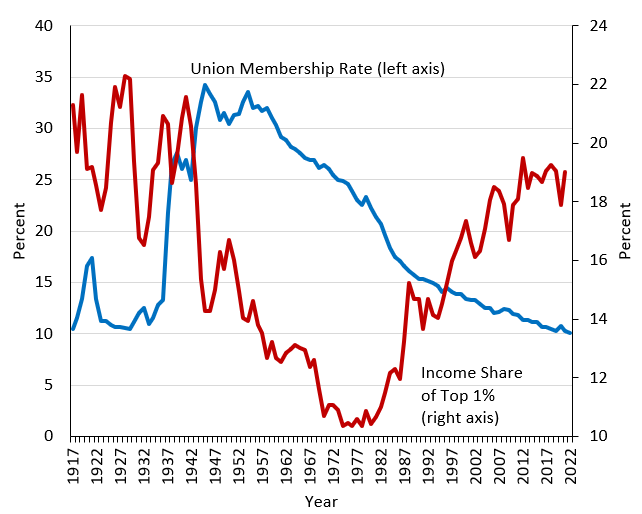
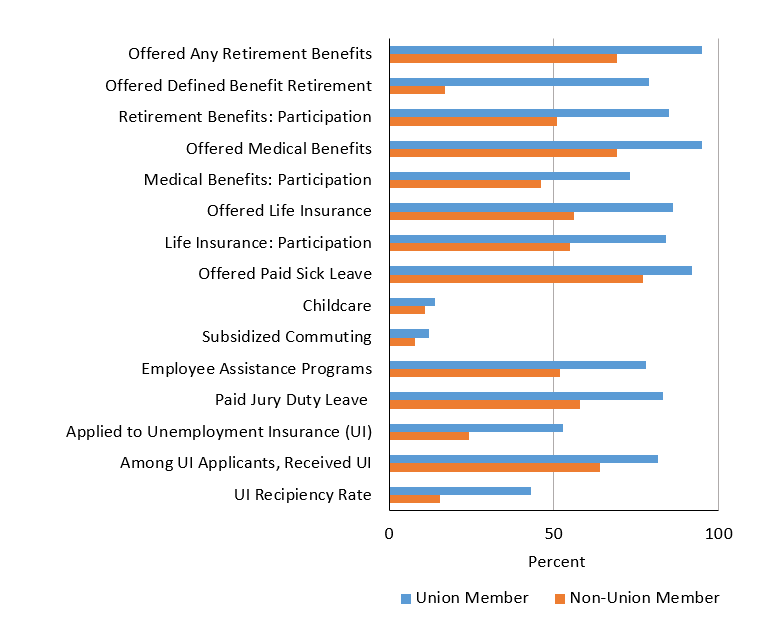
Worker power – even in the form of unions that often did not fully reflect worker interests – lead to significant gains for workers in both wages and benefits. Instead of focusing narrowly on attracting businesses that already pay workers well, an economic development program that aims directly at increasing worker pay has a few benefits. The most obvious one is that for workers who are employed by out-of-region companies, the majority of profits leave the locality. If our mental image here is that higher wages and better benefits allow workers to extract a higher share of profits from companies, then our conclusion is that helping workers organize keeps a higher share of corporate earnings local – something which will straightforwardly benefit a local economy.
But more crucially, by being less speculative it’s also just better policy. While I have no doubt that current norms around economic development have led to some successes, that doesn’t mean we are doing good policy writ large. Absent a larger comparative review, I think it’s likely that most speculative projects fail quietly, while some fail loudly, with just a few working. If those funds were redirected towards directly improving the social conditions for workers in the community, it would be easier to understand and track their impact.
Finally, if worker-oriented economic development became widespread, it would prevent the sort of reckless corporate profiteering that made Amazon HQ2 so distasteful by narrowing the scope of municipal policy towards those already in the community and away from speculative races to the bottom. On a national level, corporate tax breaks hurt one locality to the benefit of another. The only winner is the corporation, and we should do whatever we can in our power to resist engaging in losing battles like that.
Why Don’t We Do This Already?
This all sounds fine, but it’s really at odds with the history of economic development schemes in the US. While there are a few notable examples of worker-led movements leading to wins in city governments, the entire intellectual and political framework around economic development is still very narrowly defined. Even if you are unabashadely pro-worker in your political outlook and wish to revamp your local governments’ economic development agency, the people who staff that agency, the people who are considered experts in that field, and the people you are likely to find in academia are unlikely to have the experience to do this kind of work.
This kind of bureaucratic inertia is difficult to shake, even in a progressive town like Portland or Seattle. Let’s take a look at the programmatic offerings of the Office of Economic Development in Seattle to show you what I mean.

Of these five programs, just one is even potentially for workers (“Meet our Workforce Partners”), while the others are programs designed narrowly for small businesses5. This is fine, these programs aren’t problematic on the face of things, but I think it’s notable how many resources are available to small business owners, and how few are available to workers. Even the potentially for workers item – “Meet our Workforce Partners” – is still framed around the benefits to business owners of having a well-trained workforce, and is not directly run by the office.
Seattle also has an Office of Labor Standards, which enforces and litigates existing labor law, but this is a definitionally reactive body. Either a worker has to complain, or abuses have to be rampant enough for the office to pursue legal action themselves. This is a necessary aspect of a society that values workers, but at best it’s a defensive posture that will be ill-suited to making the sort of lasting changes to our economic system that are sorely needed.
The issue we have is that “economic development” and “improved conditions for workers” are defined as separate things, and that everyone in the field defines things this way in one way or another. There aren’t even radical lefties demanding that Prosper Portland and the Seattle OED redirect funds for employers to new schemes for workers6. As far as I can tell, it’s just not something anyone considers.
When I asked my good friend Connor, an honest to god professional in the economic development field, the only example of pro-worker economic development policy that he feels is common is the workforce development we’ve already touched on. So the answer of “why we don’t do this?” is mostly “because economists don’t think it’s a good idea or haven’t thought of it.”
Should We Trust the Economists?
On some level, I’m willing to accept this. A city explicitly supporting an organizing effort with money and other resources would be risky, politically contentious, and potentially novel. I’m no municipal employee, but none of those things strike me as things a city government would do unprompted – especially without some kind of academic research to reference to. But on the other hand, I think there’s enough evidence that unions are good for the economy7, so why wouldn’t we expect our local economic development agencies to assist them?
The point I’m getting at here is that the allocation of economic development funds is a strictly political choice. While governments attempt to get the best bang for their buck, they are constrained by what everyone else is doing. Municipal governments are, as a rule, conservative in their outlook towards risk, and without a strong push from intellectuals, workers, and advocates, something like this simply will not happen. On some fundamental level, we collectively view “economic development” to be synonymous with “business development”, which is perhaps why it feels incongruous to consider “improved conditions for workers” as a real choice.
I think we do this at our peril. Even in better political times, the risk of erosion of worker’s rights and norms is ever-present. Now, when things are even more dire, investing in workers is a no brainer. That’s not to say other traditional economic development schemes for small businesses are bad on their face, but it is to say that we should expand the scope of what we believe is possible. At the end of the day, social norms dictate a lot of what we do and don’t do – and for good reason. But until I see a good reason that cities shouldn’t directly invest in the local workers as they are now, I’ll challenge this one.
To close, I’ll provide a list of specific items I’d like to see economic development agencies consider vis a vis improving working conditions in rough order of feasibility:
- Free legal aid and other assistance for all workers wishing to organize a union
- Internal agency policies dictating that no funds can be disbursed to anti-union companies
- A revolving strike fund match available for established unions
Whether or not any of these are feasible is beyond me. But the important thing is to consider what’s possible and to dream of a better future.
Thanks for reading – ’til next time.
Footnotes
- To be clear, there are other benefits too – firms buy good from other firms which create more jobs, etc. but that’s all a bit besides the point here. ↩︎
- The tackiest: giving 350 acres for free and renaming a town to Amazon, or maybe just the $1B+ in tax breaks for NYC. ↩︎
- If you’re local to Portland, you’re surely aware of the ridiculousness of Prosper’s various schemes to improve the economic conditions in the city, ranging from okay to obviously bad. ↩︎
- I’m sure you can explain this on supply/demand lines, but I’m not sure I’d believe you so don’t bother trying. ↩︎
- It’s probably worth noting that Seattle has significant economic development initiatives that do not go through OED. The most obvious of these is the Port, which is beyond the scope of this post, but direct legislative interventions around corporate handouts for tech companies or things like increases to the minimum wage are also relevant to consider. ↩︎
- Other than me of course ↩︎
- Don’t believe me? Here are some sources, all of which are fairly mainstream: Unions are not only good for workers, they’re good for communities and for democracy (Economic Policy Institute); 4 Ways Unions Make Our Economy and Democracy Stronger (Center for American Progress). ↩︎


Leave a Reply