
In my day job, I spend my fair share of time reading about different types of fees that local governments can levy. While I’ve yet to do a ton of work with impact fees specifically, they’ve been on my mind anyways. And not for the normal mainstream urbanist reason of “impact fees are detrimental to development and end up as costs passed through to the end resident of a home”. No, instead this all came about when I was engaging in my time-honored tradition of writing comments in other blog’s comment sections.
This particular instance was someone talking about how disappointed they were in Mayor Wilson’s proposal to raise the regressive sales tax to fund more bus service in Seattle (which I obviously support!!). This meant I needed to read RCW 36.73.040, which spells out the general powers of a transportation benefit district, which is the specific authority that levies the current transit measure tax to articulate why the proposal is a sales tax and not something less bad.
In short, the answer is that a transportation benefit district can only levy four types of taxes: sales taxes, vehicle license fees (car tabs), transportation impact fees, and vehicle tolls. The car tab was dismissed by the Mayor as unpopular and a hard sell (which is certainly true historically). But most news outlets you see will only mention those two – with no specific talk about why the Mayor didn’t propose a toll system or a transportation impact fee.
To be fair to most news outlets, a toll would be even more politically contentious than a higher car tab. But what about the transportation impact fee? Well the eagle eyed among you will note that RCW 82.02.090 from the excerpt contains our statewide definitions relating to impact fees. Let’s take a look as to why they aren’t being used for this particular bus ballot measure.
An Obvious Answer …
Well it turns out that Seattle doesn’t actually levy a transportation impact fee, despite having studied it in depth in 2023. I can’t find specific reasons why it wasn’t implemented (though I suspect the general sentiment from the first paragraph in the post is part of it). It’s probably harder to levy a new tax than increase an old one, so the transportation impact fee was never going to cut it for transit.
But that’s got nothing to do with RCW 82.02.090. The actual reason why a transportation impact fee doesn’t make sense is that transportation impact fee dollars cannot be spent on transit projects to begin with. Or at least not projects that are exclusively transit related1. And it certainly cannot be spent on operational support for Metro.
To explain why a transportation impact fee (or any impact fee) can’t be used on something like operational support for Metro, it’s worth dwelling on what an impact fee is supposed to be. MSRC defines them as:
One-time charges assessed by a local government against a new development project to help pay for new or expanded public capital facilities that will directly address the increased demand for services created by that development.
The one-time charge is key. Since an impact fee only comes once (when a development happens), the link to a capital project makes some sense2. The capital project has a more direct link to the margin of increased demand, and it should last for a similar amount of time. Or at least that’s the idea. In reality, an impact fee makes most sense for a suburban or newly developing area, as they are often doing developments which lack infrastructure altogether.
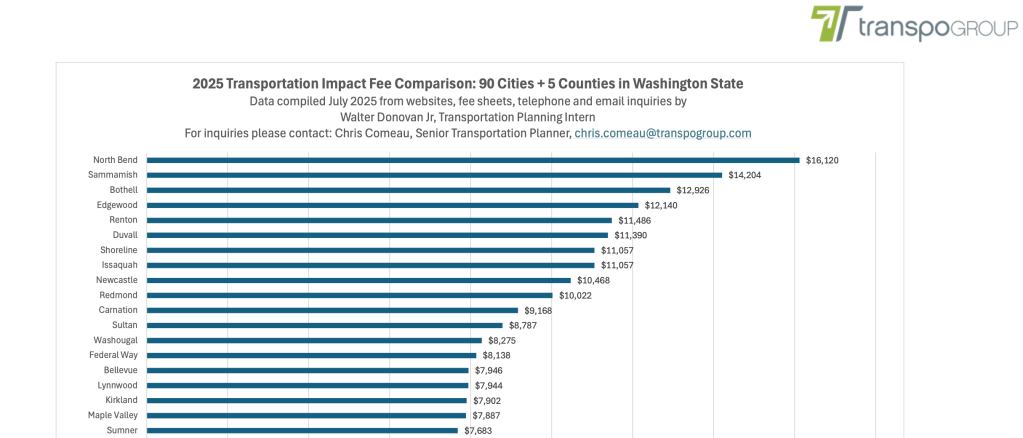
We can see this above, where all the cities with the highest impact fees are Seattle suburbs, mostly near the fringes of the urbanized area. Impact fees of all kind are a financing tool for cities and counties that want to do greenfield development. This is probably why Seattle hasn’t had one – by the time the enabling legislation was passed in the 1990s, Seattle was pretty much done building new streets.
Of course, this doesn’t explicitly tell us why a transportation impact fee can’t be used on transit. But it essentially does.
… Leads Us to Consider Our History
Since transportation impact fees are essentially tools for suburban areas to build roads, it comes as no surprise that spending on infrastructure for transit isn’t allowed. For all the Seattle suburb’s support of transit over the years, the public financing structures which have allowed them to grow have an inherent hostility to public transportation.
For the purposes of a transportation impact fee, state law defines public facilities as: “public streets, roads, and bicycle and pedestrian facilities that were designed with multimodal commuting as an intended use”. MSRC concurs that “it is unlikely that transportation impact fees can be used for other multimodal improvements not listed above, such as transit vehicles or recreational hiking trails.”
And as someone who works in the field, it’s understandable to an extent why a transportation impact fee wouldn’t be used on something like a new busway or train line. To be eligible for transportation impact fee funding means being on a local governments capital improvement plan, and there is always a greater need than dollars available. Even before we consider that transportation impact fee-levying jurisdictions are generally transit-hostile in their outlook, few agencies have plans for new busways or rail lines that can neatly fit into a six-year capital improvement plan – especially considering the additional level of coordination that takes.
But this is still a bit ridiculous. Especially for the case of a transit vehicle – which unambiguously is a capital asset and unambiguously could assist with the “increased demand for services created by that development” – there isn’t really any reason for state law to exclude transit projects. It’s simply an example of anti-transit bias baked into in our legal system. But really, this lack of ability to fund transit capital projects with transportation impact fee funds is the least of our worries.
Public Finance Policy Isn’t Neutral
Taking a step back, it’s worth emphasizing an earlier point again: transportation impact fees are essentially tools for suburban areas to build roads. Without the financing tools to build and expand these roads, suburban development becomes less feasible. The core inequity of TIFs isn’t that they pass costs of onto end users, it’s that they enable sprawling suburbs that erode the social and economic base for walkable places and viable public transit.
It’s like the Federal gas tax with no upsides. While the Federal gas tax at least gestures to the need for transit in the form of the 80/20 split between highway and transit funding3, Washington’s transportation impact fee forbids it outright. And while blaming the gas tax alone for the mass suburbanization and transit death spirals of the twentieth century would be a bit much, it’s undeniable that the existence of a strong public financing tool was paramount to our ability to achieve such destruction.
While there are surely bigger fish to fry, I think the case of the transportation impact fee is illustrative in both how and why our best efforts to curb suburbanization and car dependency in the last 50 years have gone backwards. If Seattle is the only major city this side of New York to have more transit ridership now than it did in 2002, it’s not because our suburbs have been built to allow it.
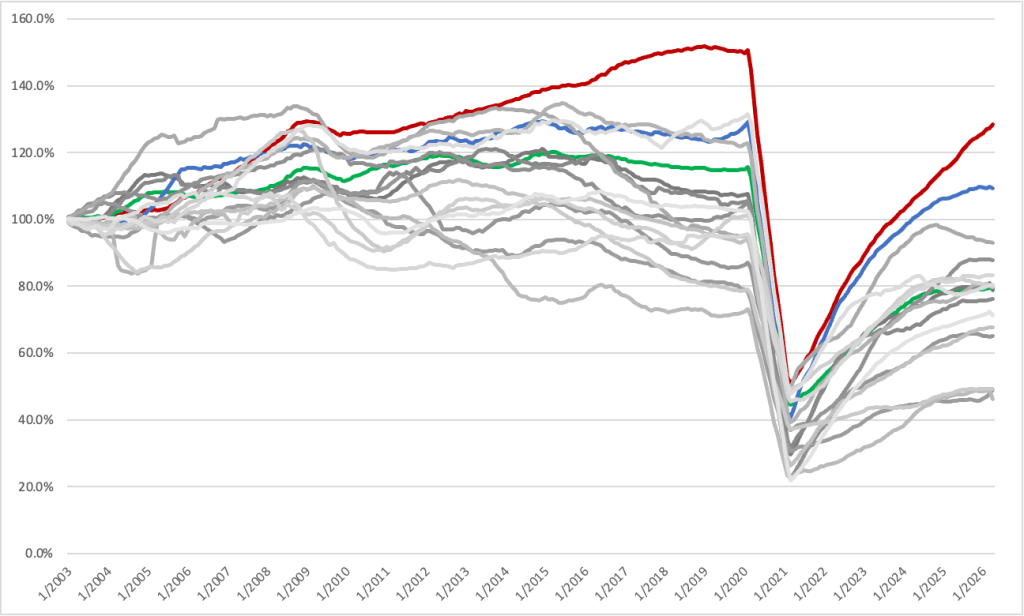
Instead, Seattle had a highly specific set of circumstances: public support for transit and extremely high population growth (the MSA has added over a million people in the last 20 years). To some extent, the transportation impact fee played a key role in all of this too: without new suburbs, it’s not likely that Seattle would have been able to physically contain all the growth our region has had. If the housing crisis is bad now, it could have somehow been even worse.
The reason to bring this up is that we are likely entering an economic regime where white-hot growth is unlikely to continue. In an environment like this, transit projects need more tools to get built, since we can’t rely on future growth filling in the gaps. The tacit Sound Transit policy of “new ballot measure to bail out the old one we didn’t finish” isn’t really feasible without that growth. Transportation impact fees can’t close that gap, but that’s not the point.
The point is that our society is still structured to favor cars. Even after decades of advocacy, there’s still a lot of work to do. Reforming transportation impact fees is a drop in the bucket, but a bucket cannot be filled without those drops.
Thanks for reading – ’til next time.
Footnotes
- I am not sure if any places that levy transportation impact fees have tried to build any bus lanes or BRT type projects with transportation impact fees in Washington. Looking at the spread of cities that levy, I think the answer is a likely no. ↩︎
- Though on the other hand, it’s also very silly. Based on the logic of the fee, surely the marginal impact to roads from developments have an operational and/or maintenance impact too. But I digress. ↩︎
- Of course, the 80/20 split is still stupid. We are behind in transit relative to cars and spending 80% of money on cars widens the gap rather than narrows it. ↩︎


Leave a Reply