Ever since moving to Seattle, I’ve been excited about the prospect of using Trailhead Direct – King County Metro’s seasonal bus service to a series of popular local trails. If you’ve read anything else on here you’re already aware of my love for a transit-oriented adventure, and while the prospect of a direct bus to a nice hike does take some of the fun out of the planning process, it also opens up a bunch of places that really aren’t accessible otherwise. Mount Si is a Seattle-area classic, but few people are willing to walk the 2 miles down roads without sidewalks from the nearest bus stop to the nearest trailhead.
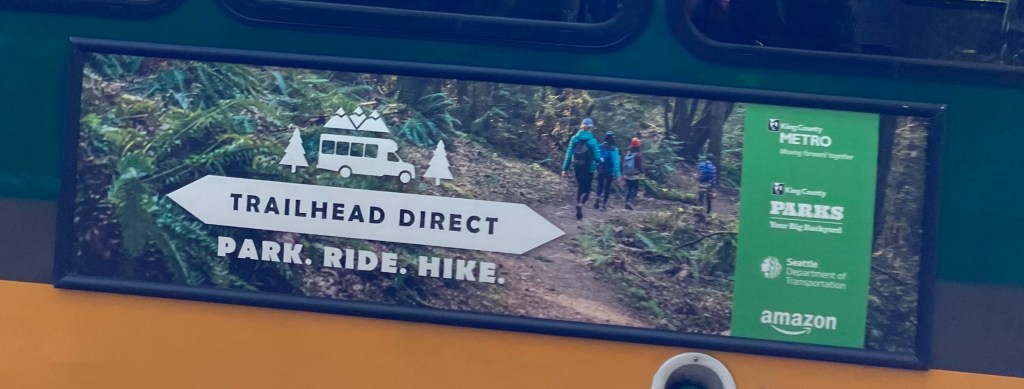
If you’ve ever used the service, you’ll know that it can be very busy and that most people using it seem to be accessing it from places other than the suburban park and rides. Thus, it will come as no surprise to learn that 70% of users in 2018 didn’t have access to a car1. This evidently wasn’t the original intention of the program – and it’s slogan of “Park. Ride. Hike.” reflects this.
After learning who was using the program, King County Metro did pivot some of the framing away from parking lot relief at major trailheads to access for car-free folks, but the somewhat narrow goal of trailhead parking and traffic relief as an “environmentally focused compass” for the program remains. But this was never a practical goal for reasons we’ll get into later, and the original framing fundamentally limits the ability for the program to adequately serve car-free hikers in the Seattle area.
Trailhead Choices
On the latter point, the two major trail areas served are a big tell.
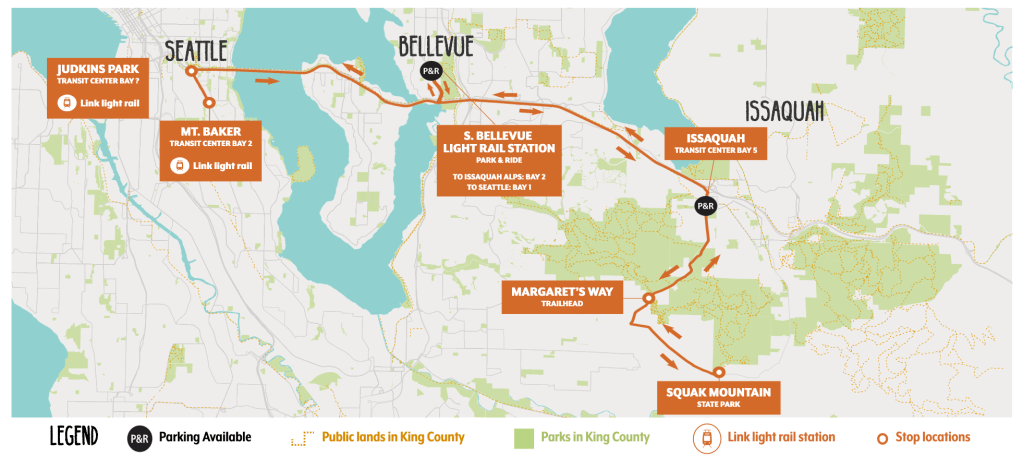
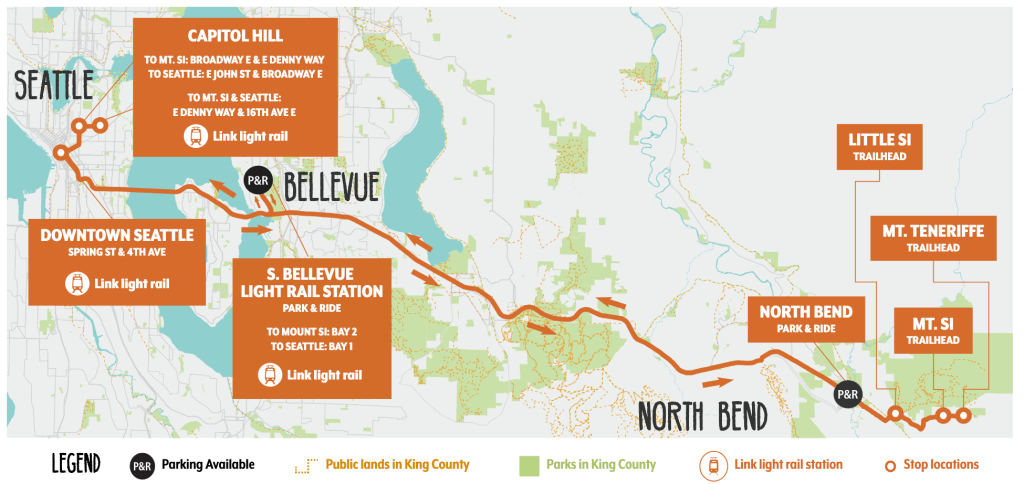
While I can confirm that parking is constrained at Mount Si and Squak Mountain, I think it’s worth highlighting that the Issaquah Alps are already transit accessible. The 554 stops a mere half-mile away from a trailhead that will get you to Squak Mountain. Other Issaquah Alps areas like Cougar Mountain (Route 203) and Tiger Mountain (Route 208). These may be fringe trips, and they may involve a quarter-mile to half-mile walk to the trailheads, but it is possible2.
The Mount Si area is much less transit accessible than the Issaquah Alps by virtue of being in North Bend (which frankly gets awful service on the 208), but it would be relatively easy to get at least a bit closer to the Little Si trailhead with a short extension. Honestly, this should probably be done independently of linking hikers to the Little Si trailhead as there’s a lot of relatively new housing in the area. Previously, Trailhead Direct also served Mailbox Peak (in the form of a shuttle from Issaquah)3, opening up at least a little bit of the popular Middle Fork area to car-free folks. But this hasn’t returned in the post-Covid service restorations.
If the goal of the program is to reduce the most amount of parking lot congestion for the least amount of money, then the current Trailhead Direct system makes a lot of sense. The Issaquah Alps trailheads are quite busy and by virtue of being very close to Seattle are cheaper to serve. Mount Si is a bit of a long ride, but it more or less fits into the same boat.
But if the goal of the program is to expand access to King County’s great natural areas for those living car-free, then having our precious few options taken up by an area that we can already (nominally) get to is a bit frustrating. While trailheads aren’t fungible, and a hike starting and ending at Squak Mountain State Park is fundamentally different than one starting in downtown Issaquah, I would personally value more variety over serving the closest places.
And yes, not everyone is willing to comb through bus schedules while cross-referencing AllTrails to plan a Sunday hike. But surely King County Metro could advertise good hikes that are served by their “normal” routes. And if they need some help, I’ll even do it for them as part of my forthcoming “Trailhead Indirect” post.
Unintended Side Effects
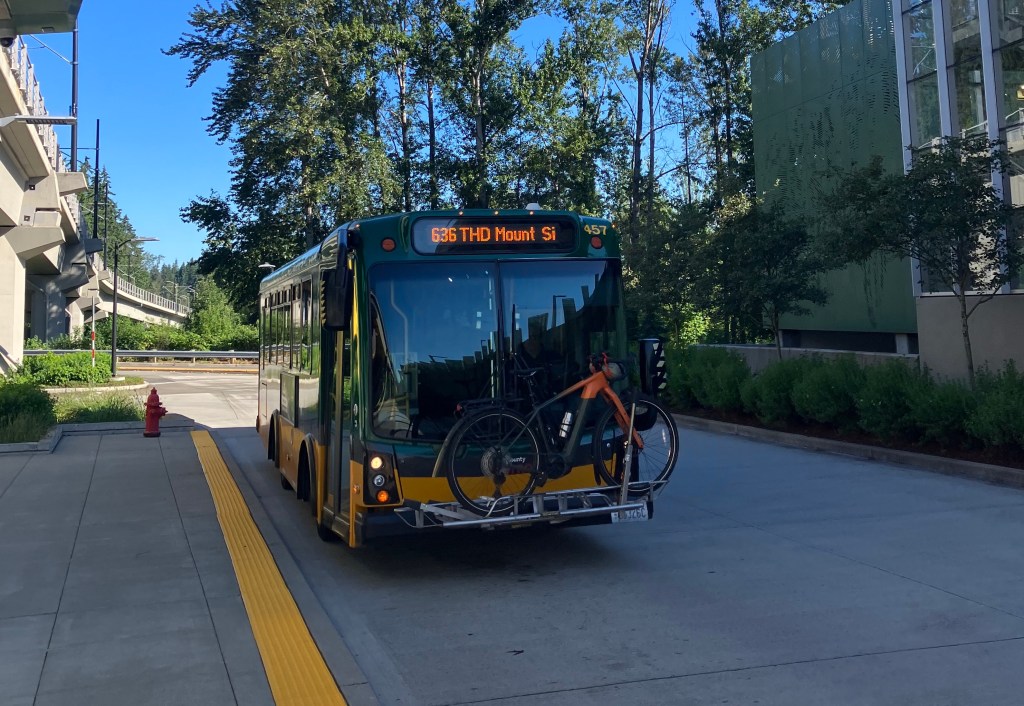
Something I find particularily interesting about the Mount Si route is a funny unintended effect: it’s easily the best way to get to North Bend4. Because of this, people can and do use the service to visit or do errands in North Bend. When I rode out to Mount Si, my bus home was standing room only and included a few folks who boarded at the North Bend stop with arms full of grocery bags. I also recall reading a comment on a Seattle Transit Blog post about someone living in North Bend using it run errands in Seattle5.
This is clearly not the intended purpose of the service, but it proves that if a bus exists, people will use it. North Bend’s access to Seattle is truly nominal. The 208 is the only bus and it barely cracks 50 round trips per week – and that’s just the slow way to Issaquah. Despite this, the Trailhead Direct is scheduled to essentially preclude the North Bend – Seattle trip, instead preferring to deadhead buses.
It may feel a little goofy to have the Trailhead Direct service also be the North Bend direct service, but there are clear economic (and social) ties between North Bend and Seattle. We don’t even need the anecdotes of people using Trailhead Direct to travel between North Bend and Seattle. Seattle is the top destination for North Bend commuters (25%) with Bellevue in second (12%). Amazon runs a shuttle to North Bend.
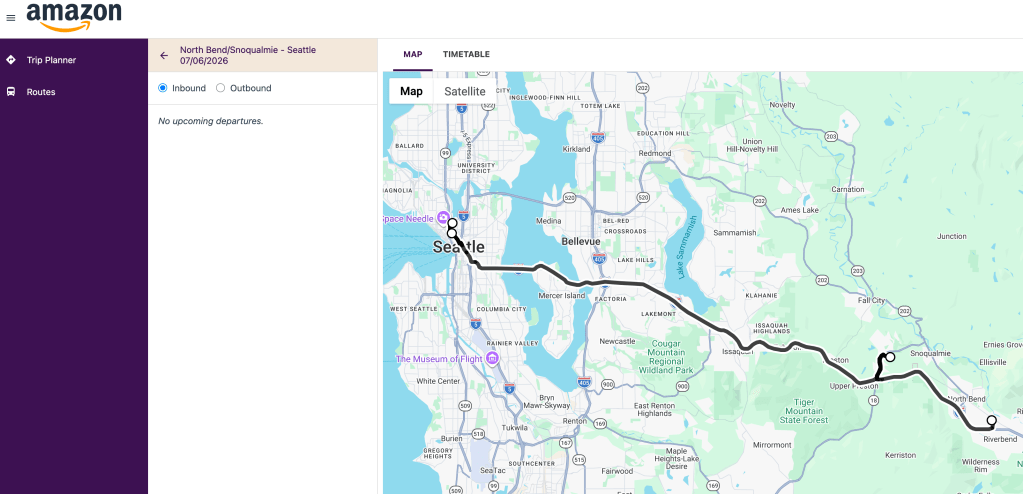
Running Trailhead Direct as a proper bus route – one that allows for any trip, not just one-way trips an intended direction – would likely mean marginally higher costs, but it would also allow the service to play two roles, which expands ridership opportunities.
In this spirit, here’s a handful of route ideas in order of practicality:
- Redmond – Duvall – Cherry Creek Falls. The trailhead is busy enough to show up on Street View, and Duvall (like North Bend) is a rural/suburban town with strong links. The 224 is the only link to Duvall and doesn’t run on weekends.
- Issaquah – North Bend – Snoqualmie Pass. There are so many trailheads in the Snoqualmie Pass area, many of which could be accessible via freeway flyer style stops6. This could also go to Seattle, but Issaquah is easy enough to get to.
- Federal Way – Enumclaw – Mount Rainier. This is a stretch, but I would really love a bus to Mount Rainier so I’m adding it. It would probably just be the SR 410 part of the park.
Ultimately, I think these kinds of services should be provided by Sound Transit or WSDOT to avoid county-line issues. Highway 2 has lots of trailheads too, but it isn’t in King County7. But we don’t need to add more services to my imaginary list of things I’d like if we had more money for transit.
Serving Drivers is Quixotic
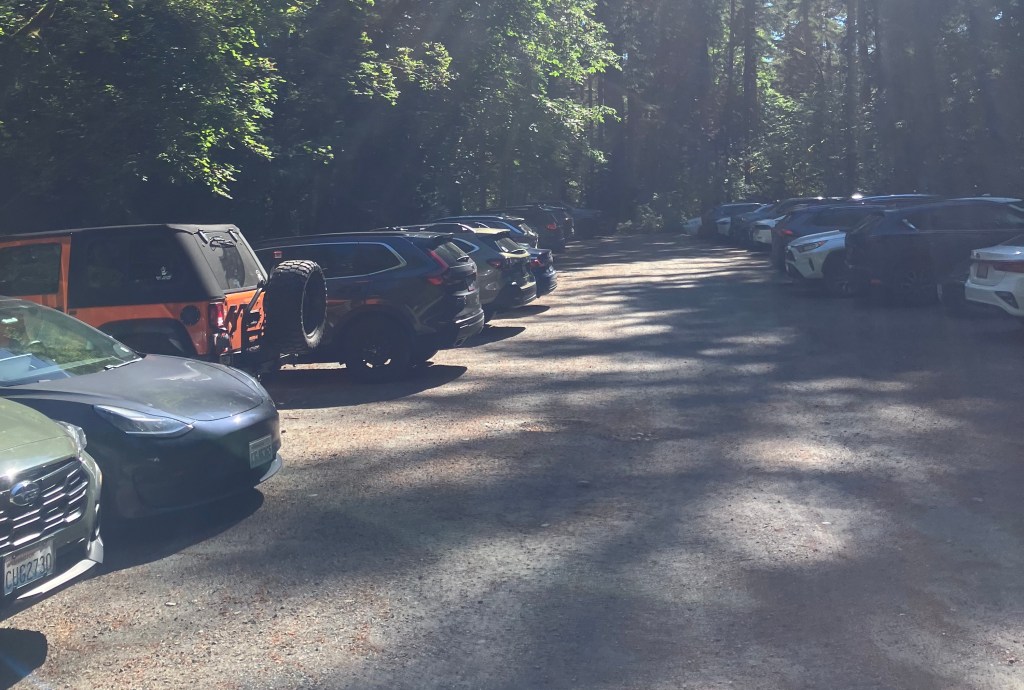
Bold ideas about a King County Metro bus serving Duvall on the weekends aside, there’s an issue with the original framing of Trailhead Direct as a parking reduction tool: it probably won’t work very well. At the end of the day, if you have a car and are planning on hiking, you have your pick of the litter for trailheads. If you know you started too late to get a parking spot at Mount Si, you can always head to Snoqualmie Pass.
And if Trailhead Direct manages it’s stated goal of parking reduction, the trailheads being served aren’t even likely to get less crowded with cars. Once the news spreads that parking isn’t so bad at Mount Si, more people will start driving there again. Does this mean we shouldn’t run the service? No, but it does mean that the basic framing amounts to little more than a fools errand.
We see this time and time again. Link was pitched in part as a traffic reduction service, but no one can really say that traffic has improved much on I5 since it opened. And while it provides an alternative to traffic, the benefit for transit riders is really that it makes more places easily accessible in less time.
Trailhead Direct is no different. It isn’t likely to relieve parking congestion or trailhead traffic in any significant sense in the long run, but it can provide an alternative. If that alternative is good enough, it may allow the agencies that manage the trailheads to reduce the size of the parking lots. That’d be a big environmental win in my book, as parking lots are typically lined with blackberry and baking in the summer sun. A perfect place for a bit of restoration.
Parting Thoughts
While the original framing of Trailhead Direct may amount to little more than trivia these days, it has important consequences on how the service is run. A partial pivot to the obvious access value the service provides over the fringe parking congestion benefit represents progress, but it still isn’t enough for the transit loving hikers of the Seattle area.
And while this may seem like a fringe thing, “proximity to nature” is almost always quoted as a reason to move to Seattle8. If we are serious about people living car-free here, we need to be serious about providing access to the number one reason people want to be here. This is part of why I’m so passionate about exploring the nooks and crannies of the transit system as a way to do local hikes. Trailhead Direct is cool and all, but my desire to walk in the woods does not end on August 30th. Having seasonal access makes sense if the goal is to reduce parking congestion, but if the goal is to provide access then we can’t do things only in the peak season.
I want to highlight that it’s both possible and legitimately fun to hike by bus. On Sunday, Olivia and I hiked over Squak Mountain down to Issaquah and our Coal Creek to Issaquah via Cougar Mountain was an all-time great. Point to point hiking provides a lot of variety that loops and out-and-backs just don’t. But this isn’t something that’s advertised to the intrepid hiker living car-free.
For a city and region that pride themselves on sustainability and that dream of a zero emission future, we need to have more than five trailheads accessible by transit. And I mean we do, as my endless raving about transit hiking bears evidence to. But we need more. We need our transit agencies to treat hiking and access parks and natural areas as a must-have, not a fringe thing contracted out and run for 12 weeks in the summer, and the towns en route shouldn’t be afterthoughts.
The great trails, parks, and natural beauty of the Seattle area can not and should not be gated behind car ownership.
Thanks for reading, ’til next time.
Footnotes
- According to this Seattle Times article ↩︎
- The 208 also has a god-awful schedule but you can work around that by only taking it one-way and catching to 554 on the way back. ↩︎
- There was also a Cougar Mountain link from Tukwila. As previously mentioned, Cougar Mountain is already transit-accessible. ↩︎
- It’s at least 20 minutes faster to take the Trailhead Direct from North Bend to downtown Seattle than it is to do the 208/554 trip (that doesn’t run on Sundays) ↩︎
- They apparently had to talk their way onto the bus back, as all trips after about 1 PM deadhead back to the trailheads. ↩︎
- A freeway flyer style stop is like the Star Lake express bus stop ↩︎
- Yes I know Skykomish is in King County, but you get the point. ↩︎
- Don’t believe me? Here’s an article saying this. ↩︎


Leave a comment