

I recently read in the Urbanist that Clyde Hill is facing an existential crisis of a 69% property tax hike or absorption by neighboring Bellevue or Medina. For the blissfully unaware, Clyde Hill is one of the wealthiest cities in the country located near the east shore of Lake Washington. Neighbors Medina (longtime home of Bill Gates), Yarrow Point, and Hunts Point make up the “Gold Coast”, and while Clyde Hill lacks shoreline on Lake Washington, it fits in spirit.
The reason for this is obvious and stated clearly in the original piece by the Urbanist: Washington limits property tax revenue growth to 1%, and Clyde Hill has chosen to be a nearly exclusively residential place. With no sales tax to supplement their budget, it was only a matter of time before this crisis surfaced. Clyde Hill is just uniquely exposed.
Of course, this is all partially true. But it doesn’t tell the whole story.
Partially True is as Good as Wrong
I was scrolling on Bluesky (a website where I do not have an account) to see if I could find any updates on some unrelated City of Seattle news, and I stumbled upon my old nemeses: YIMBYs.
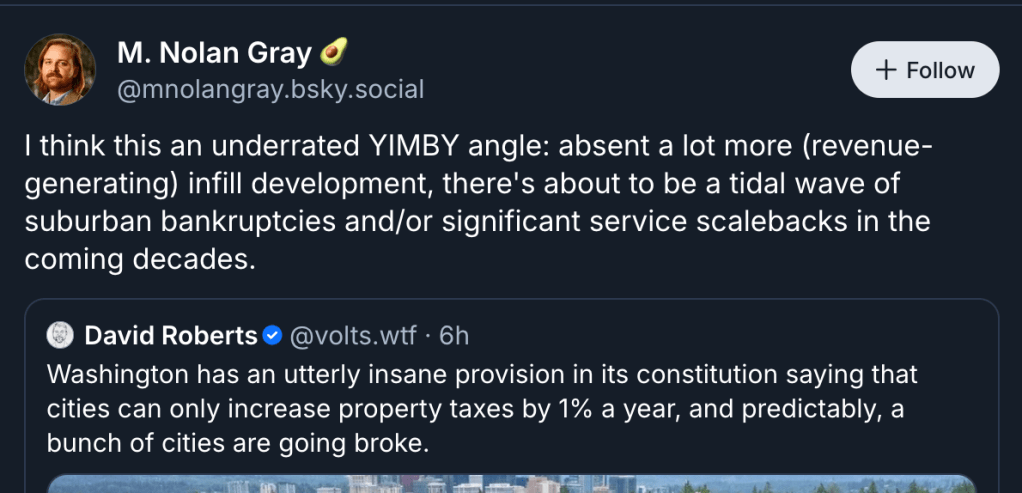
The above tweet-equivalent has two points that need clarification. On the first point, I’ll hit David Roberts with the pointless “um actually it’s just state law, not a constitutional provision” and follow it up with the “the new construction exemption matters a lot for the long-term impacts of the 1% limit”. New construction is calculated separately in a way that essentially exempts it from the 1% limit for one year1. To illustrate how much this matters, here’s the difference in levy rate after 20 years for a city with no construction versus one where 2% of properties are developed each year.
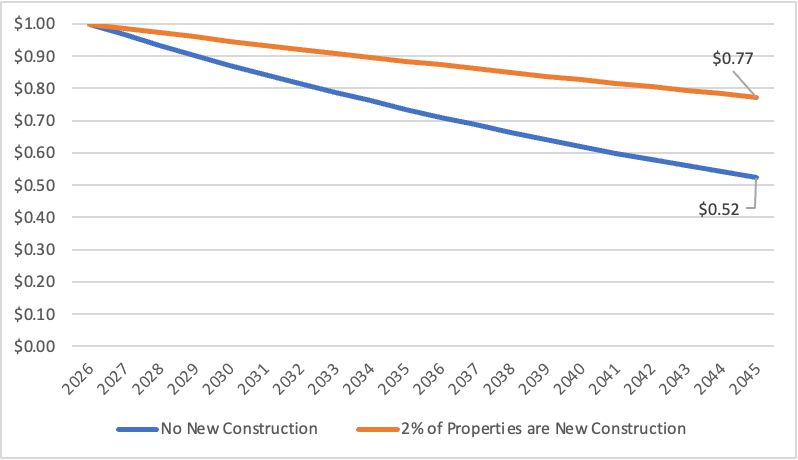
For a city like Clyde Hill with about $5B in assessed value, this difference works out to about $2.9 million. That’s a lot of money when you’re about to go broke!
While I am not in any way supporting a system that requires redevelopment for cities to remain fiscally solvent, it’s worth saying that the actual growth in property tax collected in my imaginary 2% new construction per year city is 3%. This still isn’t enough to cover costs in a lot of places, but it is a lot more sustainable than 1%. I think it’s fair to say that the new construction clause makes a substantial difference, and it isn’t something that can be ignored when discussing the ramifications of property tax policy in Washington.
To M. Nolan Gray’s original point of “a lot more (revenue generating) infill development”, we need to stress that this new construction need not be infill development. It just has to be new. This is a deeply esoteric nitpick, but the idea that infill middle housing is more fiscally sustainable for Clyde Hill is only true because that would necessitate development of any kind.
If single family homes were knocked down and rebuilt with enough frequency, Clyde Hill would become more solvent. And if they completely redeveloped the entire city to be stacked three flat cottage clusters they would push out their bankruptcy by a mere 20 years. The issue with Clyde Hill is the 1% limit at the end of the day, but the magnitude of the issue is still heavily dependent on local context.
The local context that creates mitigating factors for cities in Washington boils down to alternative income sources. The most obvious of these is the sales tax, but the business and occupancy (B&O) tax is potentially relevant as well. Clyde Hill has just two commercial businesses. They also don’t levy a B&O tax2. Most cities have more commercial activity than the Gold Coast suburbs, so they are more able to leverage other income sources to replace falling property taxes.
The World Is What You Imagine It To Be
Of course, I don’t really expect M. Nolan Gray or anyone else to think about the way Washington State handles new construction with regards to property taxes. It’s wonky enough to even be aware of the 1% limit to begin with, how many layers of wonk can we reasonably expect from people? The answer is always “more”, since the role of a public intellectual should be to speak the truth and expose lies.
But in rushing to the conclusion that Clyde Hill is a canary in a coal mine that could be saved by middle housing, we miss the opportunity to reflect on the precise nature of how the interaction of their exclusionary tactics and bad state policy have led us to this point. Instead, the reaction of “infill housing” is colored strictly along dogmatic lines regardless of if that will even solve the problem at hand in the long run.
Incidentally, I don’t doubt that M. Nolan Gray et al. would bristle at a more thorough analysis of the specifics here, but I do think this is illustrative of a real issue in the world. If the only tool you know is a hammer, everything looks like a nail, and the only tool being talked about is the role of denser development.
I am obviously pro infill housing and more density everywhere, but I consider this to be essentially different from the need for healthy municipal finances. In terms of assessed value unit area, Clyde Hill is in the middle of the road in King County. It’s #24 at $1.6M per square mile – similar to Maple Valley, Covington, Des Moines, and Burien. In a sane world, this amount of wealth could be taxed by a city to pay for services. But in our silly kookoobananas world, that’s not possible. This issue needs to be addressed in addition to the issue of Clyde Hill’s exclusionary patterns.
To the extent that Clyde Hill is uniquely exposed is interesting, but it’s really not the most interesting thing about this issue. Instead, the state has continually allowed cities to shift services formerly paid by property taxes onto the sales tax. That’s why the 0.1% public safety sales tax is levied. That’s why the King County Council just voted to raise the sales tax 0.1% to pay for roads. Even if property taxes aren’t perfectly progressive, they are much more progressive than sales taxes.
If we look at every problem and say “infill development would have fixed this” and enough people believe us, that’s what our solution will be. But when this fails to stabilize municipal finances in Washington in the long run, we will have only achieved a partial victory. But a dense city with a bankrupt government that cannot adequately tax the wealth it creates in the form of property will then fail to provide the services a dense city needs to survive.
The trend in Washington has been to offset losses in property tax revenue due to the 1% limit with new sales taxes. That’s why there’s a 0.1% public safety sales tax and that’s why the King County Council approved another 0.1% sales tax to pay for roads. These are two functions that have been historically funded by the more progressive property tax that are now funded by the more regressive sales tax.
This is the real issue reflected in the Clyde Hill bankruptcy. Their exclusionary housing practices are abhorrent and should be fixed by state intervention if needed, but they still should not be going bankrupt. It simply should not be possible for a city with $5B in property and a budget of less than $5 million to go bankrupt.
Thanks for reading, ’til next time.
Footnotes
- If you want more detail than this, I am happy to oblige, but it’s quite wordy. I can refer you to the DOR Property Tax Manual or WAC. Or you can always send me an email. ↩︎
- Cities that do can be found here ↩︎


Leave a Reply