If you know me, you know that I am something of a Lord of the Rings guy. I first read the trilogy1 sometime around fifth grade. Admittedly this was when I thought it was cool to read the longest book I could find, so that colored my interpretation of the book at the time. As a result of my strange intentions, my preference for a skim to a deep read (even as a fifth grader), and the fact that I was about ten years old, it didn’t make the strongest impression on me.
That changed the first time I saw the films, which would have been shortly after I read the books. In middle school, I bordered on obsessed with the films and took to watching them what can only be described as an unhealthy number of times. Since then, I’ve held them in my head as good movies worth seeing, but it’s been at least five years since I had taken the time to watch any of them.
In that time, I’ve read the books at least five times (I make a point to read them yearly), and I even re-read the Silmarillion2 this summer. I also think it’s fair to say that my taste in media has changed substantially. So when Olivia’s friend Grace suggested we watch the movies, I was an easy sell. And since Olivia is reading the books (and watching the movies) for the first time, I get to experience this with her3.
So let’s begin our journey into the world of critiquing Lord of the Rings with the first (and in my memory, best) film: The Fellowship of the Ring. And a clerical note: I’ll assume you have a passing familiarity with the story of Lord of the Rings throughout, but I won’t expect you to know the difference between Gondor and Gondolin4.
Place and People
If you’ve ever read Tolkein, you’ll be aware that he spends most of his time describing landscapes. At its core, the story is about the passage of the characters through the various lands of Middle-earth and their interactions with the people who inhabit those lands. You’ve probably heard the word “world-building” repeated ad nauseam as a result of the influence that Tolkein has had in the fantasy space, but it’s hard to understate just how much the physical world of Middle-earth is essential to the story.
The films do a good job of recognizing this and are at their best when the characters experience the land and its people. I think this is why the beginning of Fellowship is so pleasant to revisit. It’s the hobbits doing their hobbit things in the Shire, and it helps frame the four hobbit heroes (Frodo, Sam, Merry, and Pippin) as kind-hearted people from a country dominated by small farms and fields.
Issues only arise when the hobbits start to leave the Shire. Rather than the meticulously planned journey from Bag End to Crickhollow5 (and beyond) that we get in the books, Frodo and Sam rush off alone with Merry and Pippin joining essentially as accidental hangers-on. In the book, Frodo takes care to make all due preparations to ensure that his affairs are in order and the people of the Shire (who love to gossip) don’t ask too many questions about him leaving. He even tries to trick his friends into believing he’s simply moving off to Crickhollow but is undone by Sam, and then graciously has the ability to heed Gildor’s6 advice to “not go alone. Take such friends as are trusty and willing”.
The impression that the Shire is close-knit and kindly comes through these sorts of details. Of course Frodo, a prominent hobbit, can’t just up and leave without causing a stir. And given the sensitive nature of his quest, it makes sense to have as few folks know about it for as long as possible. It even shows his desire to protect his friends from harm, even if his own friends consistently foil him on this front. These kinds of subtle motivations that are rooted in the culture of the characters making the decisions, and are sorely lacking in the film.
There’s a lot of epic scenery shots to establish the beauty of the land, but if there’s something that keeps me returning to Tolkein its the character of the people who live on that land that really matters. Maybe this would have been too hard to get across on screen, but rushing through quiet places with subtle meaning in favor of big battle set pieces is an issue that plagues the Fellowship of the Ring (and all the other films too – but more on those later).
Every Character is Wrong
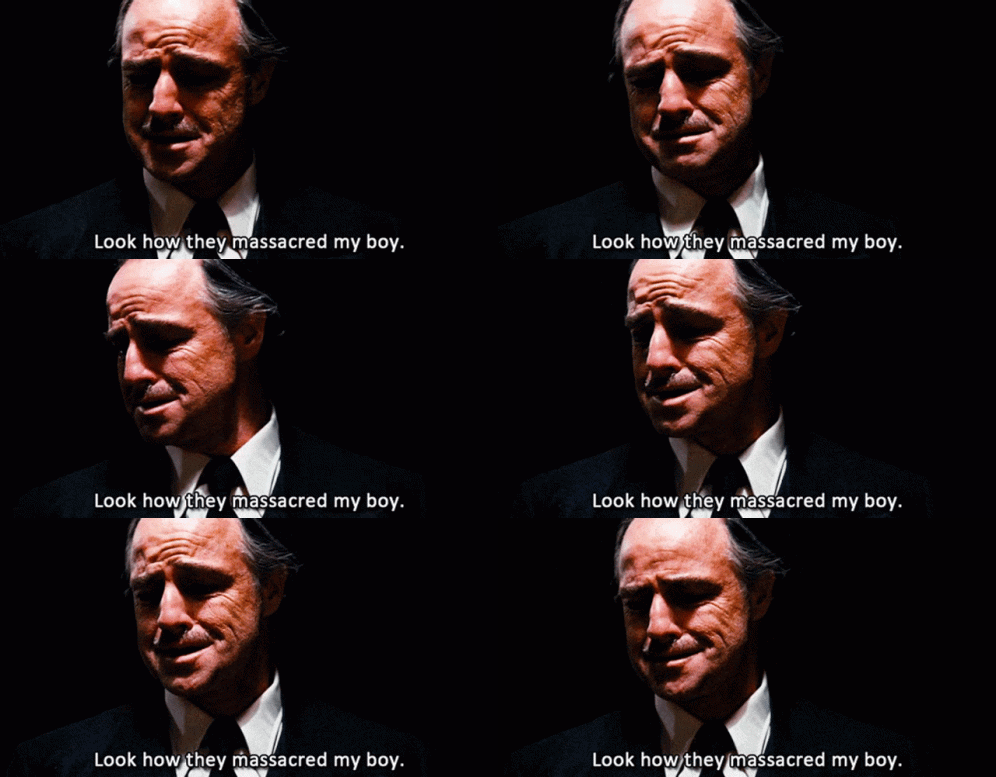
Roger Ebert put it better than I will in his review of the Fellowship of the Ring:
If the books are about brave little creatures who enlist powerful men and wizards to help them in a dangerous crusade, the movie is about powerful men and wizards who embark on a dangerous crusade, and take along the Hobbits.
This is a profound departure, and it’s one that I have a hard time looking past when revisiting the films. In the books, Frodo is pretty clearly the most important character with Sam a close second. In the films, the hobbits feel more like MacGuffins for our real hero (Aragorn) to shepherd from point A to point B.
And while some changes to the characters were almost certainly inevitable, even welcome, removing the essential character of the two main characters just makes the story facially different. Arwen replacing Glorfindel as the elf who rides from Rivendell to assist the hobbits and Aragorn after the attack by the Ringwraiths on Weathertop makes sense. But choosing to remove Frodo’s final moment of resistance to the Ringwraiths when it seems that all hope is lost furthers the diminishing of Frodo’s essential character. “If you want him, come and claim him” (as said by Arwen, who is aware that a flood will drown the wraiths) pales in comparison to “By Elbereth and Lúthien the Fair, you shall have neither the ring nor me” (as said by Frodo, who is defying evil with no hope of recourse).
This is all most obvious at the end of the film. In the books, Frodo is struggling with how to break the fellowship and strike out to Mordor alone. This inner conflict does feature in the films, but instead of Sam being the only member of the fellowship to intuit what Frodo intends to do, Aragorn, Merry, and Pippin all see Frodo at one point or another and let him go. This is a deep betrayal of Sam’s character (and his plain hobbit sense).
It matters a lot in the books that Sam is able to cut through the noise and be practical in the face of danger. And (spoilers!) its this good-natured hobbit sense that ultimately saves the quest in the end. Yes, we get the same result in the end – Frodo and Sam alone on their way to Mordor – but at what cost? And what do we even gain? A cheap goodbye to Aragorn in service of yet another superhero battle with orcs, followed by a cheap goodbye to Merry and Pippin in service of yet another superhero battle with orcs7.
This all bothers me because the specific relationship between Frodo and Sam is central to the work as a whole. Removing Sam’s explicit understanding of Frodo and what he intends to do undermines the emotional core of the story. Tolkein said that Frodo and Sam’s relationship was modeled off “the privates and batmen I knew in the 1914 war, and recognized as so far superior to myself”8. While omitting some of the master/servant dynamics that exist in the books is, in some ways, an understandable choice for a modern audience, the fact that Sam knows Frodo so well (while Frodo is sometimes unaware of Sam’s needs) still strikes an emotional chord.
For those of us who work for a living, there’s a resonance in Sam’s ability – and indeed in his need – to anticipate Frodo’s needs in advance and meet them in stride. It’s the same sort of relationship we have with our employers. To do good work requires anticipating needs, and this in turn involves interpreting and imagining what people really mean by words and actions. Because the film is nervous about centering the unequal social relationship between Frodo and Sam, it is unable to portray this moment (and many others) with the emotional clarity it demands.
So Many Cuts, So Few Gains
Missing the core of what makes the characters and places in Lord of the Rings special, we’re left with the worst part of it all: the gratuitous fight scenes. Revisiting the films now, this is easily my least favorite part of them. Even though I just spent hundreds (thousands?) of words complaining about how the way characters are portrayed doesn’t work for me, I can recognize that, as reinterpretations of works conceived the better part of 100 years ago, different characterizations are inevitable and ultimately could be for the better. I’m open to the explicitly gay interpretation of Sam and Frodo.
And while Slaughterhouse Five these books are not, I find the glorification of the battles to be thematically vacuous and morally questionable. Tolkein was, by all accounts, deeply affected by his experiences in the First World War. In the books, battle scenes are brief and Faramir (in the Two Towers) describes his feelings towards war thusly:
I do not love the bright sword for its sharpness, nor the arrow for its swiftness, nor the warrior for his glory. I love only that which they defend.
Peter Jackson and company might have missed this message. Battle scenes stretch on for what feels like an eternity even as key character moments are left on the cutting room floor. Aragorn, arguably the central hero of the entire film trilogy, is noted for his strength in arms above all. I’ll return to this point when reviewing the Two Towers and Return of the King at length, but I was struck when watching the Fellowship of the Ring just how long is spent on entirely pointless battle or action scenes.
We get the big fight in the Chamber of Mazarbul (in Moria), the big fight at Amon Hen (at the end), the big fight with the Balrog (in Moria), the bafflingly dumb fight between Gandalf and Saruman9, the scuffles with the Ringwraiths on Weathertop and on the flight to the ford. We even get the hobbits running away from the Ringwraiths on foot in the forest at night en route to the Buckleberry Ferry. This last scene is particularly annoying to me, since it really feels like the movie is trying to go for “wow shocking scary!” instead of the dread and fear that the hobbits experience in the books.
That general feeling was pervasive for me while I watched. It felt like a bunch of cheap attempts at drama with high-stakes action scenes. It’s hard to understate how radically different that is than the books. Would a literal interpretation of the Council of Elrond be needlessly dry? Maybe. But I still deeply dislike the creative choice to have Frodo yell above the fray that we get in the movies. In the books, Frodo only agrees to take the ring to Mordor after a long period of silence, when it becomes clear to him that this is his burden.
Most of the key emotional moments in the book are cut, replaced with orcs being whooped by our band of heroes. There’s no better person to explain this than Christopher Tolkein, J.R.R. Tolkein’s son and the editor, publisher, and co-author of all of the post-Lord of the Rings Tolkein works. In his words10: “They eviscerated the book by making it an action movie for young people aged 15 to 25”.
Tolkein and Women
As mentioned earlier, some of the changes (like giving Arwen a real role) work pretty well. But there’s a certain sense of lipstick on a pig that I feel when seeing how women are treated within the context of the films. Because if we are looking to interpret Lord of the Rings, it’s not some accident that women play minor roles. Should we expect a film to reinterpret the women within his works and give them more to do within the story?
Because male friendships within the context of war underpin the characters and themes of the books, and because the books were written in a different social context, it’s hard for me to see how further fleshing out the few women that exist in the book can really be done without radically reinterpreting the work. Ah! But haven’t I been droning on about how these films really are a radical reinterpretation of the works, and mostly not for the better?
Fellowship of the Ring is not really the best film to answer these questions with, but this topic (like all others) will feature centrally in my future reviews of The Two Towers and Return of the King. Within the context of the first film, the only substantive example of women being given more prominent roles comes from the aforementioned choice to have Arwen take Frodo to the Ford of Bruinen. And you’ve already read what I think of this with regards to Frodo’s characterization.
But it would have been possible to bring Arwen into the story more substantially without reducing Frodo’s essential bravery. Even in the limited context of Fellowship of the Ring, there are small points in the book not played out in the film that could have been included as points of emphasis for a more substantive Arwen character11. The tricky thing is that a film can only be so long, and by choosing to emphasize flashy action scenes elsewhere, the filmmakers aren’t left with much room to emphasize Arwen without taking away from other characters. So we get the “if you want him, come and claim him” mentioned earlier.
Perhaps I’m avoiding larger questions about the role that women play within the Tolkein mythology and how Tolkein reinforces patriarchal gender norms. Because I do take issue with this aspect of Tolkein, and is is overwhelmingly the case. Only three women in the larger Tolkein mythology have major roles to play in the stories that really matter (Galadriel, Eowyn, and Lúthien)12. This is just not enough to be satisfactory for anyone who wants to see women played as more than figments in the imagination of the men.
But I view these shortcomings as inherent to the works themselves, which are really about the relationships between men, war, trauma, and home. I would posit that if you want a fantasy world where women have a significant role to play, Lord of the Rings is simply a poor choice. While I would personally be interested in an even more radical reinterpretation of the work, where characters in the Fellowship are women (or explicitly queer), but this is unlikely to be a bankable hit and it is most likely to come across as a cynical marketing ploy (as has been the case with slop like Amazon’s Rings of Power series that I will never watch13).
Choosing a different work of fiction to interpret is always an option too. And frankly, we don’t even need to leave Tolkein’s mythology to find the clear winner of a strong female character. In the story of Beren and Lúthien (described by Tolkein as the chief tale in the entire mythology), Lúthien rescues Beren from the dungeons of Sauron14, sings Morgoth15 to sleep, and successfully pleads before the gods to bring Beren back to life16. There is no need for a radical reinterpretation, it’s just that stories from the Silmarillion probably weren’t bankable assets in 200117.
This is all to say that some of the choices the film makes around how women are treated as characters is a genuine improvement over the books. But there will still be issues to consider (especially in The Two Towers) over if what the films have to offer is actually better or not. But we will save that for another day.
Thus we arrive at our destination: why do these stories still matter to me and what is lost in the Peter Jackson interpretations?
What Are The Stories We Tell Ourselves?
When I was younger, I spent my time as a swimmer. If you’ve never been a boy finding his way in the world, its hard to describe how easy it is to believe that all your problems can be solved through violence. Even if you have great parents who teach you all the right things (as I have been lucky to have), the world has other things to say. Swimming isn’t a violent sport, but all sports trade in this fantasy – the one that your problems can be solved through physicality and force of will.
So despite my relatively ideal upbringing, I was faced with how to exist in a world that wanted me to be someone I didn’t feel that I was. Even though the films flatten out much of the tenderness between men that makes Lord of the Rings so notable to me as an adult, it is impossible to tell the story without including some of that. Upon reflection, my adolescence and early adulthood was marked with wanting to have the love shown between the men in the Lord of the Rings reflected in my own life.
At my core, I think I always have been and always will be someone who prefers conversation and compassion as ways to navigate strife than physicality and force of will. And while it’s true that all four of these play major roles in the Lord of the Rings, violence is only ever a means to a peaceful end. The goal of the hobbits in setting out is not to seek glory in battle, but to protect their home against dire threats. Returning to the Faramir of the books: “War must be, while we defend our lives against a destroyer who would devour all”.
It is this context that I find the stories that the films tell me to be less satisfying with each passing year. When I take stock of our world, I see the wanton destruction and violence of our current political system being perpetrated by small men who imagine themselves to be great; who imagine themselves to be saving their society through indiscriminate violence. In the books, and in Tolkein’s work, I find clear-eyed rebuttals of this fascist ideology. The films, for all their great cinematography and genuinely good moments, struggle to fully digest the themes that matter in the book. Yes, the films make clear that evil is evil, but in glorifying the sword for its sharpness and the arrow for its swiftness, they do not fully turn their backs.
When we finished watching the Fellowship of the Ring, my primary feeling was that it got across most of the setting and a good deal of the spirit of the book, but it missed the essential core. It’s still a good movie, but an essentially different story than that of the book. This may not matter to you, it seems like it doesn’t matter to anyone based on the dearth of even lightly negative reviews to be found about the films, but it matters to me.
Thanks for reading, ’til next time.
Footnotes
- And yes, I am aware that it is intended to be read as one book and that it was only split into three due to the original publisher’s doubts and constraints. ↩︎
- And wow, just learned that Peter Jackson is in talks to make that into a movie. I look forward to his interpretation of the Ainulindalë, but l dread to see what he does with the Kinslaying at Alqualondë. ↩︎
- Yes, despite my long-standing love of Lord of the Rings, Olivia is still (as I write this) reading them for the first time. That’s okay with me, with the only reason for this note being that it’s been hard to avoid spoiling things. ↩︎
- If you’re curious, Gondor is the (southern) kingdom in the northern part of Middle-earth (where all the action takes place) founded by Elendil and ruled by his son Anarion and his descendants. It features prominently in Lord of the Rings. Gondolin is the hidden city in the Encircling Mountains built by Turgon, son of Fingolfin in the image of Tirion upon Túna the home of the Noldor in Valinor that was destroyed through the treachery of Turgon’s nephew, Maeglin. It features sort of prominently in the Silmarillion and is referenced a few random times in the Lord of the Rings. ↩︎
- It may be worth noting that Crickhollow isn’t ever mentioned in the films. ↩︎
- Gildor is an elf that Sam, Frodo, and Pippin meet as they set out from the Shire who never appears again. He makes sense to cut from the films, but I really love the conversation between Frodo and Gildor, and establishing Frodo as an elf-friend early on is relevant to his characterization too. ↩︎
- Okay, to be fair the scene where Boromir defends Merry and Pippin from the orcs is genuinely good and clearly worth inclusion (And yes I know they are uruk-hai, but sorry don’t care about that distinction right now) ↩︎
- Further reading here ↩︎
- This is runner-up for worst scene in the movie. Gandalf telling Saruman everything he knows… why! ESP staff boxing match? Don’t they know that the power of Saruman is his voice and persuasion? Did they read the same books as me? ↩︎
- You can read more of this thoughts here ↩︎
- Off the top of my head: when Frodo, Sam, and Pippin meet Gildor in the Shire, this role could have been filled by Arwen (or a female elf) without issue. Or if we want to keep with the film’s preference for flashing action scenes, a scene where Arwen and her brothers seek news of the drowned Ringwraiths after the flood at the Ford of Brunien could have worked too. ↩︎
- More on Eowyn when I get around to reviewing the Two Towers and Return of the King. Suffice to say she is the most important female character (as written) in Lord of the Rings, and while I think the films do a decent job of making her more important, I think they miss some key thematic beats because of a few questionable choices (you know the ones I mean). But I’m specifically writing this as a review of the first book/film so you’ll have to be patient. ↩︎
- This entire series is beyond the scope of me reviewing (because I will never watch it), and I think the people who gripe about Black people and women being included are losers, I do think there’s room to be critical about (I believe) amounts to cynical inclusion to pad the list of who the work will appeal to in service of the bottom line. ↩︎
- This would be the original tower of Minas Tirith, built by Finrod Felagund at Tol Sirion. In Lúthien’s rescue of Beren, Felagund dies in the dungeons of the tower he originally built. ↩︎
- Morgoth is the original evil in Tolkein’s mythology and you could think of him as Sauron’s original mentor/boss. ↩︎
- To be specific, she pleads with Mandos, the Valar in charge of the doom of the world. ↩︎
- But hey, at least the films didn’t cut out Aragorn singing part of the Lay of Lúthien to the hobbits. Oh wait, they totally did. I wish they kept more songs in the films. ↩︎


Leave a Reply