
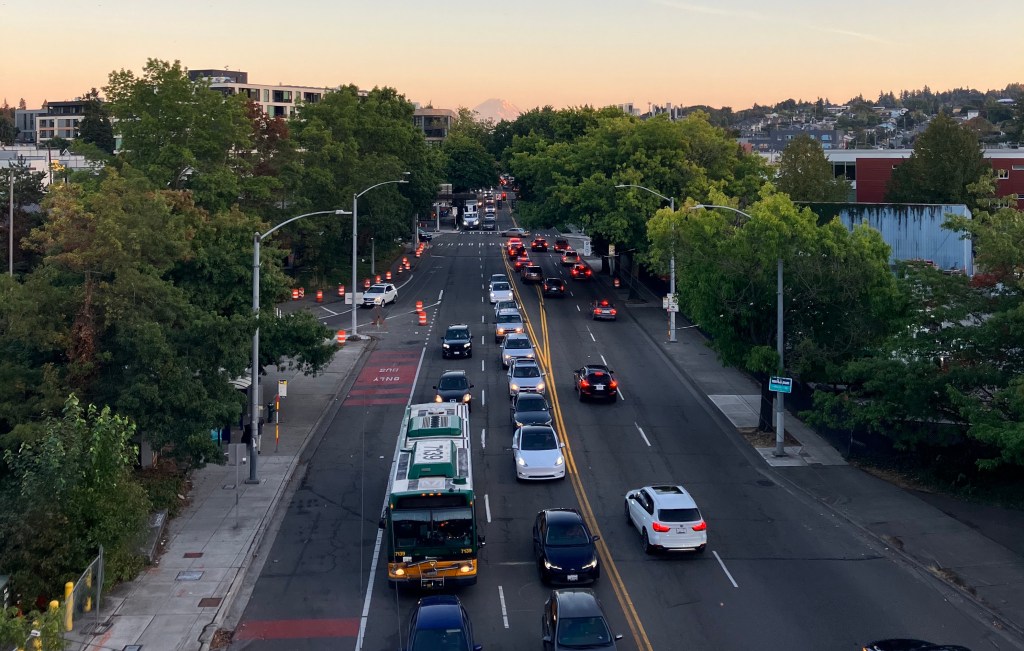
Lately, I’ve been tracking the progress of King County Metro’s proposed RapidRide R project. If all goes to their plan, the unofficial People’s Bus of Seattle (Route 7) will be replaced by the new, shiny R as soon as 2032. Since RapidRide is nominally bus rapid transit (or at least it was inspired by it), what constitutes bus rapid transit (or BRT) has been top of my mind lately.
BRT is a fraught concept. Even the most successful examples of lines – in Mexico City or Bogota – are often successful to the point of “probably should be a metro line”. In the US, there are a few examples of strong BRT projects – the Eugene EmX is a personal favorite of mine – but too often the concept is watered down to the point of farce1. At its best, it’s a cost-effective way to improve bus service when capital funding for “real” (i.e. rail-based) rapid transit is cost-prohibitive to build2. At its worst, it’s a cynical way to win grant funding from the FTA to do sewer replacements.
If BRT is conceptually fraught writ large, no BRT “system” is more filled with these issues than Metro’s RapidRide. To illustrate this point, I took a look at historical timetables of buses on the eve of their conversion to RapidRide lines, then compared them to the timetables immediately afterwards3.
| RapidRide | Prior Route | Pre Travel Time | Post Travel Time | % Change |
| C | 54 | 46 | 44 | 4% |
| D | 15 | 27 | 27 | 0% |
| E | 358 | 63 | 53 | 16% |
| H | 120 | 69 | 53 | 23% |
| G | 12 | 14 | 9 | 35% |
From this, I think it’s clear that there are two routes that saw only minor upgrades (the C and the D), two routes that got fairly substantial upgrades (the E and H), and one route that is so much better it hurts (the G). Of course, looking at service levels matters too – and in this, the C and D represent massive upgrades over the 54 and 15 respectively, but we should acknowledge that we don’t need to spend hundreds of millions in capital projects to improve bus frequencies.
Returning to Rainier and Route 7, the latest plan involves few of the larger changes which gave the E, H, and G their substantial travel time savings. Indeed, there are no current public records showing an up-to-date travel time saving estimates. New bus lanes are unlikely outside of a few minor additions, and most of the savings are set to come from stop consolidation. Transit signal priority (buses getting more green lights) may be implemented in key locations, but transit systems in the US are generally reluctant to implement anything resembling absolute transit signal priority (buses always getting green lights).
Everyone who has ever been on a train train stops at a stop light on MLK – something that has happened to me 30 times in my 25 rides in the corridor since late June of this year (yes I keep track) – has experienced this dynamic. It is entirely possible for all buses, trains, and other transit vehicles to receive total signal priority – most places in France do this – but doing so means slowing down cars and (occasionally) inconveniencing pedestrians.
It’s worth mentioning here that there is relatively little readily available, English-language information on how French transit agencies implement transit signal priority. WSDOT’s definition (below) includes “more likely”, but I’ll note that absolute signal priority is the de facto standard for all railroad grade crossings. It’s not like we have no idea how to implement a system that gives complete priority; it’s more that we choose not to.

Based on what we all collectively know about US traffic planning, it’s obvious that the interest of automotive travel is the primary limiting factor here. And given that the US tends to have a higher density of traffic-light controlled intersections than other parts of the world, this lack of priority is particularly damaging to transit travel times. Even Third Avenue – Seattle’s bus spine – wastes precious time with leading pedestrian intervals at intersections where no bus/pedestrian conflicts are possible.
As someone who cares deeply about having better public transportation service, the shortcomings of projects like the RapidRide C and D really jump out. But it’s worth pointing out that system wide, even when projects are smashing successes like the G, the high capital costs associated with these projects make system-wide implementation untenable. Sure, next to the unfathomable costs of Link projects, the G’s $133 million pricetag looks like the bargain of the century. But with Metro’s 50-odd routes that run every 15 minutes or better, upgrading all of these to G Line standards would run us well north of $10 billion4.
In general, that sort of money doesn’t exist to spend on local bus upgrades. We can shout until we’re dead about how it should, and at times that may be the right approach, but I think it’s worth reframing what local buses are. While the E is better than the 358, the choice of a letter and the red livery does not make it so. The E is better by virtue of having better (yet flawed) priority and more frequency.
But the E still struggles. The trip can be a slog even down the Third Avenue spine, and full priority on Aurora is still lacking. And if the E still struggles, much more can be said of the issues facing the nearby 5. On the 5, buses still pull out of traffic to serve stops (and are thus faced with long waits to merge back in) and bus lanes are basically non-existent. Fixing these problems is, for all intents and purposes, free.
So a broader question emerges: if we can get a large benefit from extremely low cost solutions, why don’t we?
We Don’t Want Fast Buses
The cynical answer is that we, as a society, do not value public transportation. Even in Seattle, a place where transit wins at the ballot 80/20, there is still great reluctance to the sort of allocation of roadway space that would allow every bus to be rapid. And while armchair urbanists may point to a lack of ambition within the planning bureaucracy, the larger problems are unfortunately political5.
Perhaps its not surprising that planners, advocates, and elected officials gravitate towards BRT as a catch-all solution that allows the pastiche of a fast bus to exist, even when the reality of the bus is largely identical to other local routes. I’m reminded of this dynamic every time I go to Ballard and realize that the D is no faster than the 40 if I’m going to 24th/Market anyways. When RapidRide projects have been successful, it hasn’t been because they are RapidRide projects. It’s been because they successfully allocate roadway space to buses.
For the 7, it’s worth keeping in mind that in 2011, it took just 46 minutes to get from Rainier Beach to 3rd and Pike6. These days, it takes 54. This presents us with a larger question needs to be asked in the design of the RapidRide R: why does it take 8 minutes longer now than it did then? And if we save 4 minutes with the design now, are we going to acknowledge that riders were still better off (travel-time wise) 15 years ago?
To the Metro planners who may or may not be reading, I’m sure it’s a question of traffic congestion and higher ridership. I don’t mean to dismiss these factors. Rather, the point is that if faster buses were possible in the past, they are certainly possible now. It just means we need common-sense solutions like bus lanes, level boarding, and signal priority. Those were likely needed in 2011 too – but the corridor as it exists now demands them.
But crucially, this dynamic is not unique to the 7. My home route, the 36, has gone from 31 minutes7 to 39 minutes since 2011. But there’s still no plan to build bus platforms on Beacon to bust bus bunching – even as Metro acknowledges the issue. For the 36, it’s been prioritized for the next round of RapidRide projects, but I can only imagine that means a completion date in the 2050s. Why should riders on Beacon Hill wait 25 years for bus improvements when we can get 95% of the benefit now for about 5% of the cost.
Forging a New Path
Originally, my intention was to recreate the methods for better local buses outlined in this piece from Marco Chitti. I still am interested in a “Walls of Constantinople” approach to improving bus priority in Seattle. But I think the gruesome details are not entirely relevant right now, and I’ll instead work on a longer white paper to outline the approach and details. For now, I think we should consider five major changes to the local bus network:
- Full transit signal priority. I’ve discussed this in some detail above, but buses should never be stopping at traffic lights. There would be some cost associated with implementing this, depending on the details of the hardware currently used by SDOT.
- All bus stops should be in-lane. Every time a bus pulls out of traffic, it’s subject to delays when it pulls back in. Modular bus platforms as an interim solution are relatively low cost that can be rolled out in advance of a permanent fix.
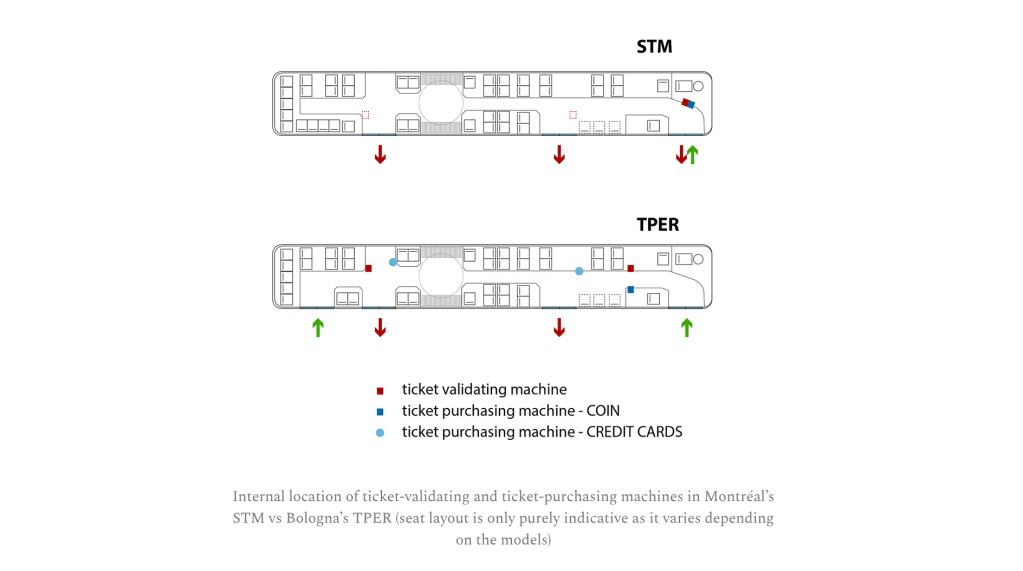
- Better boarding policies and more bus doors. In Italy, single-length buses have three doors while articulated buses have four or more doors. This allows for dedicated boarding and deboarding at multiple doors, speeding up the boarding process.
- Thoughtful stop consolidation. Metro is generally ahead of the curve on this, and while stop consolidation is a politically fraught conversation, a standardized approach of 300 to 500 meters (1,000 to 1,650 feet) is generally considered best practice8.
- Level boarding. Perhaps the most difficult piece for US transit agencies to get right, level boarding makes for fewer wheelchair ramp deployments which is one of the biggest sources of uncertainty for bus travel times.
Most of these can be achieved with minimum additional capital outlay. Transit signal priority will be the most challenging of these projects, both in terms of politics and funding. Current TSP in Seattle is limited to shortening or lengthening signal phases moderately, but this has only been implemented on RapidRide corridors and it’s not clear to me what the cost of that is. A full inventory of bus stops that need to go from pull-out to in-lane will take some time to put together, but will also have significant costs. One estimate from Sacramento for modular platforms stood at $50k, so for $50M we could do 1,000 bus stops.
New buses with more doors may sound like a niche thing, but my observations from Italy – corroborated by the previously highlighted piece is that having more doors means that boarding is much faster. Other small changes like ticket machine location have an impact too.
The final point – stop consolidation – is the most difficult topic to approach. In transit wonkery circles, the general impression is that buses in the US stop too frequently. I think this is situationally true, but there is not a single one sizes fits all approach that can be taken, and we should keep in mind that King County Metro has already done a fair amount of consolidation on major corridors.
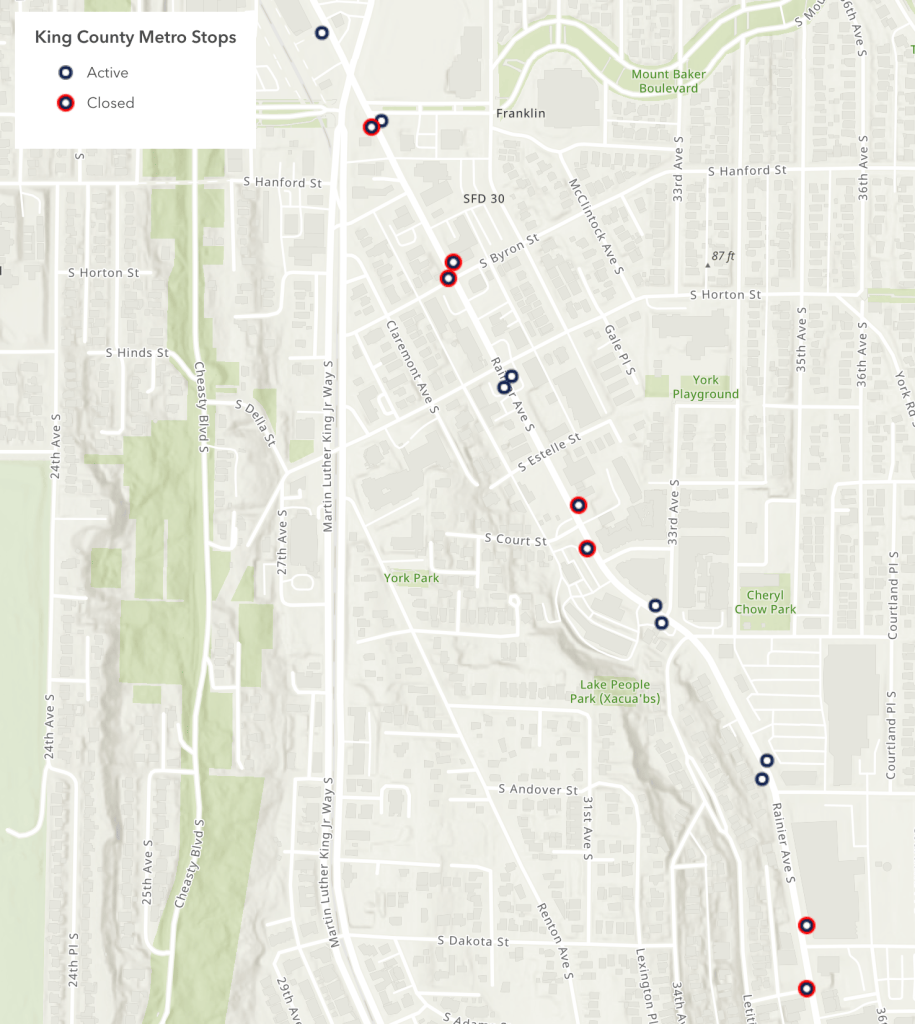
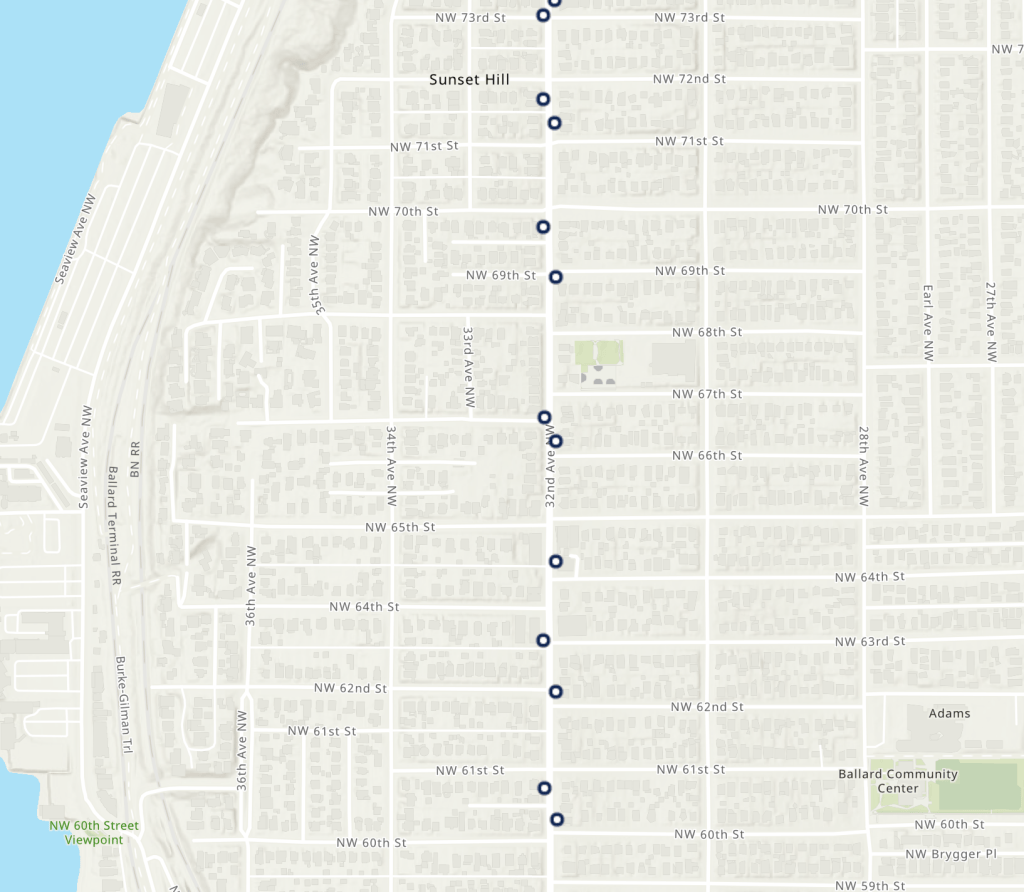
Above we see this dynamic on Rainier. About every other stop has already been consolidated, leaving typical a stop spacing of 200 to 400 meters – essentially within the range of where it “should” be. Below, we can see the same map for Sunset Hill, where the lone 17X runs peak hour only. No stops have been removed, likely because ridership is lower.
But the crucial thing here is to approach this issue as the proper level. The current RapidRide focus on corridors may have been an effective tool for winning FTA grants, but it inherently creates a tiered system. RapidRide projects are held up as Metro’s best possible routes, something that can only be true if the negative exists. Local buses provide more service to more people, often times (as is the case with the 7) in ways that is entirely indistinguishable from a RapidRide bus. But I think the system as it exists now still creates the impression that some buses are good and some buses are bad.
Transit does not occur solely within the context of individual corridors, and the 15 year timeline for the RapidRide R alone is reason to be skeptical of the power of the tools that we have now as transformative for transit riders. If RapidRide has done anything right, it’s been to illustrate that having buses run more often is a core factor in providing service that people can rely on. But we need all of our bus routes to run more often. And here it’s useful to recall that faster buses aren’t just about convenience for riders, they are also a cost saving tool. The number one cost for transit agencies is labor and buses running faster means buses coming more often. I’ll have more details to come in a forthcoming report on the subject.
Parting Thoughts
Ultimately, I think that many of the issues relating to RapidRide, and RapidRide R in particular stem from a political system that empowers people who have little experience or interest in public transportation. To his credit, Executive Zahilay seems genuinely invested in making the RapidRide R happen as quickly as possible because he views it as an improvement to the current bus. To the extent that the community has pushed back is only the extent to which this is a debatable notion.
What I’ve noticed in following these discussions is that we collectively do not have good language to address this kind of issue. Transit advocates – myself included – are often come across as obnoxiously wonky and struggle to link the wonkery with the real issues that people face on the ground. Stop consolidation becomes a legitimate technical method to defend from attackers, rather than a qualitative concern to address.
My goal here is simply to articulate that a more holistic and comprehensive approach to making buses faster is an approach that we have not tried to our own detriment. I have no doubts that if any Metro planners are reading this, that most of the anecdotes will be old news to them. Perhaps I’m biased as a member of the planning bureaucracy, but I don’t think the folks working within that system are the problem.
And if we lack the politicians who can articulate these issues clearly, it’s undoubtedly a result of a political and social environment that systematically favors anything other than transit riders. There are many ways to approach these issues. Transit riders on transit boards and educational ride-alongs with politicians are great and necessary tools for the here and now, but my feeling is that the work has to be more all-encompassing.
On the off chance that any political big-wigs are reading this, I want to challenge you to orient your thinking around public transit away from flashy corridor-level projects and onto the mundane. If you’re at King County, you have the power to make transit better by prioritizing improved outcomes (reduced travel time, reduced waiting, etc.). It’s worth asking: do the big projects where the ribbons are cut achieve these ends? I know what my answer is.
Thanks for reading, ’til next time.
Footnotes
- Marco Chitti has more in his excellent piece, Down with BRT, long live the Bus, which I recommend reading if you’re curious. ↩︎
- To be clear, I don’t think that rapid transit has to involve trains. It’s just that there is good reason that the Bogota BRT is hopelessly overcrowded with passenger levels that a typical metro could handle without issue: trains can move more people. ↩︎
- You can find sources in this Google Sheet. Note that for many of these numbers, I had to do some GTFS digging to get information. Metro’s website does not play well with the Internet Archive. ↩︎
- Sure, that’s a totally reasonable amount of money in the scheme of regional transit investments in Seattle, but we don’t exactly have that laying around right now. ↩︎
- If you want more on this topic, I highly recommend this piece. ↩︎
- Source. Trip leaving at 8AM ↩︎
- Source. Trip leaving at 8:02 AM. ↩︎
- I want to acknowledge that there is no one “best practice”. It’s a trade off between accessibility and speed. If a bus stops every block, more people will be closer to a stop, but the bus will run very slowly if it does. If it doesn’t stop enough, it won’t be useful to people. Local conditions vary, but I still think this is a good rule of thumb. On many routes, this level of spacing is already implemented. ↩︎


Leave a Reply