A few years ago, there was a bunch of action on a proposal to develop a new city in California. It crossed my mind again recently, so I thought I’d dredge those thoughts back up. The project has the obnoxious name of California Forever. This is, in many ways, an entirely accurate portrayal of the project. After all, it essentially amounts to a massive land amount of land speculation undertaken by wealthy industrialists. It really doesn’t get more California than that.
But what struck my interest wasn’t the generally corrupt nature of the dealings related to the project (corrupt as they seemed to me), nor the utopian urbanist ideals presented in renderings (utopian as they may be). What I found most interesting was the way that the project reveals ideas about what the root cause issues at play are. For the CA YIMBY folks who endorsed the project, it’s clear that their belief that removing the market distortions of single family zoning is enough to beat the ills that plague many other parts of the Bay Area. I’m skeptical of the answer, but the adherence to free market dogma is nothing if not ideologically consistent.
Longtime readers of the blog know that I have a long-standing, one-sided beef with arch-YIMBY and CA YIMBY head honcho M. Nolan Gray, and perhaps that bias will be evidenced throughout. But I do think that many (if not most) aspects of our land use regulation system are both not justifiable and partially causal in the housing crisis, which unfortunately for me does align me somewhat with that camp.
As ever though, how good a policy is has more to do with the specific details than the vague political ideas it touches on. Perhaps no (semi-recent) scheme better represents this. Because while I am deeply skeptical of the utility of all greenfield developments, this skepticism isn’t because I think greenfield developments are wholly wrong1. It has more to do with the ways in which building new suburban developments (and make no mistake, California Forever is a squarely suburban development) is at odds with my ideas about how who urban space is for.
Background
But first, a bit of background. California Forever is a land development scheme for a new city in Solano County. Solano County is just north/north east of Contra Costa County near the Bay Area, but is a distinct metropolitan statistical area. The principal city of Vallejo sits on the shores of the San Francisco Bay (well technically the Carquinez Strait), while the county seat of Fairfield is inland along I-80 and the Union Pacific mainline between Sacramento and Oakland.
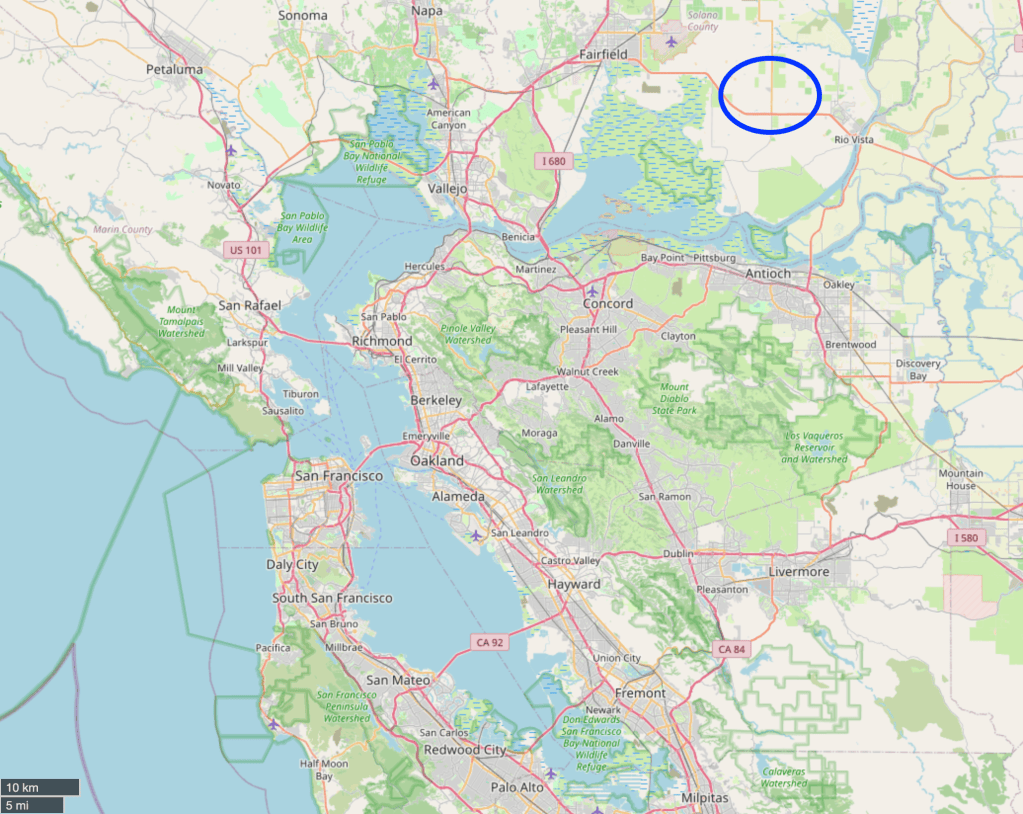
The California Forever development is not particularly close to any existing major city. While part of the area acquired by the who’s who of annoying Silicon Valley-ites does abut Suisan City (a suburb of Fairfield), the principal axes of the new city are planned to be California State Routes 12 and 113. This puts it about 2 hours away from the City by car. California Forever may cite Solano County’s horrible commutes, but it’s hard to see how this new development would shift the zeitgeist.
Well it’s hard to see how this would shift the zeitgeist if you’re skeptical of the jobs plan presented by California Forever. Their two major plans – an advanced manufacturing park and a shipyard – seem about as likely to occur to me as pigs flying.
On the Difficulties of Industrial Development
The primary issue to digest in all of this is in fact the job plan. Because that is ultimately what makes this “different” than “traditional” greenfield sprawl – the promise of high-paying manufacturing jobs colocated with the shiny new city. The two promises of shipbuilding and advanced manufacturing both have unique challenges, but shipbuilding is where I want to begin.
A report commissioned by California Forever talks extensively about the economic impacts of each of these proposed developments, but neglects to mention if a case exists for them being built in the first place. This is a glaring, albeit unsurprising, issue. After all, the plan’s origins are not in shipbuilding and the specific location of the development hinges on where a bunch of billionaires were able to buy land, not on anything resembling a strategic missing node in the national (much less global) shipbuilding industry.
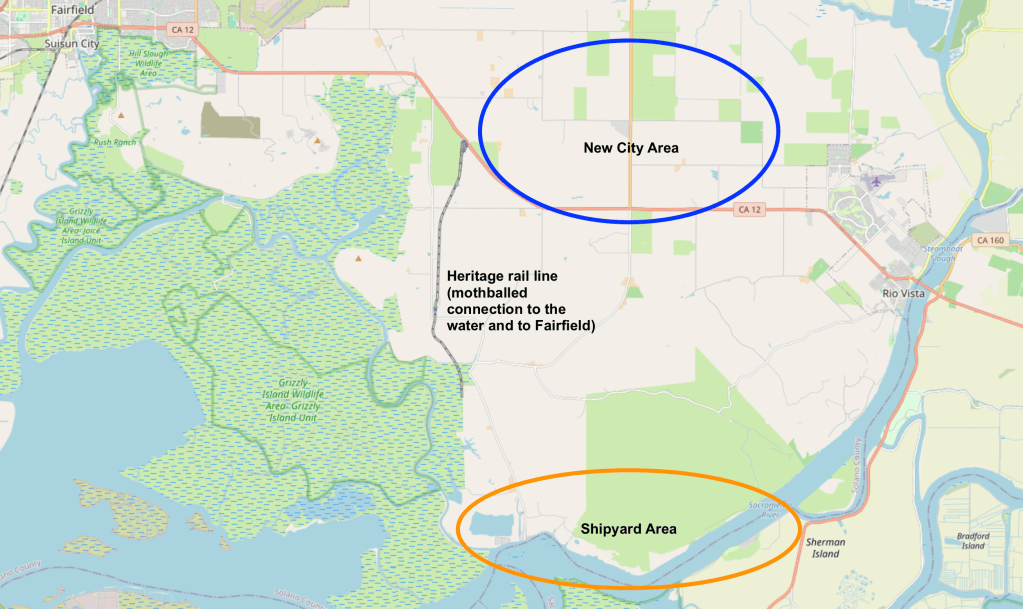
So let’s ask the question: is it reasonable to cite the largest shipbuilding facilities in the history of the world on the shores of the Sacramento River at Collinsville? I think even asking this question seriously is giving California Forever et al. too much deference. Let’s outline the issues that would face a major shipbuilding facility.
- Railroad access. While an old branch of the Sacramento Northern is nearby, there hasn’t been regular service in decades and it’s on an out of the way branch line. Not ideal for an industry that requires a lot of raw materials
- Highway access. So the railroads aren’t really up to snuff, but luckily the road network isn’t either.
- Water access. While the dredged channel of the Sacramento River is nearby, most of the waterfront areas are somewhat removed from this. Significant (and environmentally challenging) navigation improvements would almost certainly be required.
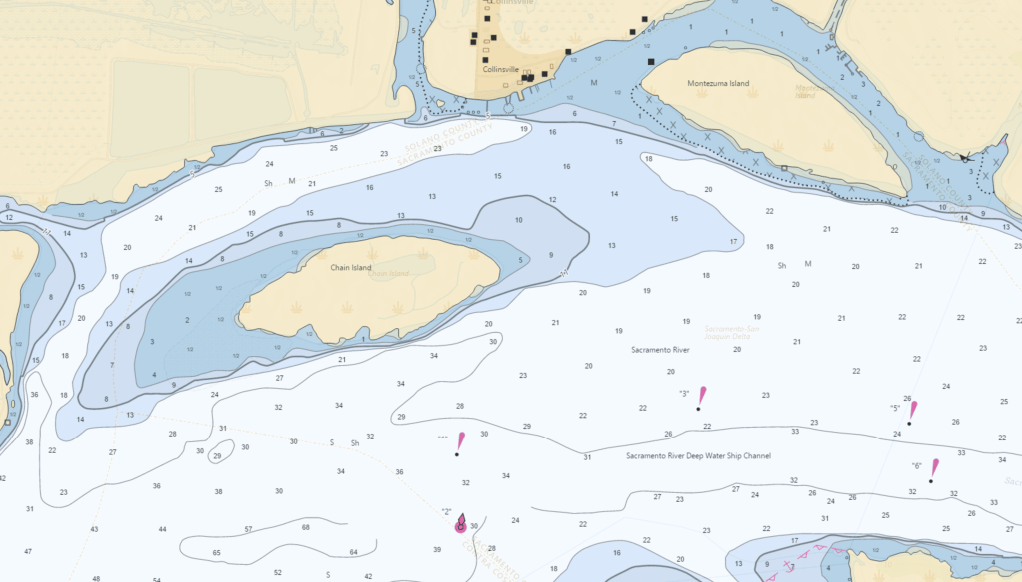
And it’s worth saying that of the 7,500 acres mentioned, a large amount is either the existing wetlands of Van Sickle and Chipps Islands or the hilly scrubland just inland from the bay. There are obvious environmental issues with doing major industrial development on some of the few remaining wetlands in the San Francisco Bay, but it’s probably somehow less practical to do major industrial developments in the hills. Since plans do not identify the specific parcels that make up their theoretical 7,500 acre set of sites, it’s hard to take this at face value.
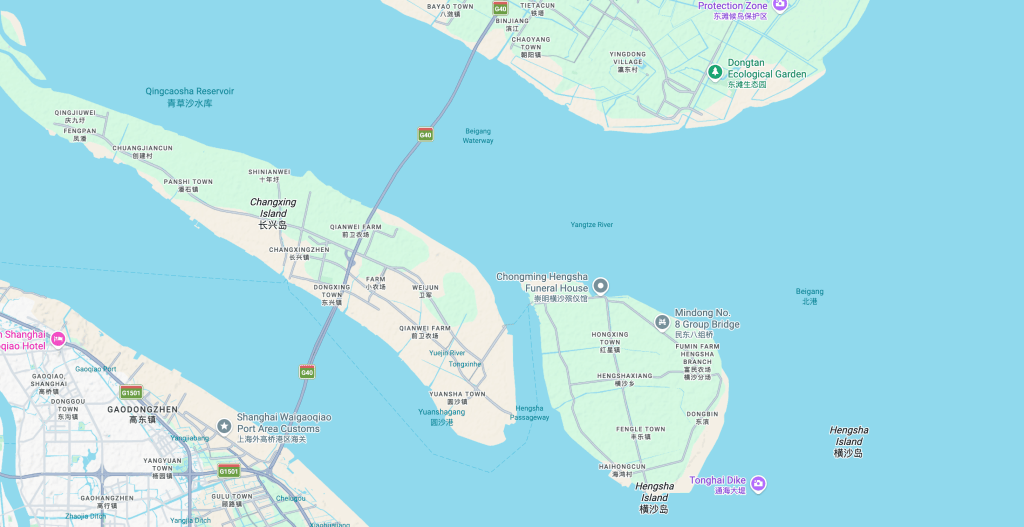
They make a comparison to the current largest ship building site in the world – China’s Changxing Island – but a brief glance at that will make it clear that the sites are not at all comparable. Changxing Island is pancake flat, next to Shanghai, and located at much closer to the open sea. Collinsville is not flat, much further from the sea, and nowhere near San Francisco.
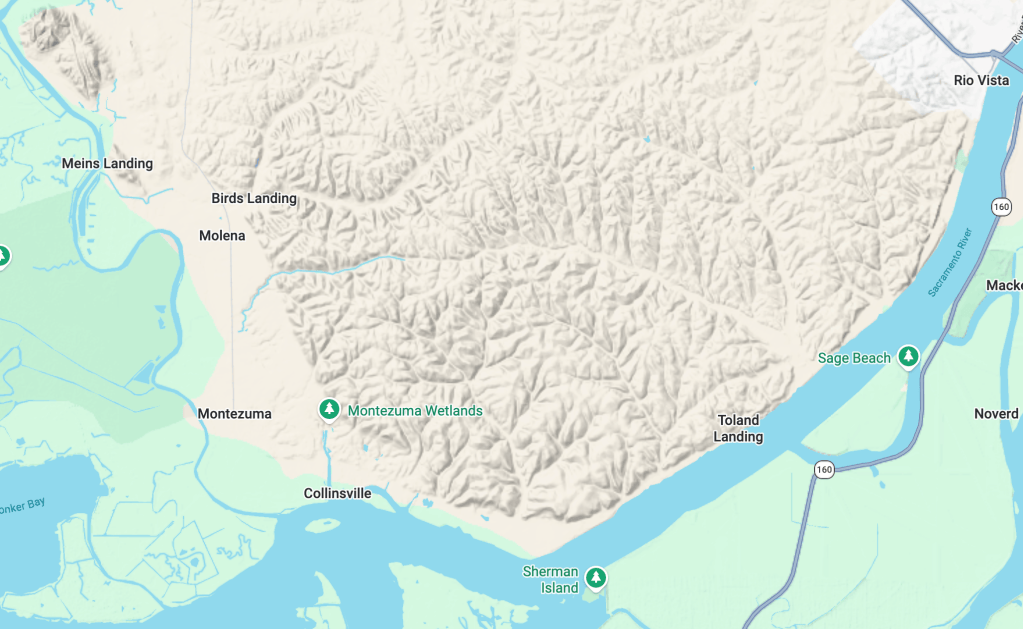
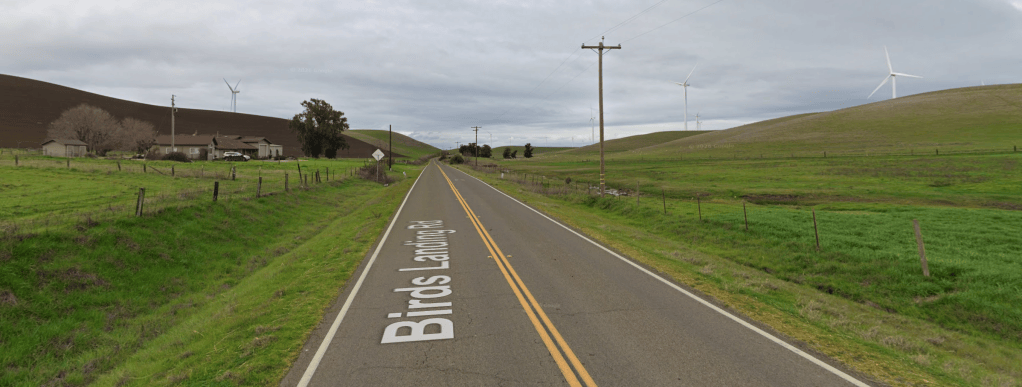
Even if we take the broader premise on good faith, that the US shipbuilding industry is in disarray and more shipbuilding facilities is something we all collectively agree are needed, why on earth should they be located in the middle of nowhere with a massive additional infrastructure development need? There are windy two lane country roads connecting Collinsville with the narrow two-lane CA 12.
Why on earth would any shipbuilder prefer this site over any former shipyard in the Bay Area? The WWII-era Richmond shipyard is basically auto storage now, has direct mainline rail access (to both UP and BNSF mind you), is on I-580, and is directly adjacent to the deep-water San Francisco Bay. Sure, it’s “only” 500 to 700 acres, but it essentially already exists. Oh, and it’s in the already urbanized portion of the Bay Area.
Within 10 miles of the former Richmond shipyard, there are some 385,000 workers. For the Solano Shipyard? It’s under 90,000.
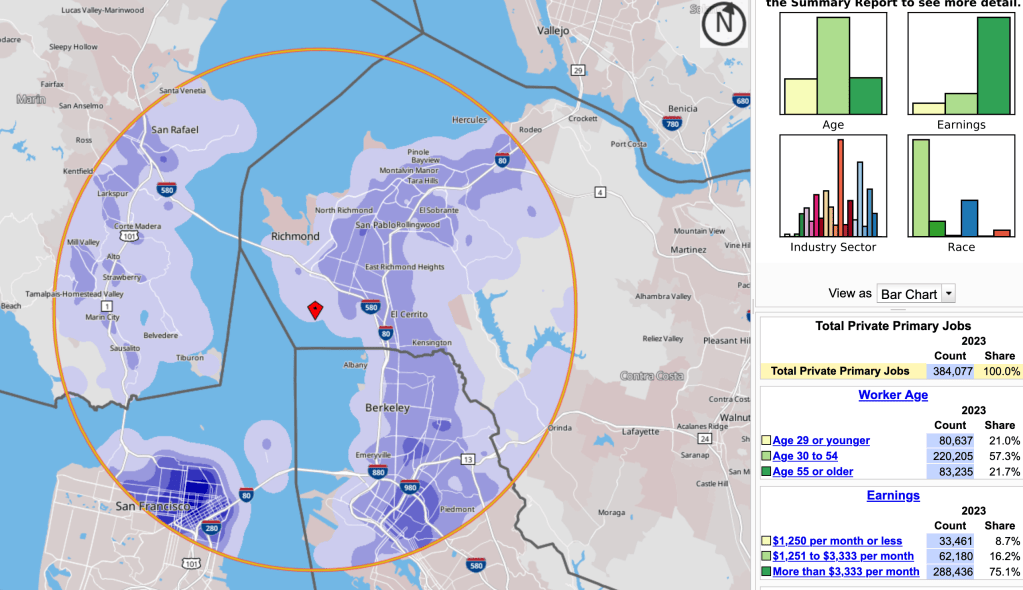
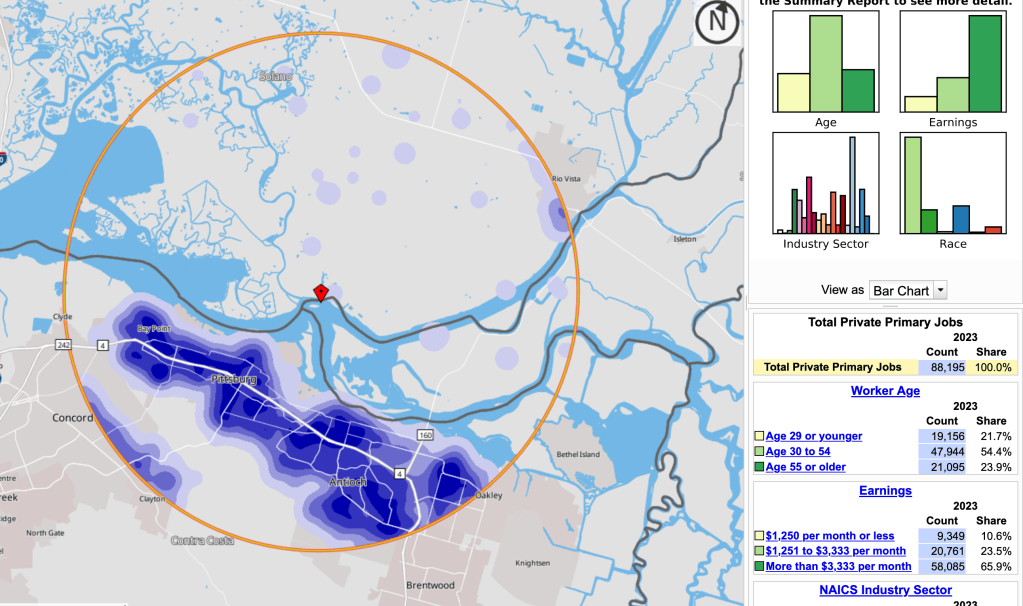
To be honest, this exercise is a waste of time. The purpose is simply to illustrate that even in the context of the Bay Area, this development simply does not make sense. It should be obvious that the job plans are pure post hoc justification to get the plans off the ground. Because if they cannot make lavish job plans, even the boosters themselves cannot imagine a bedroom community along urbanist lines. If everyone is leaving to work in the Bay, what use is perfect urban design? No amount of woonerfs can make up for fact that 4 hours of driving await the median resident of the California Forever city if the jobs promised don’t materialize.
And moving past the hilariously impractical Solano Shipyard isn’t much better. Everyone can shout til their hoarse about advanced manufacturing, but again why on earth would anyone build a manufacturing plant so poorly served by the existing freight distribution network? Maybe this is a result of my childhood being overshadowed by the Foxconn debacle outside of Kenosha, but unless California Forever identifies specific firms that have specific needs and desires to take a massive risk on siting their factories in the middle of nowhere near nothing, there is no reason we should just take them at their word that they would be able to attract a single major client.
Renderings Do Not Make a City Livable
I spent so long looking at the ridiculousness of the job projections because the entirety of the plan is built on people being able to live without cars. If everyone is commuting to San Francisco, Oakland, or Sacramento, most of these people will choose to be in a car regardless of the number of speculative regional transit buses shown on a master plan. Vallejo only manages 3.3% of commuters using public transit despite having a direct ferry connection to San Francisco2, and that is both more convenient and much cooler than a long slog on a commuter-oriented coach bus.
There’s a tendency for landowners to overpromise and under deliver on any development. It’s natural to use hype to sell properties, but how well the place functions after the developers have made their cash is anyone’s guess. For suburban developments contingent on quality transportation links to job networks, public transit is usually the first to go.
One doesn’t need to look far into California’s past for evidence of this. Los Angeles was built out primarily by and served by the Pacific Electric Railroad. But service was always expensive to run and the real estate moguls who owned and operated the railroad viewed it essentially as a loss leader to get people to purchase properties in the first place. Once that initial cash was made, their was no real reason for them to provide anything other than the barest bones of service.
This is partially why Los Angeles was so amenable to the car in the first place. Tons of people bought property in places far away on the promise of quality transit, but the actual quality of that transit was never quite as good as it needed to be. In the here and now, California Forever can commit to leveraging the derelict branch of the Sacramento Northern railroad for an Amtrak or BART connection all they want, but once they sell all the lots, will that promise be delivered on?
And it sure seems that this rail line is already over-promised. As the only real link to the national rail network, it’s a crucial part of any future largest shipyard in the world. But that is fully at odds with also developing a passenger connection to Amtrak or BART. Setting aside the obvious fact that a BART extension would be a massive financial commitment for an agency currently facing a fiscal crisis and the even more obvious fact that the rail line in question doesn’t even directly serve the new community in question, you can’t promise the rail line to the world’s largest ship yard and also get good passenger service.
Perhaps its not reasonable to expect a speculative real estate development plan to be realistic. But too many organizations (as in more than zero) took these promises seriously without an ounce of critical thought on implementation. Sure, it’s all technically possible to achieve. But is the issue facing cities a lack of technical ability? Or is it the reality of the world we all share?
The Purpose of This Plan is to Manufacture Consent
All plans exist as a means to create the public desire for something that doesn’t currently exist. This means that, on some level, they require persuasive elements to create public support. While this is a long way away from the type of consent manufacturing outlined by Chomsky and Herman, you can see elements of the idea scattered throughout California Forever.
Consider the centering of jobs and alleviating commuting challenges that face Solano County. It is exceedingly unlikely that the original development would have centered on this idea, as the specific land purchased by the investment group is not exactly well-suited for the sort of typical suburban job development. It’s far away from existing population centers nor is it near anything resembling a critical infrastructure node.
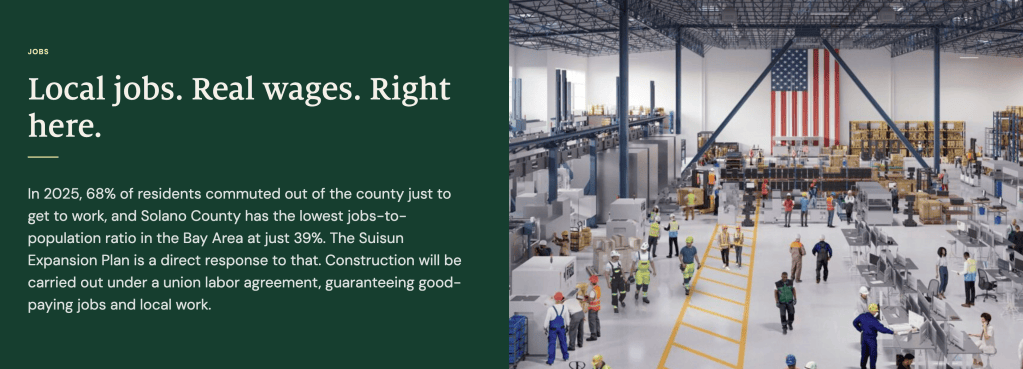
But as the plan encountered opposition, the investors realized that it’s one thing to buy a lot of land with the intention of developing a new city and its another to get the series of public buy-ins required to make it happen. Thus the post hoc nature of the job plans. This is abundantly clear just from the fact that, when I was tracking this two or three years ago, the shipyard wasn’t even proposed yet. Facing opposition, the only response was to up the ante further (hence the largest shipyard ever conceived).
To the extent this plan differs from all other plans is simply in the fact that this plan is the brainchild of a bunch of outlandishly wealthy real estate speculators. Plans in the public sector and sphere necessarily have a wider range of players at hand, but the landowners in this case have given themselves carte blanche to do whatever it takes to make a return on their investment.
Yet no matter how many studies they commission3 to demonstrate the economic value of siting the world’s largest ship yard in the part of Solano County where they just so happen to own a bunch of land, they cannot beat the iron truth of the physical reality that we coinhabit. And in this world, industrial development happens in places that have some sort of infrastructure to support them. Sure, you could build the railroads, highways, and ports required in Colinsville, but the question remains: why there?
Looking over the plans at hand, the only thing that I see coming through is “we will make a ton of money because we own a lot of land here”. There are probably dozens of places in just the San Francisco Bay Area better suited for this kind of industrial development4. And for housing? We can and should build more and denser housing in places nearby to existing employment centers. These are trivial to locate, but getting more housing built can be politically contentious.
And while I am deeply skeptical that this project will ever work out, there is absolutely no guarantee that things would improve much in the long run if they did. There are challenges to having a city of 400,000 in an area that wholly lacks the sort of water infrastructure required to support that many people, but moreover this project does nothing to do address any of the systematic issues that have created the housing crisis and our K-shaped economy in the first place. If all the big promises of jobs do come true and this new city becomes a magnet for commuters entering, the lack of quality transportation links will be crippling too.
These factors ultimately underlie why I feel that greenfield development is not a good idea. While the environmental degradation is real, the ultimate issue is that it just doesn’t do much to improve the quality of life of any involved. Cities and metro areas should be both compact and affordable. Throwing down a major hub in the middle of nowhere is antithetical to these ideas. If we want to actually solve the issues of cost that face our cities, simply building more will never fully address our problems. 120 years ago when zoning codes were a twinkle in McAneny and Bassett’s eye, cities were unaffordable for the working class and filled with issues all their own.
On the Danger of Apocalypse Dreams and Billionaire Utopias
I remain convinced that to solve an affordability issue, we should make direct policy to reduce prices5. This can mean providing additional supply, but the ironclad laws of supply and demand are only as ironclad as the set of policies which create them. Market forces are not inherent to human societies and it is entirely possible to divorce basic needs from these systems. Just ask an Italian about the price of counter service espresso.
But this is a meatier topic that brings up more questions than answers that I have at the moment. Instead, I’ll close with thoughts on why this kind of development is so antithetical to my ideas of urban space and who their for: they represent a refusal to reinvest in the communities that already exist.
This project is not happening in a vacuum. The choice of wealthy Silicon Valley investors and oligarchs to spend $900 million on land on the fringe of the urbanized Bay Area is not morally neutral. You don’t do that if you believe in the places that already exist closer to home. All utopias trade in the problem of abandoning our share reality for the terra nullis of undeveloped land, but the specific political movement that Silicon Valley oligarchs represent deepens these issues.
Perhaps the apocalyptic underpinnings of the AI investment world6 are beyond the scope of a land development scheme in Solano County. But I don’t think it’s incidental that a utopian development scheme would come out of that environment. Utopias require a dystopia to exist as a foil, and as dystopian as the peninsular suburbs of San Francisco may be, they are still flawed places that matter deeply to the people that inhabit them. And based on what I’ve seen in my time in the Bay Area, I have a hard time imagining that Marc Andreessen imagines Palo Alto as the dystopia to California Forever’s utopia.
San Francisco, with its sclerotic politics, long history of labor organizing, its earnest and forthright acceptance of people from all walks of life, and its occasionally radical tendencies of municipal ownership is far more likely to be the implicit dystopia for the Silicon Valley elite. To me, San Francisco is a profoundly beautiful city that is worth caring for and nurturing into a future where people can afford rent without working for a factually evil company. It’s hard not to feel that California Forever rejects this notion, that San Francisco can be a place for everyone. But this requires improvements to San Francisco as it is now, not moving out to a patch of land where the accumulated history of the people of the Bay Area can be ignored.
As an urbanist of sorts, I cannot accept the utopia as framed by a series of billionaire investors if only because of this. San Francisco is far from home for me, but when I visit and ride the original municipal transit service, or when I see the people and all their beauty basking in a summer day at Mission Dolores, I see a city worth investing in. It reminds me that, despite our flaws, our greatest strength comes from building on the great places that we already share.
Thanks for reading, ’til next time.
Footnotes
- To be fair, I can’t think of an example of a current greenfield development that I would support. ↩︎
- I would presume that more than 3.3% of people who live in Vallejo and work in San Francisco commute by transit, but no way is it a majority. There isn’t great data on this sort of thing unfortunately. ↩︎
- This study is the one I have in mind. It talks a lot about economic development but no time is spent addressing if any of this would ever happen. ↩︎
- Of the top of my head: Richmond, Port Chicago, the Port of San Francisco, Alameda, and Vallejo are all smaller than the quoted 7,500 acres but have large sites with far superior connections to the regional freight transportation network. ↩︎
- I realize this puts me at odds with most mainstream economists, but I don’t mind being in that position. Supply and demand are just as much social constructs as private property and we collectively have the ability to reject them. ↩︎
- More context here ↩︎


Leave a Reply