
For Olivia’s 30th birthday, we traveled to Ciudad de México (Mexico City). I had never been to Mexico before, and while I expected to like it, I was surprised by how interesting it was (in both good and not so good ways). The things I liked – food, public transportation, museums, and vibes – won’t surprise anyone, and most of the things I didn’t like had little to do with the city itself.
I’ll start in typical fashion by highlighting just how incredible the public transportation in Ciudad de México is. The backbone of the system is the Metro de la Ciudad de México (Mexico City Metro), which consists of 12 lines spanning 195 stations over 125 miles of tracks. That makes it about half the size of the New York City Subway, and it gets about 1.5 billion rides per year (a little over half the NYC Subway). Not bad for a system that didn’t open until 1969.
But what really made the system special is how often the trains run – every 2 to 4 minutes (depending on the line). Its hard to overstate how incredible this is, though if advertising is any indication its clear that even Sound Transit is aware that 4 minute headways are world-changing. The difference between having one corridor where this exists (as Seattle does) and dozens is stark. And it’s not just the Metro. There’s also an extensive network of buses that can actually be considered bus rapid transit (BRT). We only had the chance to ride one of these lines (Line 7 on Paseo de la Reforma), but the BRT lines run as often as every minute1.
And as far as I can tell, the limiting factor for service (and ridership) is simply the number of vehicles that can be run. The buses and trains were often crush loaded far past the point of comfort. This was sort of exciting at first (I really do love public transit), but after about two packed trains I was reminded of a random (maybe apocryphal) comment I read years ago about how visitors to San Jose from Seoul remarked that they appreciated how empty the trains were as if that’s a good thing!
Crush loads aside, being in a place where public transit is so well utilized means you can get just about anywhere you want to go on it. We didn’t stray too far from the standard semi-touristy things, but everything we could have wanted, needed, or imagined seemed to be within a 20 minute walk of a metro stop. It was a rude awakening back to the #1 light rail system in the US2.
The Sights, Smells, and Tastes of the City
And where did we go on all of our metro trips? Mostly to restaurants and cafes recommended by Connor, to some truly excellent museums, and to a fair few unambiguously tourist-y places. The food cannot be described in words, but as I no longer am in possession of the phone I entered Mexico with and the AI slumlords ruining our world have yet to invent smell-o-vision, they will have to do. I’ll never forget the aguachiles at El Pialadero de Guadalajara, nor the cafe de olla at Centrina.
But it probably goes without saying that the Mexican food in the capital of Mexico is very good. And while apparently everyone else I was traveling with was well aware of Ciudad de México’s excellent museums, I was not. So the museums were a real treat. We went to the Museo Nacional de Antropología (Anthropology) the Palacio de Bellas Artes (European/fine art), and the Museo de Arte Popular (Folk art). More on the Museo Nacional de Antropologiá later, but of these the Museo de Arte Popular was easily my favorite.
As someone who tends to eschew constructs like fine art3, it was easy to like. But even compared to other folk art museums and exhibits I’ve seen, it was exceptional; there’s good reason that Mexico is well-known for craftspeople. If you find yourself in Ciudad de México, this would be high on my list of recommendations. It made for an interesting contrast with the Museo Nacional de Antropologiá, despite many visual similarities. As I’ll touch on later, this museum certainly leaned into more of a colonial/Euroamerican framing, but the through line in folk art felt obvious to me. The Museo de Arte Popular did a good job of centering that too, which was nice.
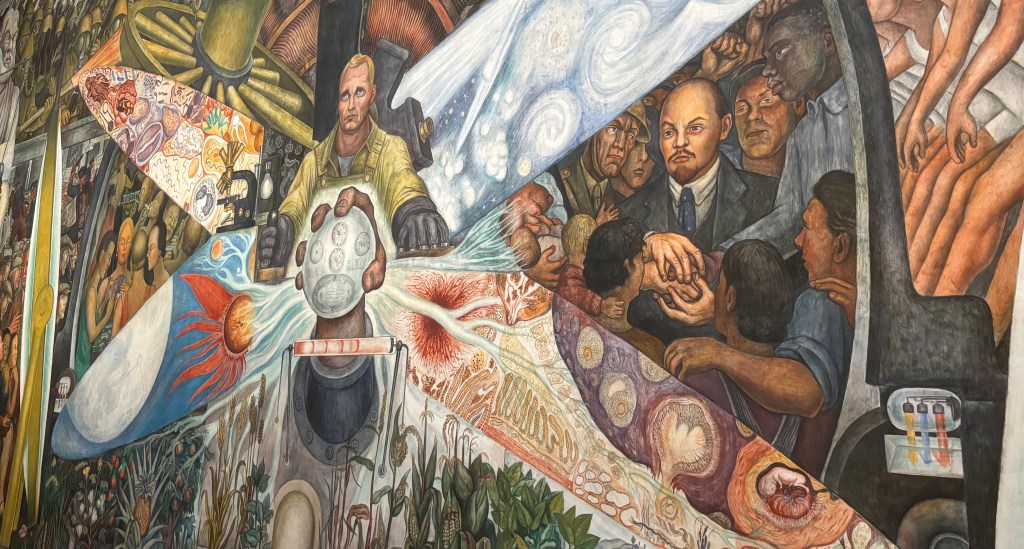
And finally, the Palacio de Belles Artes was worth the price of admission just to see the Diego Rivera’s El hombre controlador del universo. Commissioned by the Rockefeller family (yes that one), it was deemed “anti-capitalist propaganda” once they saw it and the original work was destroyed4. Rivera then repainted it in Mexico. The other exhibits were interesting enough, but I really liked the mural.
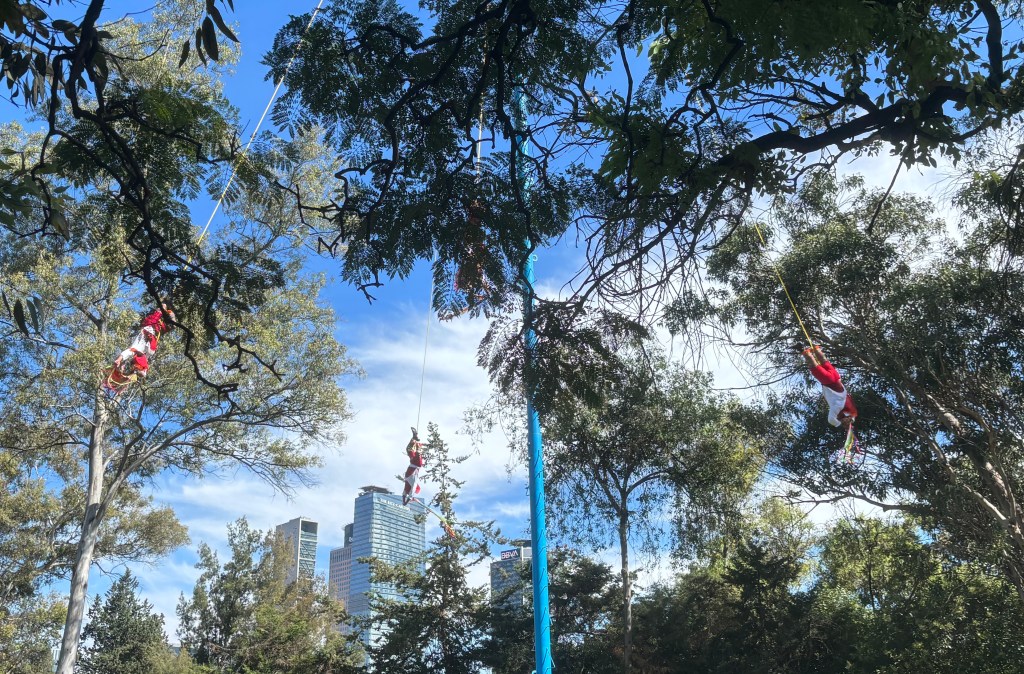
Beyond the wonderful food and excellent museums, I have to give a shout out to Chapultepec Park too. Ciudad de México is infamous for its poor air quality and the Bosque de Chapultepec was a lovely place to take a walk, in and of itself but especially as a refuge from the smog. I think any time you’re in a big megalopolis, its easy to forget that something was lost in the creation of the city. Enjoying a big park is relaxing, though perhaps the melancholy of loss is a little, well, melodramatic to emphasize.
On Pickpockets and Globalization
But it wasn’t all aguchiles and folk art. Ciudad de México – despite its access to capital, flashes of wealth, and gentrification – unambiguously sits in the Global South. I experienced this first hand on the Servicio de Transportes Eléctricos trolleybus Line 1 where I had my phone stolen. This particular trolleybus line connected our hotel (near the Salta del Agua metro station) with the Palacio de Belles Artes – a local service shadowing much of Metro Line 8. Riding it was simply something I wanted to do as a trolleybus enthusiast.
I won’t bore you with the gruesome details of the pick-pocketing. It was a (typically) crush-loaded bus and I knew it happened almost immediately. I even knew who on the bus was responsible. But by the time I could react, the bus was emptying out at a stop and my 7 year old iPhone was going with them. I had a mild panic, but luckily Olivia was with me to both be a source of stability and to provide a way to contact my parents and my bank. But the next day, while walking from the metro back to our hotel, I saw my phone for sale on a table5.
It’s easy to feel angry when things like this happen; it’s violating and upsetting to be robbed6. But on reflection, it’s hard for me to ignore the role that the US has historically played in destabilizing Mexico, how that has interacted with petty crimes of survival, how modern “digital nomad” gentrification has accentuated this, and why a glaringly obvious gringo with an iPhone like me is a natural target (even if that makes me unhappy).
In his seminal work on cricket, the esteemed Trinidadian anti-colonial scholar C.L.R. James stated:
“What do they know of cricket who only cricket know?”
It’s a twist on a Kipling poem (“What should they know of England who only England know?”) and it gets to the core of the issue far more succinctly than I can. Reframed for our purposes here (and less poetically): if you only ever spend your time in the US, can you accurately understand the way that US economic, social, and military power impacts how other people live?
If we imagine that the petty thief working the STE Line 1 trolleybus is 40 years old, then they came of age at a time where Mexican participation in the North American Free Trade Agreement meant an influx of US-subsidized corn devastating the rural economy and the repealing of the section of the constitution protecting Indigenous communities from privatization. This latter portion – the core of Emiliano Zapata’s campaign of “tierra y libertad” (“land and freedom”) – was won through a literal revolution.
And while the US is decidedly not the place to uphold as a model of Indigenous sovereignty, dignity, or rights it is worth pointing out that our constitution establishes certain protections for Indigenous communities through the treaty process. The US did not ask itself to amend its constitution to annul all treaties with our Indigenous communities, but it did ask this of Mexico.
The impacts on Mexican society are beyond the scope of a travelog written by someone who has been to Mexico exactly once, but it’s this sociopolitical context that underwrites a good portion of the 40% in population growth that Ciudad de México has undergone since NAFTA passed in the 1990s7. Mike Davis referred to this dynamic as “urbanization without jobs” in his work Planet of Slums8. The Scylla and Charybdis of urban disinvestment and rural destabilization inevitably leads to poverty and its associated social ills in cities. There may not be much work in the city, but its better to eke out a living there than to starve in the countryside where the ejido (community-held land) has been sold to Cargil. That this urbanization without jobs has happened in Mexico (and in Ciudad de México in particular) is no coincidence, and if I am looking to point a finger, the natural place is inward.
… And Gentrification
Compounding (and seemingly related to) the issues of disinvestment and poverty is the other obvious thing about Ciudad de México: gentrification. It’s even bad enough to register on the digital nomad life advice blogs with costs rising 100% in just a few years9. I think it’s worth articulating the way in which open borders (for rich tourists and so-called expats10) means reducing opportunities for a dignified life for locals (provided you don’t want to work in tourism) and how that ties into broader economic patterns relating to petty crime and the like.
On our trip, this was most obvious when we were in the Rome Norte neighborhood – likely the epicenter of gentrification in Ciudad de México. We went to a vintage store after seeing good reviews and much to my surprise the clothes were outrageously expensive – even by my “used to gentrified vintage stores” standards. I’m talking $2,000 peso ($104) for a t-shirt. Here I must take a brief aside to invoke Macklemore and illustrate how far we’ve fallen as a society:
They be like, “Oh that Gucci, that’s hella tight”
I’m like, “Yo, that’s 50 dollars for a t-shirt”
I fear that, adjusted for inflation, the $50 Gucci t-shirt referenced by Seattle’s own in 2012 is now $73.50 – which is still a better deal than the stuff I saw at this vintage store in Roma Norte. But the ways in which the second hand market has gone out of control is not new news to me, though I was surprised to see it so bad in Mexico. But this sort of foreign/tourist/digital nomad oriented is close to the norm now, at least in the trendy parts of the city. According to a study of the greater Roma/Condesa neighborhoods in Ciudad de México from the Tecnológico de Monterrey, the portion of businesses with foreign names rose from 16.3% in 2020 to 32.5% in 202511. Rents are increasing accordingly (up 30%) as are Airbnb listings (up 74%).
I think it’s worth saying that gentrification like this is bad for both long-term residents and the city at large. It’s obvious how its bad for residents who are pushed out by higher prices or a sense of cultural alienation, but gentrification is often explicitly (or implicitly) pursued by local governments so its worth articulating why I think it’s bad for cities too.
The process of gentrification (and displacement) ultimately requires people with more money and resources displacing those with fewer. It implies a level of social inequality that allows certain people to use the power of the market to displace others. That is ultimately a recipe for a bad place to live, as the gated mansions of the rich existing don’t become gated for aesthetic purposes, they do it out of fear of the toiling masses. I don’t want to live in (or visit) places where fear is the only thing holding the city together.
Beyond Tourism
I’ve been feeling increasingly alienated from tourism lately, despite the flurry of travels that present evidence to the contrary. It feels like my options are to engage in a tacky, Disney-ified experience or to trample all over a culture that I am not a part of. The trip to Ciudad de México was not immune from this alienation, and though I came out the other side feeling great about having gone, I want to briefly interrogate the link between the ills of the modern economy and tourism.
This puts me at odds with just about everything I see, since it seems like everywhere I look, there’s another travelog or report espousing the benefits of travel and tourism. But of course, this general idea is not new ground for me. In my last post, I detailed how the modern AI slop machine misconstrued the broader points I made in an old post about London to further the idea that tourism is a net positive for society, and a few months back I talked about how I find being a tourist to be boring.
And while these points hold, what I ultimately find distasteful about tourism and the tourist economy is tied up in my idea of what it means to live “the good life”. While most Americans seem to define this as going on lots of trips, I think the impact that tourism has on local economies is ultimately parasitic at best and destructive at worst. Chasing out-of-town dollars may seem like a great way to generate “free” revenue for businesses12, but when places orient around external desires they become vulnerable to the whims of the market (and by extension rich foreigners). This is essentially identical to the issues of gentrification outlined above. When a city (or any other place) is not built to serve the people who live there, it risks alienating the people who live there and failing to serve their needs.
On this topic: when I was in grad school, I wrote a brief paper on the economics of the Duluth area13. It was interesting to me in large part because of the contrast (and conflicts) between the Boundary Waters-oriented tourist economy and the history of iron mining and related heavy industries. And while I’m clearly not in favor of mining projects in Northern Minnesota for a litany of reasons, its worth articulating a key finding I had while researching that report: wages are 5x higher in St. Louis County (Duluth’s county) in mining than they are in outdoors tourism.
And it isn’t just wages. While all wage work is subject to the whims of an increasingly globalized market, tourism is intimately linked with a customer-service type relationship. It is possible for these jobs to support a dignified life (if workers are able to organize themselves in such a way), but our cultural expectations of the tourism industry are radically different than the mining or manufacturing industries. I think a place that is oriented solely around tourism (and especially international tourism) is a place where workers are ultimately belittled to serve the interests of a functionally absent and interchangeable set of tourists.
This dynamic was certainly on my mind when we were in Ciudad de México, and no place exemplified it more than the canal tour we took at Xochimilco. One of the last lacustrine remnants of the lakes that used to dot the Valley of Mexico, it’s main tourist draw are scenic boat rides down the canals that dot the area. While I was happy to see that the tourists weren’t just gringos, and the prices seemed to be high enough to support a decent-ish wage (we paid $2200 peso for 2 hours, which is about triple the minimum wage14), I’m still not sure if I truly enjoyed it.
Well I did enjoy it. It was very nice. But maybe it was the extensive number of small shops offering axolotl experiences (Xochimilco hosts the last habitat for the iconic salamander), or maybe its just my broad skepticism towards “experiences” in a broader sense, I just found it to be sort of uncanny. It’s cool to be shown around a bunch of canals on a boat, but I just can’t shake the feeling that the world would be better off if we didn’t all collectively orient ourselves to the external gaze.
It’s this last sentiment that ultimately undermines my apprehension towards the tourist industry writ large. At a conceptual level, it requires subjecting yourself to the whims and desires of an outside (likely rich American) need. I’m happy to subject myself to many whims and desires, but I’m most happy when they are my own. And most of all, I do not want to subject other people to my whims and desires.
On Teotihuacan
On the note of tourism, much of the tourism in Ciudad de México revolves around what I would describe light-heatedly as the “Navel gazing about human sacrifices industrial complex”. This dynamic was most stark to me when Olivia and I were perusing the exhibit in the Museum of Anthropology about Teotihuacan.
For those unaware of the history of Mesoamerica before the Spanish conquest, Teotihuacan was built around 100 BC and was mostly abandoned around 750 AD. It predates the Mexica (Aztecs) by at least 700 years, as the Mexica did not arrive in the Valley of Mexico until the 1300s. The circumstances of Teotihuacan’s decline from the quasi-imperial/religious seat of Mesoamerica around 600 AD are, as I understand it, hotly debated within the broader anthropological world. What isn’t debated is that some level of social strife marked this final period and that a great deal of relatively uniform-sized apartment/housing complexes were built around that period as well.
David Graeber and David Wengrow outline this in their 2021 book, The Dawn of Everything, and posit that a general rejection of the strongly hierarchical society present in Teotihuacan before ~600 AD led to a more egalitarian social structure – something evidenced by the sudden appearance of a lot of apartment buildings of roughly equal unit size. But in any case, this sort of discussion was wholly absent from the Museum of Anthropology, though the emphasis on human sacrifice in a religious context was not.
My feeling is that this sorts of cultural apparatus – the museum telling the visitor about human sacrifice (scary, different) rather than affordable housing (obvious good) – serves primarily to distance the viewer from the people who lived in Mesoamerica at the time. After all, we find human sacrifice to be (rightfully) disturbing. But its important to note that most Mexicans have Indigenous roots of some kind, so in Ciudad de México – the heart of Mesoamerica – it is likely that many are direct descendants from the Mexica and Teotihuacanos.
Emphasizing the differences – the autocratic, hierarchical, human-sacrificing – between historical Mesoamerican society and our own serves to break these ties and orient people towards a colonial/European outlook. Or that’s the impression that I get. My issue as a visitor was primarily that I am just not interested in this, but I’d be remiss to say that I think this kind of portrayal of culture (one rooted strongly in the European tradition) is bad writ large for reasons that (I hope) are obvious.
I had wanted to go to Teotihuacan, going as far as to look at the bus options, but seeing the exhibits in the Museum of Anthropology made me wary. My own desires – to see an example of an old society that rejected hierarchies and built social housing – are not commodities that trade well in the global market15. And while I can concede that the city itself would be interesting regardless of framing, I visit historical sites because of what they mean to me – not solely to see great places listed as “must visit” by travelogs. Perhaps this means I need to renege on my prior statement. Maybe it isn’t that I do not want to subject others to my whims and desires, but that my whims and desires are at odds with the broader space inhabited by tourist economies oriented to Americans.
Parting Thoughts
Let’s consider the old adage that travel is worthwhile because it expands your horizons. On the surface, I think this is true: if you never leave the confines of your home and routines, its difficult to expand your worldview past the ordinary experience of your daily life. But looking more deeply, I think that travel (and by extension tourism) is like school: you get out what you put in.
I went to Mexico seeking, above all, to understand Olivia a little better. The trip was for her birthday and being Mexican is a core part of who she is. I feel that this trip achieved this, though of course the work of loving and understanding is a lifelong effort16. Secondly, the trip was about seeing Amanda (currently living in Tuxtla Gutiérrez, Chiapas) and meeting her partner Abi. This exceeded all expectations and was a real treat – it’s great to see friends that you haven’t seen in a while, and meeting the people they choose to share their lives with is a rare joy.
All the other thoughts – around gentrification, public transportation, tourism, and the rest – were tertiary. And I think these intentions of visiting and connecting with friends has helped me stay grounded as I’ve traveled in the last few years. I have an innate desire to see the world is in all its imperfect glory but my growing skepticism of tourism has presented challenges there. Splitting the difference by visiting friends (and doing some tourism on the side) feels like a middle ground I can live with.
Thanks for reading, ’til next time.
Footnotes
- Honestly, this is probably just evidence that Avendia Insurgentes (Metrobus Linea 1) and Paseo de la Reforma (Metrobus Linea 7) could easily support a metro line. ↩︎
- If anything, this trip made me realize just that we should think of NYC transit as great, but not exceptional. Its the only point of comparison I have, and I honestly think Ciudad de México has better transit than NYC. ↩︎
- Well mostly. I am writing this immediately after going to see Mozart at the Seattle Symphony and I did say something to the effect of “I like fine art” to Olivia while waiting for the bus. Maybe I like to have my cake and eat it to. ↩︎
- Apparently, they were mostly offended by the overt portrayal of Lenin and future Governor of New York (and US Vice President) Nelson Rockefeller was ultimately responsible for its destruction. ↩︎
- Or at least I saw what appeared to be a 2019/20 iPhone SE with the same scratch marks on the side. I know it’s a big city, but I’m still fairly sure it was mine. ↩︎
- I also want to add that the kind old man who comforted Olivia and I on the bus after the fact said to “be careful on this line”. I don’t want to hear anyone – anyone – complain about how buses are unsafe in Seattle. ↩︎
- NAFTA is also noted for the rise of the maquiladora, but even that rise in manufacturing work was not enough to reduce poverty in Mexico after it was signed. Things got worse for the typical person living in Mexico after NAFTA and we would be wise to remember that. ↩︎
- Here’s the chapter in question. A relevant quote: “Urbanization [outside of China], as a result, has been radically decoupled from industrialization, even from development per se.” ↩︎
- Here’s the post I found detailing this. ↩︎
- I say “so-called” because we should call “expats” what they are: immigrants. There is no need to have two words here just because rich people want to imagine themselves as something else. ↩︎
- You can find the study here. ↩︎
- This, as I understand it, is the real thing that drives toursim-oriented economic development. Like the export economies of old, if money considered to be external from the unit of analysis can be included, it makes for an easy win. But I think it misses the chance to do in-situ, cottage-industry development that recognizes that the ultimate benefactor of a product should be the producer. But maybe that makes me something of an out of touch antiquarian. ↩︎
- A paper which you can read here if you feel inclined. ↩︎
- To the extent that our boat driver covered his costs doing this sort of work is beyond me. I tried doing a bit of research into how easy/difficult it is to earn a living as a canal worker, but my lack of Spanish reading skills made it tough. ↩︎
- Despite what the cottage industry of American city councilors going to Vienna to tour social housing would have you believe. ↩︎
- A lifelong effort that is extremely worthwhile, I might add. ↩︎


Leave a Reply